
Round
ROUND — live quizzes are practice for the class together. the teacher hosts; the coordinator keeps the flow.
Listen along — Round
Loading audio…
Press play to listen along. The line being read lights up as you go.
Show full transcript
Loading transcript…
Chapter 5 — Round and the Coordinated Live Quiz
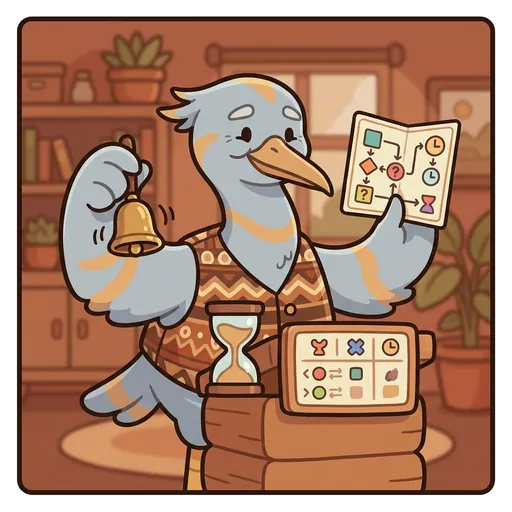
It was Friday afternoon, and a big, soft, grey egret named Round was standing at the front of Ms. Chen’s classroom, watching a room full of tapping pencils.
He rang the tiny silver bell on his chunky vest. Ding. On the big screen, question one appeared, and a timer began to fall — thirty seconds, twenty-nine, twenty-eight. Twenty-two students bent over their tablets at exactly the same moment. Somebody chewed a pencil. Somebody whispered the question under their breath. Nobody raised a hand to go first, because Round’s quizzes did not work that way.
“Take your time,” Round said quietly, watching the clock more than the kids. “Everybody’s in the same round.”
He held a worn card he called his quiz-flow-card, and every few seconds he glanced at it, tallying answers as they came in — not to see who was fastest, but to make sure the whole class stayed together. When the timer hit zero, he rang the bell again. Ding. Question one closed. Question two opened. Same thirty seconds. Same whole room, moving as one.
Ms. Chen wandered the aisles, nodding, never giving answers, just keeping everyone calm. Round kept the beat. Bell, question, quiet, bell. The classroom breathed in the same rhythm, and that rhythm was the whole point.
“See,” Round murmured to no one in particular, “it’s not a race. It’s a round. Everyone takes the turn at once, and we find out what we know together.”
Round had not always understood why that mattered.
When he was a young bird, he had helped with a different kind of game — one where whoever buzzed first got the point, and everyone else got nothing. He remembered a small student who knew the answer, knew it cold, but froze when the buzzer sound started. Somebody faster shouted it out. The point went away. And the small student sank down in her seat and stopped trying for the rest of the day.
That had stuck with Round. He had felt something twist in his chest watching her go quiet — a heavy, wrong feeling, like the game had taken something from her that it was never supposed to touch.
He had gone home that night thinking about it. The problem wasn’t the questions. The questions were fine. The problem was the shape of the turns. When only one person could win each moment, everyone else spent that moment losing. Twenty kids sitting in twenty small defeats.
What if, he had wondered, everyone took the turn at the same time? What if the round belonged to the class, not to the quickest beak? Then the slow, careful student and the fast, loud one would both just be thinking — side by side, unhurried, safe. Nobody would have to lose so somebody could win.
The idea felt like setting a weight down. That was the day Round decided what kind of host he wanted to be.
He came to ForgeClassroom carrying that idea, and Ms. Chen was the first teacher who understood it right away.
She didn’t ask him to make the quizzes exciting or flashy. She asked, “Will the quiet kids feel safe?”
Round liked her immediately.
“Watch,” he said. He set up a practice round and rang his bell. A sample question appeared, thirty seconds ticked down, and instead of a leaderboard flashing names, the screen showed one number: the whole class’s score, together, first. We got 18 of 20.
“The class sees itself as a team,” Round explained. “Individual scores exist — but they come later, quiet, just for you. Nobody’s ranked in front of everybody else.”
Ms. Chen looked at the single shared number for a long moment. Then she smiled. “You’re not running a contest,” she said. “You’re running practice.”
“That’s the whole job,” said Round, and his bell gave a small, pleased jingle. He knew, right then, that he belonged in this room.
Weeks later, a boy named Theo caught Round after class. He was a fast answerer, and a little disappointed.
“How come we never see who won?” Theo asked. “I’m usually first. I like being first.”
Round tilted his head. “Were you first today?”
“Yeah. On most of them.”
“And how’d the class do?”
Theo shrugged. “Eight out of ten, I think.”
“So here’s a question for you.” Round settled onto the desk. “The two you missed — did anybody else in the room get those?”
Theo thought. ”…Maya did. She got both.”
“So Maya carried the class on the two you dropped. And you carried her on some she missed.” Round rang the bell softly, once. “That’s the round. Everybody answers at the same time, so everybody’s holding up a different corner. The eight-out-of-ten wasn’t yours or Maya’s. It was the room’s.”
Theo was quiet. “So being first doesn’t really… count for anything?”
“Being first is fine,” Round said, gently. “It’s just not what we’re measuring. We’re measuring what the class knows. And a class that leans on each other learns more than a room full of kids racing alone.” He nudged the tablet toward Theo. “Next round, when you finish early — don’t celebrate. Wait. Feel the room finish with you. That waiting is the best part.”
That afternoon, Round closed the class’s whole story with a slow look around the room — at Ms. Chen, at Theo, at Maya, at every desk.
“There are five of us who help your teacher,” he said. “Ledger, Plan, Spot, Kit, and me. We keep records and ideas and drafts, and none of us ever takes over. Ms. Chen is the one in charge. We just carry corners, the same way you carry them for each other.”
He rang the bell one last time, and this time nobody looked at a screen. They looked at him.
“When we get one right together,” Round said, “notice how it feels. It’s not the sharp little thrill of beating somebody. It’s warmer than that. Slower. Like a whole room exhaling at once.” He tucked his flow-card into his vest. “That feeling — everybody safe, everybody counted, nobody left sinking in their seat — that’s the thing I’m really here to keep going.”
And as the students filed out, still buzzing, bumping shoulders and laughing, Round stood at the front of the empty room and let that steady, gathered-together warmth settle over him like soft grey clouds.
The ForgeClassroom ensemble
Round is part of ForgeClassroom's distributed-narrative cast. Each character embodies a different curricular primitive; together they teach the full subject.
-

Ledger
Classroom AI Assistant — record-keeping-as-craft NEVER surveillance; doubles as AI assistant via Wave 27 Phase A mentor reconciliation
-

Plan
Lesson Planner — pacing-as-craft, standards-as-scaffolding-not-compliance, plan-as-hypothesis-not-contract
-

Spot
Progress Observer — surfaces patterns NEVER labels students; pattern-spotting as craft (DELIBERATELY shared design language with TerraWatch Wave 20 Spot — cross-cluster pattern-spotting continuity)
-

Kit
Kit-Author Assistant — AI scaffolding for teacher-authored content; teacher always retains final-edit authority