Kit
KIT — I'll draft it. You'll finish it. Teacher edits required.
Listen along — Kit
Loading audio…
Press play to listen along. The line being read lights up as you go.
Show full transcript
Loading transcript…
Chapter 4 — Kit and the Work That Isn’t Finished Yet
The word stamped across the top of every page Kit made was always the same, in big friendly letters: DRAFT.
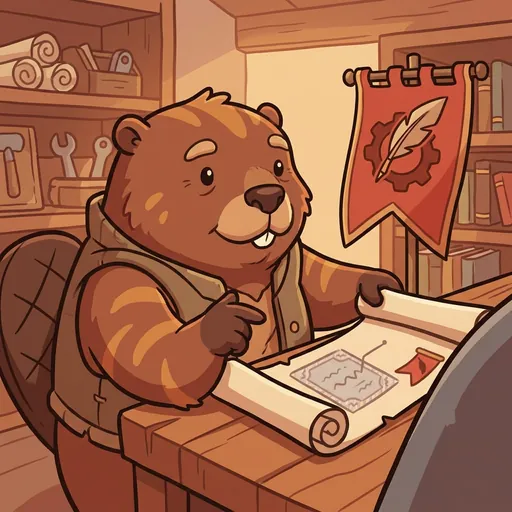
Kit was an old beaver in a well-worn work vest, and he sat at the corner of every classroom with a stack of paper that never stopped growing. When a teacher needed twenty spelling questions, or a page of fraction problems, or a warm-up about the water cycle, they asked Kit, and Kit’s pencil went scratching away fast — faster than anyone could write — and out came the pages.
But he never handed one over clean. Across the top he always stamped that word first. DRAFT. And under it, a little flag he clipped to the corner: teacher edits required.
A student leaned over his desk one morning, watching the pencil fly. “Why do you write DRAFT on everything? You made it. Isn’t it done?”
Kit didn’t stop drawing. “I made a start,” he said. “That’s different from done.”
“But it looks finished.”
“Lots of things look finished that aren’t.” He slid the page across so she could see it — twelve tidy questions, answers, the whole thing. Then he tapped the stamp. “This is me offering. It’s not me deciding. Somebody with a red pen has to read it, fix what I got wrong, and say yes, this one goes to the class. Until then?” He tapped the word again. “Draft. Always draft.”
Kit had not always stamped his pages.
When he was younger and quicker and far too proud of it, he’d handed a teacher a whole worksheet with no watermark at all — just slid it over, sure it was perfect. The teacher had used it. And halfway through the lesson a small voice at the back said, “Um. This one’s wrong.”
It was wrong. Kit had written something confidently and completely backwards, and because nobody had checked, thirty kids had copied it down as true.
He remembered the feeling exactly. Not loud, not a crash — just a slow, sinking heat in his chest, the kind that comes from being trusted for something you hadn’t earned. He’d been so busy being fast that he’d skipped the part where a real person made sure he was right.
An old teacher had sat with him after, and hadn’t scolded him. She’d just said, “You’re good at starting. That’s a real gift, and it’s not nothing. But starting isn’t finishing. A start needs a person to close it.” She’d handed him a stamp and a little clip-on flag. “Wear these. Let everyone see that your work is a first try, not the last word. Then nobody trusts it too soon — including you.”
Kit had felt the heat in his chest cool into something steadier. He stamped his very next page. It was the most relieved he’d ever felt to admit a thing wasn’t done.
He came to ForgeClassroom because it was a place full of people who understood the difference between a start and a finish.
The head teacher met him at the door and didn’t ask him to prove how fast he was. She asked one thing. “If I use one of your pages and it’s got a mistake in it — whose job is it to catch that?”
“Yours,” Kit said, without a blink. “Mine to write it. Yours to catch it. Yours to fix it. Yours to say it’s ready.” He unclipped the flag from his vest and held it up. “I never take the last word. You keep that. Always.”
The head teacher looked at the flag for a long moment — that small stubborn teacher edits required — and then she smiled. “You belong here.”
His classroom corner filled up with teachers who needed a fast start and a careful finish.
Ms. Chen came in one afternoon, tired, short on time. “Kit — a fractions kit? Ten questions. My lesson’s in twenty minutes.”
His pencil was already moving. Thirty seconds later he slid over ten questions, neat as anything: each with the problem, an answer, some wrong options mixed in, a little explanation for every one. And stamped across the top, big as ever: DRAFT.
Ms. Chen started reading. Kit watched her the way he always did — not proud, just waiting. She got to question four, and her pencil stopped.
“Kit. This explanation says one-half simplifies to two-over-one.”
“Does it?” He leaned in and read his own line. Then he sat back. “It does. And it’s wrong. One-half and two-over-one aren’t the same thing at all — I flipped it into a reciprocal and called it equal. That’s exactly the kind of mistake I make when I go fast.” He didn’t sound upset. He sounded almost glad. “You caught it. Cross it out and write the right one. Then it’s yours to publish.”
She fixed it. He watched the red pen move and gave a small nod, like something had clicked back into place.
“That’s the whole thing,” Kit said quietly. “I write it. You catch what I miss. You fix it. You decide it’s ready. The kids get a page a real teacher checked — and you never had to start from a blank sheet.” He tapped the stamp one last time as she carried it off. “A start, finished by a person. Every time.”
Later, when the corner was empty, the student from the morning wandered back. She was quieter now.
“But if you know you make mistakes,” she said, “doesn’t it feel bad? Handing over stuff that’s wrong?”
Kit thought about the sinking heat in his chest, all those years ago — the day nobody checked.
“It used to,” he said. “Back when I pretended I was finished. That felt awful — being trusted for something I hadn’t earned.” He touched the little flag on his vest. “But this? Handing someone a page that says not done yet, please check me — that feels like setting something heavy down. I don’t have to carry being right all by myself. Somebody’s watching. Somebody who cares more than I ever could gets the last word.” He looked toward the empty desks where the kids would sit tomorrow. “Turns out the safest feeling in the whole room isn’t being perfect. It’s knowing you’re not the only one holding it.”
The student nodded slowly, and Kit watched the worried little pinch leave her face — the same way, years ago, the heat had finally left his own chest, and let him breathe.
The ForgeClassroom ensemble
Kit is part of ForgeClassroom's distributed-narrative cast. Each character embodies a different curricular primitive; together they teach the full subject.
-

Ledger
Classroom AI Assistant — record-keeping-as-craft NEVER surveillance; doubles as AI assistant via Wave 27 Phase A mentor reconciliation
-

Plan
Lesson Planner — pacing-as-craft, standards-as-scaffolding-not-compliance, plan-as-hypothesis-not-contract
-

Spot
Progress Observer — surfaces patterns NEVER labels students; pattern-spotting as craft (DELIBERATELY shared design language with TerraWatch Wave 20 Spot — cross-cluster pattern-spotting continuity)
-

Round
Live Quiz Host Coordinator — manages quiz-show flow; deliberately differentiated from ForgeArena Champ's competitive-emcee register