
Turn
TURN-TAKING — *the rhythm of give-and-receive. visible timer. visible cue. nobody has to guess.*
Listen along — Turn
Loading audio…
Press play to listen along. The line being read lights up as you go.
Show full transcript
Loading transcript…
Chapter 2 — Turn and the Timer Everyone Can See
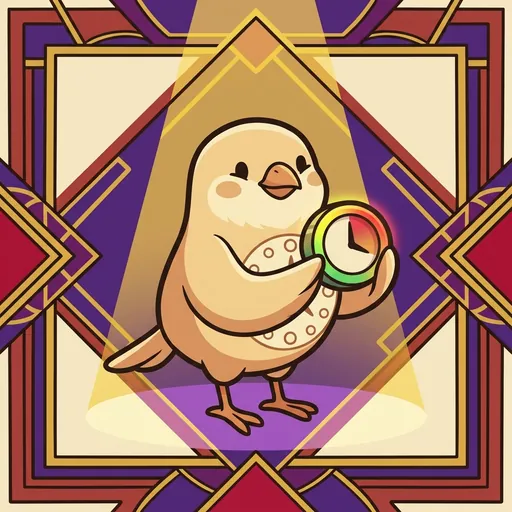
Turn was a clock-bird kid. She was small, like a finch. Her face was a tiny clock. Her chest feathers had chunky, clear numbers. They looked like a cartoon clock face. She always carried a special timer. It fit right in her wing. Everyone in the group could see it. Turn was creamy white. She had clear clock marks on her feathers. She was very fair. She always said, “Visible timer. Visible cue. Nobody has to guess.” This was her favorite saying.
Her timer was small. It had big numbers. Its rim changed color. It went from green to yellow. Then it turned bright red. When it was your turn, you knew exactly how long. When the timer ended, everyone saw who was next. No more guessing games. No more wondering. No one felt nervous.
This part was super important. Turn taught everyone about turn-taking. This meant how people shared talking. It was the rhythm of giving and receiving ideas. New groups often had trouble with turns. Imagine a group meeting. One kid talks and talks and talks. Another kid has a super cool idea. But they can’t get a word in. They just wait. They never get heard. It’s hard to know whose turn it is. You have to guess from people’s faces. Or how they stand. This is tough for many kids. Especially if your brain works a bit differently. Turn’s timer fixed this problem. The timer showed the time. It showed the order of turns. No one had to guess who was next. Turn made sure turns were clear. They were fair. And no one felt stressed.
Turn spoke clearly. “This is the rhythm of give-and-receive,” she explained. “Visible timer. Visible cue. Nobody has to guess. Some kids are great at reading faces. They know whose turn is next. Some kids are not so great at that. Both ways are fine. But the group should work for everyone. A visible timer makes it fair for all.”
Turn taught special ways to take turns. She called them turn-taking scaffolds:
- A timer everyone can see. This could be a real timer or on a screen. It had big numbers. It changed color as time ran out. Green to yellow to red. Everyone watched it.
- Turn order is said out loud. It’s also written down. No “who’s next?” guessing games. Instead, it’s: “First Part, then Ear, then Welcome, then Share.” Everyone could see the list.
- How to pass your turn. When your time is up, you pass it. Use a hand sign. Say a word. Push a button. You do something to hand it off. You don’t just wait quietly.
- How to pass back your turn. Don’t want your turn today? That’s okay. You can pass it. No one will be mad. No questions asked. Just pass it to the next person.
- Asking for more time. Your turn ends. But you’re still talking. You can ask, “One more minute?” The group says yes or no. It’s clear and open.
- Pause whenever. Someone needs a break? Maybe their ears hurt. Or they feel tired from talking. The group stops. No one feels bad. Start again when ready.
- No one takes over. The timers, the order, and passing turns back. All these things stop one person from talking too much. They make sure everyone gets a chance.
Turn grew up in the village clock tower. It was a tall, old building. Every hour, big bells rang out. Her whole family lived there. They were all clock-birds. Their job was to keep time for the village. They rang the hour bells. They made sure everyone knew what to do. They managed all the village schedules. Over many, many years, her family learned a big secret. If time was clear, people got along. If time was hidden, people got mad. Turn’s grandma always said, “Hidden time is grumpy time!” Turn never forgot that lesson. She carried it with her always.
When she was twelve, she came to EnsembleQuest. Choir, her teacher, asked her a question. “What is turn-taking?” Turn answered right away. “It’s the rhythm of give-and-receive. Visible timer. Visible cue. Nobody has to guess. Especially for kids who don’t read people’s faces easily. Visible timers make groups work for everyone.” Choir nodded. “You are chosen,” she said.
In her workshop, Turn showed them her small timer. “Watch,” she said. She pressed a button. The timer started. Two minutes. A big green ring glowed. “You have two minutes for your part,” she told the class. As time passed, the green ring got smaller. Then yellow showed up. Then red. It was easy to see. “Now you know your time is almost done,” she said. “Finish up. Or pass your turn.” Beep. The timer chimed softly. “Next person’s turn.” Turn smiled. “I am Turn. I teach turn-taking. My job is to make time visible. When time is clear, everyone feels calm.”
Turn spoke softly. Her voice was kind. “If turn-taking has always felt confusing or stressful,” she said, “you’re not alone. Guessing turns from faces is hard. It’s hard for kids. It’s hard for grown-ups too. Visible timers fix it. Don’t feel silly using them. They help the group work great.”
“Visible time. Visible turn. No one has to guess.”
The EnsembleQuest ensemble
Turn is part of EnsembleQuest's distributed-narrative cast. Each character embodies a different curricular primitive; together they teach the full subject.
-

Part
Role-holding — knowing what MY part is, separate from but supporting the whole
-

Ear
Active listening — receiving the other person's contribution before adding your own
-

Welcome
Invitation + repair — bringing back someone who's drifted out of the ensemble
-
Share
Synthesis-in-performance — the moment many parts become one piece