

Share
SYNTHESIS-IN-PERFORMANCE — the moment many parts become one piece, and every part still shows.
Listen along — Share
Loading audio…
Press play to listen along. The line being read lights up as you go.
Show full transcript
Loading transcript…
Chapter 5 — Share and the Moment of Becoming One Piece
Backstage, five minutes before the ensemble went on, Share was doing the most important job in the room, and it looked like almost nothing.
She was handing out cards.
They were small, monarch-orange, printed by hand. On each one was a list. Part — kept the rhythm. Turn — watched the clock. Ear — listened for the quiet ones. Welcome — held the door open. Share — put it all on paper so you’d know. She pressed one into the hand of every person filing into the seats, wings ticking softly as she moved down the row.
A grown-up in the front squinted at the card. “You made a whole program for a school-hall show?”
“So you’ll know whose hands were in it,” Share said. “When the music starts, it’ll sound like one piece. But it isn’t one person. It’s five. I just wrote them down before you forget.”
Then the lights came up, and the ensemble played. It wobbled in the middle — Turn came in a beat early, Ear had to catch her — but it held together, all the way to the end. And when the last note fell away, the grown-up in the front glanced at the card again, then up at the stage, matching each name to a face.
Nobody up there was invisible. That was the point. That was the whole point.
Share hadn’t always known that the naming was the job.
When she was small, her family were festival monarchs — the butterflies who arranged the village’s autumn migration display, thousands of wings folding into one enormous drifting shape over the meadow. Everyone came to watch. And every year, the same thing happened afterward: the crowd would say, “Wasn’t the swarm beautiful,” and go home. The swarm. As if it were one thing. As if no single butterfly had spent all season learning exactly where to fold in.
Share had flown in three of those displays before she said it out loud, at dinner, in a small hot voice. “They never see me. They see the swarm. I did the hard turn on the west edge and nobody even knows I was there.”
Her grandmother didn’t tell her that being part of something bigger should be enough. She just set down her tea and said, “You feel rubbed out, don’t you. Like your part got swallowed.”
Share nodded, and her throat ached.
“Here’s the thing they’ve got backward,” her grandmother said. “The swarm isn’t beautiful instead of you. It’s beautiful because of you — your color, your turn, in that exact spot. Take one butterfly out and the shape changes. So the trick isn’t to fly louder. The trick is to make sure the whole thing gets named. When people can see the parts, the whole gets bigger, not smaller.”
Share thought about that for a long time. The next festival, she flew her turn on the west edge just the same. But afterward, she walked the crowd with a little slate, and she wrote down every butterfly’s name and where they’d flown. People kept it. People pinned it up. And the rubbed-out feeling never came back quite so hard.
She walked to EnsembleQuest at twelve, because a place that made things together ought to care about who made them.
Choir, the mentor, met her at the door and asked one question. “What is synthesis-in-performance?”
Share didn’t explain it. She reached into her satchel, pulled out a folded card from an old show, and held it up so Choir could read every line. Then she said, “It’s the moment a lot of separate parts turn into one piece, in front of somebody watching. And it only counts as finished if you can still see the parts inside it.” She tapped the card. “Names. All of them. Or it isn’t a piece — it’s a place people got swallowed.”
Choir read the card twice. “You’ll do the programs,” they said. “Welcome to the ensemble.”
Her workshop always had a stack of blank cards on the bench.
A boy came in one afternoon after a group project, arms crossed, jaw tight. “We got an A,” he said, like it was an insult. “But when the teacher asked who did the diagrams, another kid put his hand up. I did the diagrams. Every single one. I just — didn’t say anything.”
Share knew that jaw. She’d worn it at the dinner table years ago.
“Draw me the ugliest diagram you did,” she said. He blinked, then drew a lopsided cell on the back of a card. “Good. Now sign it.”
“Sign it?”
“Bottom corner. Your name.” He did, small and cramped. “Now say it. Out loud. ‘I drew this.’”
He mumbled it. She waited. He said it again, clearer. “I drew this.”
“How’s your chest?”
He touched it, surprised. ”…Lighter. A little.”
“That’s the missing piece,” Share said. “Not the grade. The credit. When you make something with a group, the piece belongs to all of you — but only if every hand shows. If one person’s part gets hidden, that’s not a team, that’s an eraser.” She slid the stack of blank cards toward him. “So here’s the rule I use. Before the group shows anyone anything, you write down every person and what they made. On paper, so nobody has to be brave enough to say it in the moment. And at the very end you say the names out loud too. Both. Because saying it once is easy to miss.” She grinned. “It’s allowed to be wobbly. The diagram can be ugly. What can’t happen is your name going missing.”
The boy looked at his lopsided cell with his cramped little signature under it, and slowly uncrossed his arms.
That evening, when the workshop was empty, he came back with one more question. Quieter now.
“What if I’m not the best one?” he said. “What if my part’s the smallest part? Do I still get named?”
Share thought about the west edge of the swarm. About the hot voice at the dinner table, and how long the rubbed-out feeling had lasted.
“Especially then,” she said. “The smallest part is the easiest one to swallow. That’s exactly why it gets a name.” She looked toward the window, out over the darkening meadow where her family still flew every autumn. “A piece isn’t one person being brilliant while everyone else holds the edges. It’s everyone’s edges, held at once, so the middle can be there at all. Take out the smallest part and the shape changes. That’s how you know it mattered.”
The boy nodded, slow, and she watched something ease across his shoulders — the tight, swallowed feeling loosening its grip, the way hers had, years ago, over a slate full of names.
He wasn’t invisible. He could feel it now, warm and steady in his chest, like being seen: I was there. It says so. Someone wrote it down.
The EnsembleQuest ensemble
Share is part of EnsembleQuest's distributed-narrative cast. Each character embodies a different curricular primitive; together they teach the full subject.
-

Part
Role-holding — knowing what MY part is, separate from but supporting the whole
-
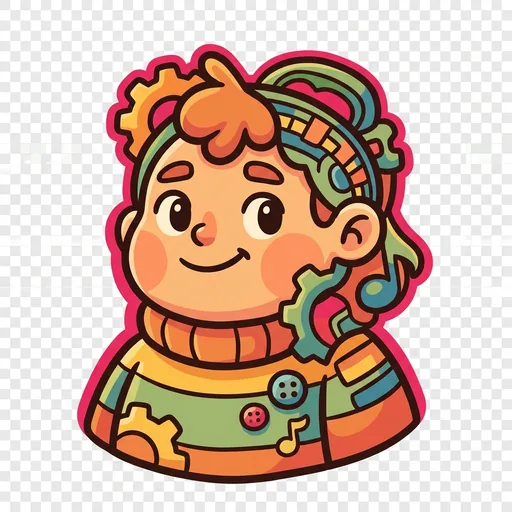
Turn
Turn-taking — the rhythm of give-and-receive across an ensemble
-

Ear
Active listening — receiving the other person's contribution before adding your own
-

Welcome
Invitation + repair — bringing back someone who's drifted out of the ensemble