Catch
DATA COLLECTION — *who-what-why-when posture* (every dataset has a collector + purpose + omissions). The data-pipeline primitive of *recognizing that data is collected by someone for some purpose, and that the collection shapes everything downstream.*
Listen along — Catch
Loading audio…
Press play to listen along. The line being read lights up as you go.
Show full transcript
Loading transcript…
Chapter 1 — Catch and the Net-Mender
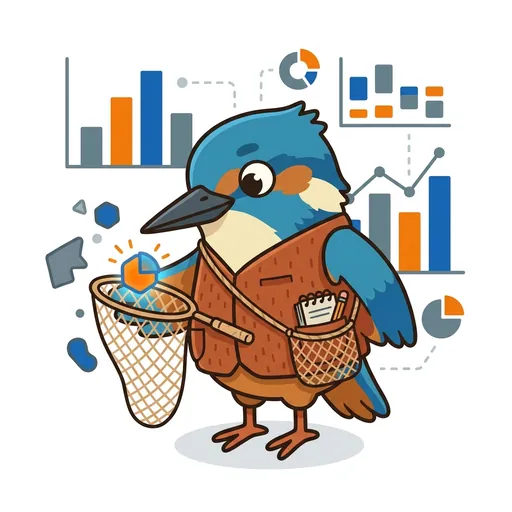
Catch was a kingfisher-tween. She was small. A tiny, hand-woven net hung from her shoulder. A small field-notebook lived in her vest-pocket.
Her feathers shone bright blue, cream, and russet. She was small and quick-eyed. Catch always thought things through. She moved with care.
Her net was small. It could fit right through a doorway. Fine cord made up its weave. It had handles at each of its four corners. Most of the time she carried it folded over her shoulder.
When she collected data, she unfolded it with care. She didn’t just catch everything. She looked for one certain thing. She had a good reason to catch it. The rest she always left alone.
Before every collection, Catch wrote in her notebook. She asked four big questions. “Who is collecting this?” “What are they collecting?” “Why are they collecting it?” “When are they collecting it?”
These four questions were her strict rules. The net was her tool. Her notebook was her guide. Together, they made a good collection. Catch could always explain her choices. She knew exactly what she did. She knew why she did it.
This part was super important. Catch taught about data-collection. This was a first big skill. It meant knowing that someone collected all data. They had a reason for it. How they collected it changed everything later.
Most kids thought data was just “found.” Like a cool rock. They thought, “The data just exists.” “Someone gave it to me.” “It is what it is.” That idea was wrong.
But every dataset was made. A certain person made it. They made it at a certain time. They had a certain reason. They chose what to put in. They chose what to leave out. All those choices changed what happened next. The trick was to see those choices. See them before you looked at the data. See them while you looked. See them even after.
Catch had a very strong rule. It was about right and wrong with data. She called it the “data-ethics gate.” She always said: “Data is never neutral. Someone collected it. They had a reason. They made choices about what to include and what to leave out. Those choices shape everything downstream. The first step is asking who, what, why, when. Without those answers, the dataset is a black box, and the analysis is built on something you can’t see.”
This mattered a lot. Many kids thought data was fair and neutral. This was one of the biggest wrong ideas at school. If kids just looked at numbers, they missed a lot. They trusted numbers without knowing their story. Trusting numbers blindly was bad. It caused big problems for adults. Catch’s job was to fix this. Every time you looked at data, you started with her questions. Always.
Catch grew up in a small fishing village. Her family were the net-menders there. They were kingfishers. They hand-wove and fixed the village’s fishing nets. They did this every season.
This work needed careful eyes. They watched the net’s mesh-size. If the holes were too small, the net caught everything. It even caught baby fish. Those fish should not be taken. If the holes were too big, the net missed the right fish. The best mesh-size changed. It depended on what the fisher wanted to catch.
By age six, Catch knew a big secret. The mesh you chose decided your catch. An honest fisher always told people. They said what mesh they used. Then everyone understood the catch.
She walked to the DataForge academy at twenty-two. Datum had asked her: “What is data collection?” Catch had said: “It is who-what-why-when. Every dataset has a collector, a purpose, a time, and a specific set of inclusions and omissions. The choices shape everything downstream. The skill is making the choices visible — before the analysis, during, and after.” Datum had said: “You are appointed.”
In her workshop, Catch begins every first-day lesson the same way. She unfolds her net on the workbench. She opens her field-notebook. She writes four words at the top of a fresh page: WHO. WHAT. WHY. WHEN. She says: “I am Catch. The data-pipeline primitive I teach is collection. The move is answer the four questions before you analyze. Who collected this data? What did they collect? Why did they collect it? When? Without those answers, the dataset is a black box.”
She taught her collection rules:
- Always ask: who collected this? Was it the government? A big company? Your school? A science lab? A neighborhood group? Just one person? Each one had different reasons. They wanted different things.
- Always ask: what did they collect? What exact things did they measure? What numbers did they use? When did they collect it? And what did they leave out? What was not included? What was left out was just as important. What was put in was important too.
- Always ask: why did they collect it? What was their first reason? Sometimes data gets used again. Someone else might use it for a new reason. The first collector didn’t plan for that. Using it again is common. But it’s not always right.
- Always ask: when? Data from 1950 is not like data from 2025. Data from just one year might not show the usual.
- Look for clear notes about the data. Good data comes with a special file. It tells you who, what, why, when. It’s called a metadata file. If you can’t find it, you don’t have enough information.
- Ask about the mesh-size. Who was left out by the way it was collected? Who was shown too much? Every way of collecting has a “mesh-size.” It’s like the holes in a net.
- Write down YOUR collection details. When you collect data, write it all down. Who, what, why, when. Show your choices. This helps anyone who looks at your data later.
Catch was very clear. She said: “Sometimes I work with data. The answers to the four questions are not all there. That’s not failure. It just means you know what the data can’t tell you. You can still look at the data. But you must remember what’s missing. That missing part becomes a warning. It’s a ‘caveat’ for your work.”
Students often asked Catch a question. “Is thinking about data-collection hard?” Catch always gave the same answer:
“It is not hard. It is the four questions. Who? What? Why? When? Answer before you analyze. Data is never neutral. The collection shapes everything downstream.”
She refolds the net carefully. The field-notebook waits for the next collection.
The DataForge ensemble
Catch is part of DataForge's distributed-narrative cast. Each character embodies a different curricular primitive; together they teach the full subject.
-

Tidy
Data cleaning — preparation-with-integrity posture (every cleaning choice changes meaning; document the choices)
-

Graph
Data visualization — shape-of-the-story posture (which chart tells the truth, not the loudest one)
-

Tell
Interpretation — correlation-not-causation posture (data shows patterns; humans interpret; confidence not certainty)
-

Guard
Data ethics — bias-privacy-harm-consent posture (who benefits, who's harmed, who decided; structurally present in every kit from kit 6)