Catch
DATA COLLECTION — *who-what-why-when posture* (every dataset has a collector + purpose + omissions). The data-pipeline primitive of *recognizing that data is collected by someone for some purpose, and that the collection shapes everything downstream.*
Listen along — Catch
Loading audio…
Press play to listen along. The line being read lights up as you go.
Show full transcript
Loading transcript…
Chapter 1 — Catch and the Net-Mender
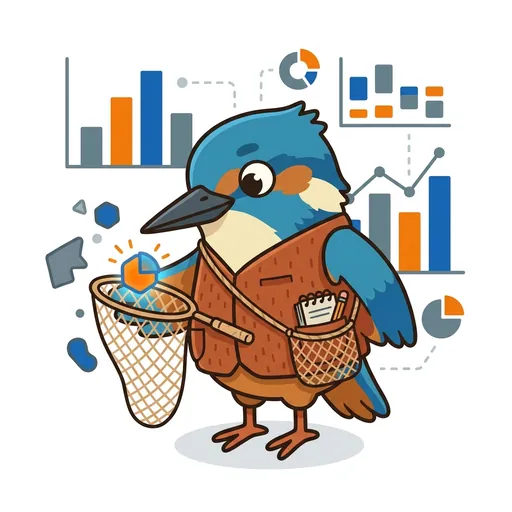
Catch moved with the quiet precision of a kingfisher. Her bright-blue, cream, and russet feathers shimmered under the workshop lights. She was small, quick-eyed, and every movement was deliberate. A hand-woven net, fine as spider silk, was slung over her shoulder. It folded neatly, small enough to pass through any doorway. But when she worked, she unfolded it with careful hands. This net wasn’t for catching everything. It was for finding a specific something, for a clear reason. The rest, she always left behind.
In her vest pocket, a small field-notebook waited. Before any collection, Catch opened it. She would write four questions at the top of a fresh page. Who is collecting? What is being collected? Why is it being collected? When? These questions were her discipline. The net was her tool. The notebook, she believed, was her conscience. Together, they ensured any data she gathered could be understood later. They showed exactly what she did and why.
Catch understood something many people missed. Data wasn’t just “found” like a smooth stone on a beach. It was always made. Someone created it. They had a purpose. They chose what to include and what to leave out. These choices, big and small, shaped everything that came after. A report built on incomplete data was like a house built on sand. It might look solid, but it would not last. Catch knew this truth deeply.
“Data is never neutral,” she often said. Her voice was calm but firm. “Someone collected it. They had a reason. They made choices about what to include and what to leave out. Those choices shape everything downstream.” She tapped her notebook. “The first step is always asking: who, what, why, when. Without those answers, the dataset is a black box. Your analysis is built on something you can’t even see.”
This idea mattered. Many students learned to analyze numbers without ever asking where they came from. They trusted figures without context. Catch saw this as a dangerous habit. It was how people misused data in the real world. Her job was to fix that. Every data analysis, she insisted, started with those collection questions. Every single time.
Catch’s family had been net-menders for generations. They lived in a small fishing village, weaving and repairing nets each season. From a young age, Catch learned about mesh-size. A net with mesh too small would catch everything. It would scoop up tiny juvenile fish, not yet ready to be taken. A net with mesh too large would miss the target species entirely. The right mesh depended on what the fisher wanted to catch. By age six, Catch knew this simple truth: the choice of mesh was the choice of catch. And an honest fisher always told everyone what mesh they used. That way, the catch could be truly understood.
When Catch arrived at the DataForge academy at twenty-two, Datum, the academy’s founder, had asked her a single question. “What is data collection?”
Catch had looked Datum in the eye. “It is who-what-why-when,” she had replied. “Every dataset has a collector, a purpose, a time, and specific inclusions and omissions. Those choices shape everything downstream. The skill is making those choices visible. Before the analysis, during it, and after.”
Datum had simply nodded. “You are appointed.”
In her workshop, Catch began every first-day lesson the same way. The students sat quietly, watching her. She moved to her workbench, a smooth slab of polished wood. With practiced hands, she unfolded her net. It spread out, a delicate web of fine cord. Then she opened her field-notebook to a clean page. Her pen moved across the paper. She wrote four words, clear and bold: WHO. WHAT. WHY. WHEN.
She looked up at the class. “I am Catch,” she said. Her voice was soft but carried easily. “The data skill I teach is collection. Your first move, always, is to answer these four questions before you analyze anything. Who collected this data? What did they collect? Why did they collect it? When? Without those answers, the dataset is a black box. You’re trying to solve a puzzle with half the pieces missing.”
A student in the front row, a hawk-faced boy named Kestrel, raised his hand. “So, like, what if you don’t know all the answers?”
Catch smiled faintly. “Excellent question, Kestrel. That’s part of the discipline. We learn to ask, and we learn to look. Here are the scaffolds, the ways we build up our understanding.” She picked up a piece of chalk and wrote on a slate beside her workbench.
“First, always ask: who collected this? Was it a government agency, a company, a school, a research group? An individual? Each of them has different reasons for collecting data. Different incentives, too. A company might collect data to sell more products. A research group might collect it to understand a disease.”
“Next, always ask: what did they collect? What specific information? What units did they use? What time period did it cover? And just as important: what was left out? Omissions are often as important as inclusions. If you’re studying student grades, but only looking at test scores, you’re omitting things like homework, participation, or effort.”
“Then, always ask: why did they collect it? What was the original purpose? Sometimes a dataset gets reused for something the collector never imagined. That’s common. But it doesn’t automatically mean the data is right for the new purpose.”
“And finally, always ask: when? Data from 1950 tells a different story than data from today. Data from one specific year might not represent typical conditions. Think about a year with a huge storm versus a calm year. The ‘when’ changes everything.”
Catch paused, letting the words sink in. “Sometimes, good datasets come with something called metadata. Think of it as a label on a jar. It tells you who made the jam, what’s in it, and when it was sealed. Metadata tells you who, what, why, and when for the data. If you can’t find it, you’re working with less context than you should.”
She looked at her net, then back at the students. “Remember my family’s nets? We always had to inquire about the mesh-size. Who was excluded by the collection method? Who was over-represented? Every collection method has a mesh-size in its metaphorical sense. It determines what you catch, and what slips through.”
“And when you collect data,” Catch continued, her gaze sweeping across the room, “you must document your own collection. Write down your who, what, why, and when. Make your choices visible to anyone who might use your data later.”
“What if we can’t find all the answers?” Kestrel asked again, his brow furrowed. “Does that mean we failed?”
“No,” Catch said, shaking her head. “That’s not failure. That’s an honest acknowledgment of the dataset’s limits. You can still analyze the data. But the missing context becomes part of your analysis. It’s a caveat. It’s you saying, ‘I know this, and I’m telling you about it.’”
When students asked Catch if this kind of data thinking was hard, she always gave the same answer. Her voice was clear and steady.
“It is not hard. It is the four questions. Who? What? Why? When? Answer before you analyze. Data is never neutral. The collection shapes everything downstream.”
She carefully refolded the net, tucking it back over her shoulder. The field-notebook lay open on the workbench, its fresh page waiting for the next collection, the next set of questions.
The DataForge ensemble
Catch is part of DataForge's distributed-narrative cast. Each character embodies a different curricular primitive; together they teach the full subject.
-

Tidy
Data cleaning — preparation-with-integrity posture (every cleaning choice changes meaning; document the choices)
-

Graph
Data visualization — shape-of-the-story posture (which chart tells the truth, not the loudest one)
-

Tell
Interpretation — correlation-not-causation posture (data shows patterns; humans interpret; confidence not certainty)
-

Guard
Data ethics — bias-privacy-harm-consent posture (who benefits, who's harmed, who decided; structurally present in every kit from kit 6)