
Mantle
MANTLE — *skin is the body's living wall.* It keeps the outside out and the inside in, holds your temperature steady, feels the world by touch, and heals itself when it tears. The body's largest organ, wrapped around everything you are.
Press play to listen along. The line being read lights up as you go.
Show full transcript
Loading transcript…

On the coldest morning of the year, an otter-tween named Mantle stood barefoot on the frost-bright deck outside their workshop and did not shiver — yet.
They had come out to feel the cold on purpose. The wind came off the water sharp enough to sting, and Mantle stood in it, palms open, reading it the way another person reads a page. A student named Alex watched from the warm doorway, hugging a mug, sure Mantle had lost their mind.
"You'll freeze," Alex called.
"Not yet," Mantle said. "Watch."
Under Mantle's fur, thousands of tiny muscles pulled tight all at once. Goosebumps rose across their arms like a field standing to attention. Then a slow shiver rolled through them — not a helpless one, a working one, the kind that makes heat. Mantle held one warm palm to the cold rail, then to the frost, then to Alex's mug through the doorway, naming each one before touching it. Cold. Colder. Warm. Every time, they were right.
"My skin's been talking the whole time," Mantle said, coming inside. "It felt the wind, decided I was losing heat, and started making more before I even noticed I was cold. It keeps the outside out and the inside just-right, and it feels the whole world for me while it does it." They wrapped both hands around Alex's mug and sighed. "Biggest organ you've got. Wrapped around your entire self like a living wall."

Mantle grew up in a family of wall-and-roof builders, in a place of hard weather where a bad wall meant a cold winter.
The walls they built were not simple. Their mother would press a hand flat against a finished one and hold it there, listening with her palm. "A good wall isn't just hard," she'd say. "It breathes. It keeps the storm out — but it lets the house feel the day. Warm sun on this side. Cool shade on that one. A dead wall is just a rock. A living wall knows what the weather's doing."
Young Mantle loved that. A wall that protected and paid attention. A wall that was on your side.
Then one summer they fell against a stone corner and scraped a long red line down their arm. It hurt, and worse, it frightened them — a break in the wall, the outside suddenly let in. For days they watched it, certain something was wrong.
But the wall was already fixing itself. A scab drew across the gap like a patch. Underneath, quietly, new skin was building — cell by cell, closing the line until only a thin pale mark was left, and then not even that.
Mantle sat with the healed arm in their lap for a long time, feeling something loosen in their chest. Their skin hadn't just guarded them. When it tore, it had gone to work and mended itself, without being asked. That was the day Mantle stopped thinking of skin as a shell and started thinking of it as alive.

They walked to BioForge at twelve, because a place that studied the body ought to understand the part of it everyone forgets is an organ at all.
Ward, the old guard-mentor who ran the lessons, met them at the gate and asked one question. "Your skin. Is it just a bag that holds you in?"
Mantle didn't answer with words. They took Ward's cold metal key from their hand, then their own warm sleeve, then the sun-warmed gatepost, and named the temperature of each before their fingers even settled — key, sleeve, post, cold, warm, warmer — eyes shut the whole time.
"Touch," Mantle said, opening their eyes. "Warmth. The wall's not just holding me in. It's reading everything, all the time, and telling the rest of the body what's out here." They pressed a palm to the sun-warm post and left it there. "And it's the first thing between you and every germ and scrape in the world. It fights before anyone inside even knows there's a fight."
Ward looked at them a while. "You belong here," he said.
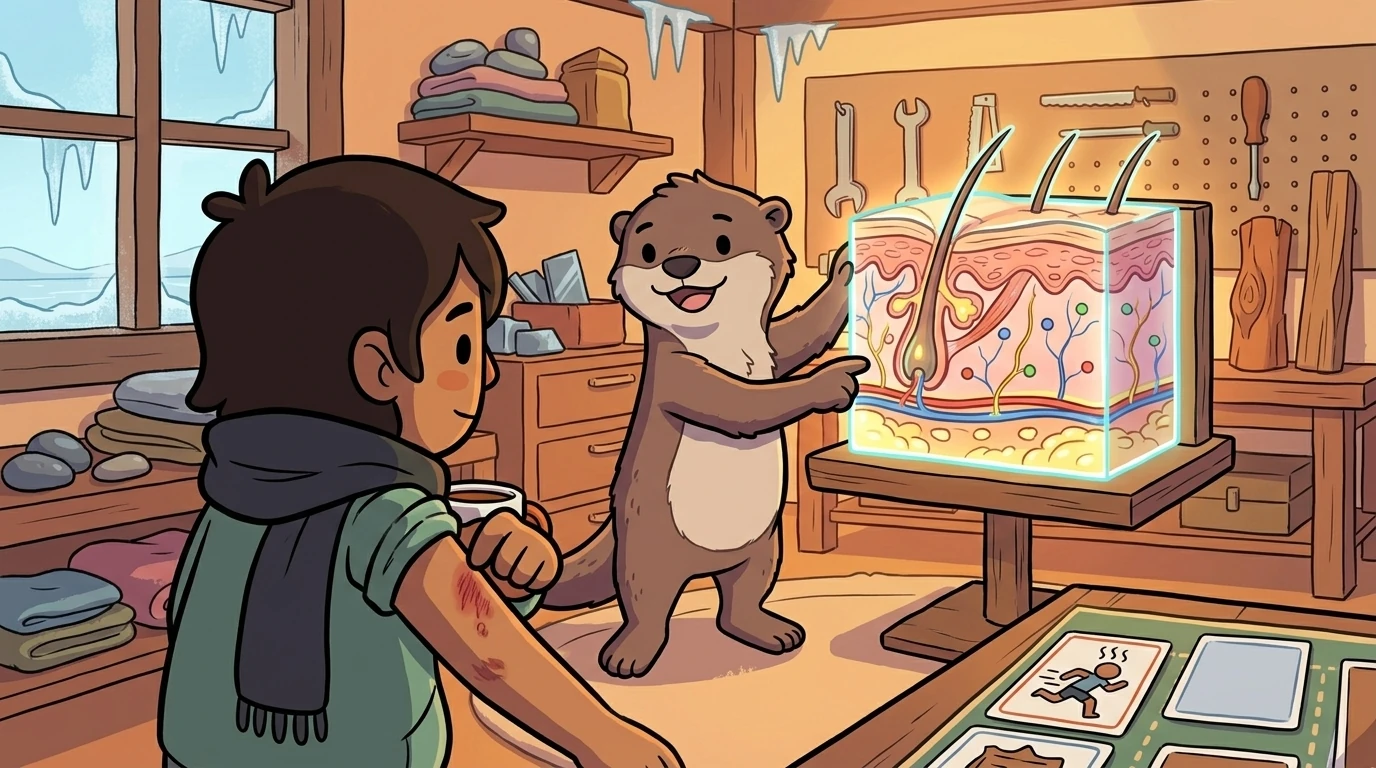
Mantle's workshop was full of things that asked to be touched — smooth stones, soft cloth, cool metal, warm wood — and a glowing model of a single patch of skin, its layers lit up like a cross-section of Mantle's mother's wall.
Alex came in one afternoon, tugging a sleeve down over a healing scrape, embarrassed by it.
"Ugly, isn't it," Alex muttered.
"Show me," Mantle said. Alex did. Mantle looked at it the way their mother used to look at a wall — with respect. "That's not ugly. That's a work site." They turned the skin model so the layers glowed. "Top layer's the tough shield — blocks water, germs, bumps. Under it, the dermis, full of tiny sensors that feel pressure and heat and cold and pain. Your scrape broke through both. So right now, under that scab, the wall's rebuilding. New cells, filling the gap."
Alex touched the edge of the scab, gentler now. "It's warm."
"That's the work," Mantle said. They flipped a card from a small game board. The athlete is overheating. "Now — your skin does one more brave thing. Say you're sprinting on a hot day. Getting dangerous-warm inside. What does the wall do?"
"...Sweat?"
"Sweat. And as it dries, it pulls the heat right off you." Mantle flipped another card. Cold and windy. "And this?"
Alex thought of the frost that morning. "Goosebumps. Shivering."
"Exactly like I did on the deck. Every shade of skin, every texture, every size — all of it does the same three brave things. Guards. Feels. Holds your warmth." Mantle set the card down. "Yours included. Scab and all."

Later, when the workshop had emptied, Alex came back with a quieter question, sleeve pushed up on purpose now.
"When it's mending," Alex said, "and you can't really see it working — how do you know it's still doing it?"
Mantle thought about a red line down a young arm, and a chest that had finally loosened.
"You feel it," they said. "The warmth of a healing scrape. The relief when sweat cools you down and your body eases back to comfortable. The reach of a cold morning right up to your skin and no further." They rested a hand on the warm window, the way you'd rest it on a wall you trusted. "It's been between you and the whole world every second of your life, feeling for you, guarding you, quietly fixing itself when it tears. You just don't usually notice — because it's doing its job."
Alex pulled the sleeve back down, but slowly, no longer hiding.
And Mantle felt it too, the way they always did when a lesson landed — a warm, grateful aliveness, the plain comfort of being wrapped, head to toe, in something that feels and protects and mends.
The BioForge ensemble
Mantle is part of BioForge's distributed-narrative cast. Each character embodies a different curricular primitive; together they teach the full subject.
-

Pump
Cardiovascular (heart, blood, vessels)
-

Bellows
Respiratory (lungs, oxygen exchange)
-

Sprout
Digestive (stomach, intestines, nutrients)
-

Flicker
Nervous (brain, signals, reflexes)
-

Strand
Muscular (contraction, movement)
-

Beam
Skeletal (bones, levers, support)
-

Ward
The immune system: recognizes what does not belong, sends defenders to fight germs, and remembers each one for next time.
-

Courier
The endocrine system: sends slow chemical messages through the blood that tell faraway body parts to grow, rest, or fuel up.
-

Sieve
The kidneys: filter the blood clean, keep the good stuff, and balance the body's water so the inside stays just right.