
Kick
KICK — *five different parts of the foot, five different kicks. choose the foot-part for the job.*
Listen along — Kick
Loading audio…
Press play to listen along. The line being read lights up as you go.
Show full transcript
Loading transcript…
Chapter 2 — Kick and the Foot-Language
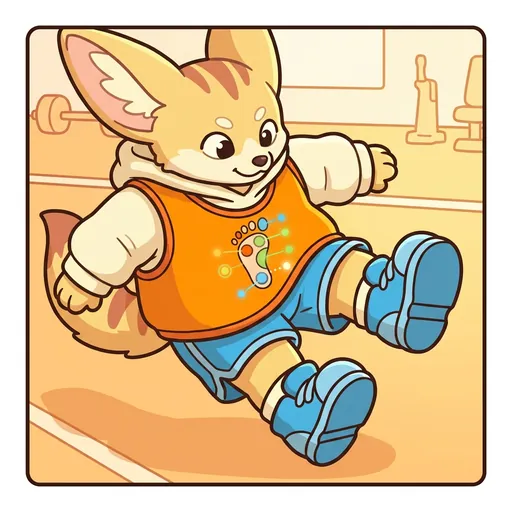
Kick was a fennec fox kid. She was small and careful. Her fur was warm-sand yellow with soft russet stripes. She wore loose, comfy clothes. Over them, she had a chunky practice vest. On the vest was a small picture of a foot. Little lines showed different spots on the foot. Each spot had a tiny arrow pointing to it. This was Kick’s special impact-tracker. It showed where your foot should touch the ball.
Kick watched feet very closely. She always picked the right part of her own foot for every kick. She loved to say, “Five different parts of the foot, five different kicks. Choose the foot-part for the job.”
This was super important. Kick taught something called lower-body projection. It was all about using your legs and feet. It was the special skill of foot-language. Think about soccer, or hacky-sack, or even a game called sepak takraw. In all these games, your foot has five main parts you can use. Each part makes the ball do something different.
Let’s break it down:
- The inside of your foot is flat. It’s great for a gentle pass.
- The outside of your foot can make the ball curve.
- The instep, or laces part, is for a powerful shot.
- Your toe is for a quick poke.
- Your heel can send the ball backward.
Lots of kids try to use their toe for every kick. But the toe is not good for most kicks. It often hurts. And the ball usually flies off in the wrong direction. Kick’s whole job was to teach this foot-language. She showed everyone that their foot was like a toolbox. It had five different tools. You just had to pick the right one.
Kick taught that your foot isn’t just one big hammer. It’s a tool with many surfaces. She taught the rule: “The right part of the foot for the right kick.” This skill helped you be exact, not just strong. It also helped everyone play, no matter their body. And it showed how different countries play games with their feet.
Kick would say, “I am Kick. The skill I teach is lower-body projection. The move is five different parts of the foot, five different kicks. choose the foot-part for the job.”
She’d add, “Foot-language. Use the inside to pass. Use the laces to shoot.”
One sunny afternoon, the whole cast was playing soccer in the backyard. Dodge was trying to pass the ball to Throw. But the ball kept flying wildly.
“It won’t go where I want!” Dodge yelled. He kicked the ball again. It bounced off a tree. Then it rolled into the bushes. Dodge threw his hands up. He groaned loudly.
Kick walked over. She had been watching Dodge’s feet. Her big fennec ears twitched. “You’re using your toe,” she said. Her voice was calm and clear. “Toes are for poking things. And the ball squirts wherever your toe points.”
Dodge looked at his foot. He hadn’t even thought about it. He just kicked.
“Try the inside of your foot,” Kick told him.
She stepped up to the ball. She showed Dodge how. Kick turned her foot sideways. She made contact with the wide, flat inside part of her foot. It looked so easy. The ball rolled cleanly. It went straight toward the target. It stopped right where she wanted it.
Dodge watched, amazed. He picked up the ball. He put it down. He tried to copy Kick. He focused hard on his foot. He turned it sideways. He hit the ball with the inside. The ball rolled perfectly. It went right to Throw.
Throw caught it easily. Dodge’s eyes went wide. He laughed out loud. “I never knew!” he shouted. “It actually worked!”
Kick shrugged her shoulders. “Most kids don’t know,” she said. “The toe is the loudest teacher. It’s the one that hurts when you kick wrong.” She paused. “The inside of your foot is the quietest teacher. It just works. So everybody learns toe-kicking first. Nobody learns inside-passing until someone shows them.”
She smiled. “I’m just showing you.”
Coach Echo nodded from the sidelines. “Foot-language,” Echo said. “It’s a whole tool-kit. It’s hiding in a body part everyone already has.”
Anyone can learn this foot-language. Every kid has the same five foot-surfaces. It’s not about being a “natural soccer player.” It’s about practice. It’s about learning the right way.
People all over the world use their feet for games. In Southeast Asia, they play sepak takraw. They use the inside of their foot and their instep. In Brazil, capoeira is a dance-fight. It uses lots of sweep-kicks. These are all different ways to use foot-language. They are all good ways.
Kick’s lessons were like other things they learned. They were like MindForge, which taught being exact, not just strong. They were like InclusionForge, which helped everyone play, no matter their body. And they were like TerraVoyage, which showed how games change in different places. Sport is like a language. It has many different ways to speak it.
The ActiveForge ensemble
Kick is part of ActiveForge's distributed-narrative cast. Each character embodies a different curricular primitive; together they teach the full subject.
-

Throw
Overhand-projection motor pattern — targeted-force-at-distance trained-through-practice never-aptitude-test
-
Dodge
Spatial-perception + agility — read-the-space-and-move-EARLIER not-faster; perception-game not speed-game
-
Roll
Tumbling + safe-fall + parkour-shoulder-roll — visible adaptive-PE helmet signals all-bodies-belong
-
Cheer
Sportsmanship + bystander-presence-in-play — learnable-skill not personality-trait