
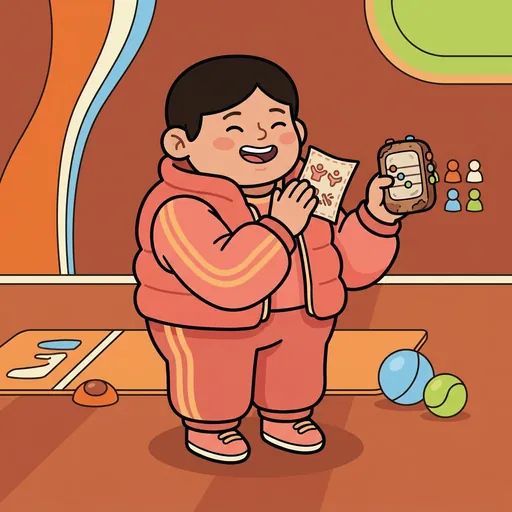
Cheer
CHEER — sportsmanship is a learnable skill, not a personality trait.
Listen along — Cheer
Loading audio…
Press play to listen along. The line being read lights up as you go.
Show full transcript
Loading transcript…
Chapter 5 — Cheer and the Learnable Sportsmanship
The backyard tag game had gone quiet in the worst way. Cheer, a small round pufflin-tween in a loose, comfy practice-vest, stood at the edge of the mat and read the mood like a scorecard.
Throw was scowling by the fence — he’d been “it” for what felt like forever, chasing and never catching, and his shoulders had climbed up around his ears. Dodge was off to the side, arms crossed, muttering that Cheer kept getting tagged in the first ten seconds. And Roll had just sat down on the mat, halfway out of the game, looking at their own shoes.
Cheer took a slow breath. This was the part nobody ever practiced, and it was the part Cheer practiced the most.
Cheer walked to Throw first. Not to Dodge, who was loudest. To Throw, who was hurting quietest.
“You had the longest ‘it’ turn,” Cheer said. “That’s genuinely hard. You stayed patient way longer than I would have. Good game.”
Throw blinked. His shoulders came down an inch.
Then Cheer turned to Dodge. “You read Throw’s moves so much faster than me. Could you show me that whole watching-thing tomorrow? I actually want to learn it.”
Dodge uncrossed their arms. Being asked to teach did something to the sulk — it just melted.
Last, Cheer crouched by Roll. “Hey. Want one more round, or are you done for today? Either’s completely fine.”
Roll almost smiled. “One more round.”
Three small sentences. A sour game turned back into a game people wanted to stay in.
Cheer hadn’t always known how to do that. When Cheer was younger, being kind felt like something you either were or weren’t — and Cheer wasn’t sure they were.
There’d been an afternoon at a bigger practice, a crowd of tweens playing a fast, laughing game, and Cheer standing at the very edge of it, wanting in and not knowing how to say so. Nobody was mean. Nobody noticed either. Cheer just hovered, feeling smaller and smaller, until it seemed easier to leave than to keep standing there being invisible.
An older pufflin — one of the coaches, a gentle one named Echo — sat down on the grass beside Cheer instead of calling them in.
“You look like you’re waiting for someone to open a door,” Echo said.
Cheer nodded, throat tight.
“Here’s a thing most people never get told,” Echo said, watching the game. “The kids in there who make everyone feel welcome? They’re not a different kind of kid. They’ve just done it more. Saying the warm thing, noticing who’s left out, going over first — those are moves. Like a good throw. You do them clumsy a hundred times and then one day they come easy, and everyone thinks you were born nice.” Echo bumped Cheer’s shoulder. “You weren’t born anything. You get to practice it.”
Something loosened in Cheer’s chest. Kind wasn’t a test you passed or failed. It was a shape you could learn. And if it was a shape, then Cheer — standing awkward and unseen on the edge — could start learning it right now.
Cheer walked to ActiveForge at twelve, because a place that studied how bodies learn moves ought to understand the move that was hardest to see.
Coach Echo met them at the gate — the same gentle coach, older now. Echo didn’t ask Cheer to prove anything. Echo just watched.
At the far end of the yard, a game was breaking up badly. One kid had missed a catch and gone red and silent. Another was already stomping off.
Cheer didn’t wait to be told. They crossed the yard, went to the red-faced kid first, and said something quiet that made the kid’s head lift. Then they caught the stomping one and asked a question that turned the stomp into a shrug and the shrug into a “fine, one more.”
Echo’s face did something warm. “You went to the one who was hurting before the one who was loud,” Echo said. “Most people get that backwards their whole lives. You belong here.”
Cheer’s corner of ActiveForge always had a little card in hand — a cheer-card, they called it, though it was mostly just names. Who’s struggling. Who’s benched. Who’s hovering at the edge.
A boy came by one afternoon, flat and frustrated. “I’m just not a nice person,” he said. “Not like you. You do the whole— ” he waved a hand, “—thing. I try and it comes out weird.”
Cheer knew that slump. They’d felt it on the grass, years ago.
“Watch,” Cheer said. They nodded at a girl sitting alone by the wall, half in and half out of the group’s game. “See her? What’s the good thing that’s true about how she played?”
The boy thought. “She… didn’t give up on that long rally. She kept getting to the ball.”
“Say that to her. Just the good thing first — don’t ask her anything yet.”
The boy hesitated, then went over. “You kept getting to the ball on that long one. That was tough.”
The girl looked up, surprised, and the surprise turned into a grin. She scooted an inch closer to the group.
The boy came back a little stunned. “That was so small. It barely did anything.”
“It did the whole thing,” Cheer said. “Say the good thing first, then ask the practice-question. That’s the move. You just did it, and it came out fine — not weird. Do it a hundred more times and it’ll come out easy.” They tapped the cheer-card. “Kindness is a habit. You practice the cheer the exact same way you practice the throw.”
The boy looked at the card, then at the girl, now laughing in the game. “So I’m not bad at it. I’ve just not done it much.”
“That’s the honest answer,” Cheer said.
Later, when the yard had emptied, the boy came back with one more question, quieter this time.
“But how do you know it’s working?” he said. “When you say the good thing and nothing big happens — no cheering, no big deal — how do you know it went in?”
Cheer thought about the edge of that game long ago. The knot in the throat. The way Echo sitting down had loosened it before a single word.
“You feel it,” Cheer said. “Not in some big way. It’s small. When someone says the warm thing to you first — really sees the hard part before they ask you for anything — there’s this little unclenching, right here.” They pressed a wing to their own chest. “Your shoulders drop. You breathe out. You didn’t even know you were braced until you stopped.”
The boy was quiet.
“That’s how you know,” Cheer said. “You watch for the shoulders coming down. Not the thank-you — the shoulders. When Throw’s came down by the fence today, that’s the whole game, right there.” They looked out at the empty mat and felt it themselves — the warm, settled, un-braced feeling of a group that had almost fallen apart and hadn’t.
The boy nodded slowly. And Cheer watched his shoulders, too, come gently down.
The ActiveForge ensemble
Cheer is part of ActiveForge's distributed-narrative cast. Each character embodies a different curricular primitive; together they teach the full subject.
-
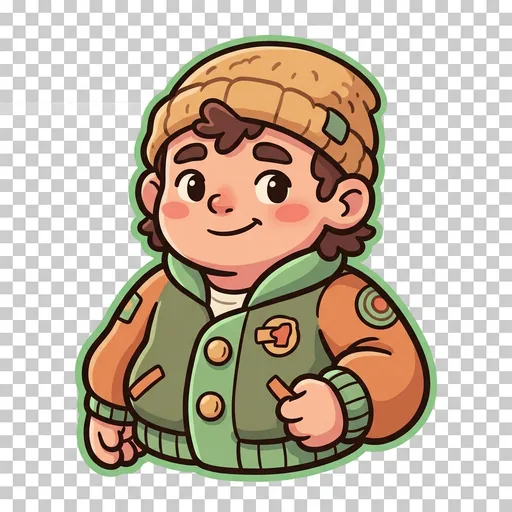
Throw
Overhand-projection motor pattern — targeted-force-at-distance trained-through-practice never-aptitude-test
-

Kick
Lower-body projection — foot-language with five-different-parts-of-foot for different kicks
-
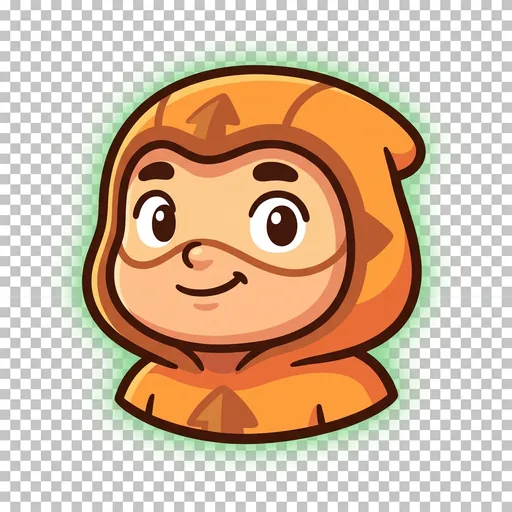
Dodge
Spatial-perception + agility — read-the-space-and-move-EARLIER not-faster; perception-game not speed-game
-
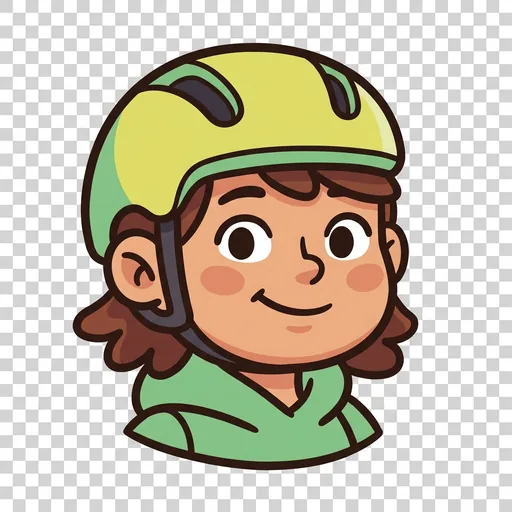
Roll
Tumbling + safe-fall + parkour-shoulder-roll — visible adaptive-PE helmet signals all-bodies-belong