
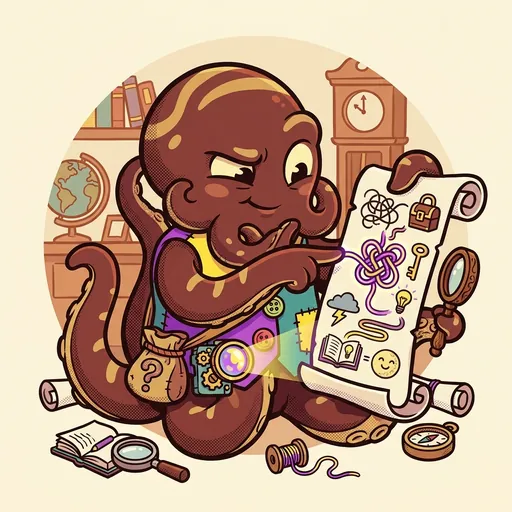
Knot
KNOT — *the riddle hides the answer in the clues. untie carefully.*
Listen along — Knot
Loading audio…
Press play to listen along. The line being read lights up as you go.
Show full transcript
Loading transcript…
Chapter 2 — Knot and the Untied Clue
Knot was a small octopus. They wore a chunky cartoon vest. A tiny riddle-pouch hung from one tentacle. Another tentacle held a clue-tracker. Knot was deep mahogany brown. Soft gold stripes ran across their skin. They often paused to think. Knot loved untying riddles. They always said, “The riddle hides the answer in the clues. Untie carefully.” Knot paid close attention to every word. They collected riddles like treasures. Then they broke each one apart. They looked for the exact word. That word held the riddle’s trick.
Knot understood how riddles worked. A good riddle was tricky. It hid its answer right in front of you. Every clue in a riddle was true. But one word did a special job. It tricked your brain. Most people missed it. “What has a face but no eyes?” Knot asked once. Quirk thought of a person. Switch thought of a monster. “Most people picture a human face,” Knot explained. “They think of a person.” Knot tapped a small clock. “But a clock has a face too.” The word “face” was the trick. Your brain picked the wrong meaning first. Then it got stuck. Knot showed everyone how this trick worked. It wasn’t magic. It was just words. Words could have many meanings. “Slow down on every word,” Knot advised. “Ask yourself, ‘What else could this word mean?’” That was Knot’s special way. They taught everyone to look closely. The answer often hid in the word you rushed past. “I am Knot,” they would say. “I teach about riddles.” “The riddle hides the answer in the clues. Untie carefully.” “Untie one word at a time. The answer is in the word you skipped.”
The friends found themselves in a new Laughtonia tavern. It was called The Giggling Goblet. The air smelled of old wood, fried pickles, and something like burnt sugar. Laughter bounced off the stone walls. Strange creatures sat at wobbly tables. A grumpy goblin polished a giant mug behind the bar. Suddenly, a shadow fell over their table. A huge creature blocked their path. It looked like a giant cat with leathery wings. Its fur was the color of stormy clouds. Its face was stern, like a teacher who just caught you whispering. This was a Sphinx-like villain. Its name was Grumbles. “Solve my riddle,” Grumbles rumbled. Its voice was deep and gravelly. “Or you cannot pass this way.” Grumbles leaned closer. Its glowing yellow eyes stared at each of them. “What has cities but no houses?” it asked. “Mountains but no trees? Water but no fish?” The friends exchanged worried glances. Their minds felt completely blank. Quirk just shrugged. He ran a hand through his messy hair. “No idea, Grumbles.” Switch started counting letters on her fingers. She always hoped a pattern would appear. Hop stared at the floor. He scrunched up his face in deep thought. Knot pulled out their clue-tracker. It was a small, smooth orb. It glowed with a soft, blue light. Tiny lines of light pulsed inside it, like a tiny map of thoughts. Knot held it with two careful tentacles. “Let’s untie each word,” Knot said calmly. Their tentacles moved over the orb. They traced the glowing lines. “First, ‘has’,” Knot began. “Does it mean ‘to own’? Like, a person has a pet?” Quirk frowned. “Or a country has cities?” “Exactly,” Knot said. “That’s what your brain wants to hear first.” Knot tapped the orb. “But ‘has’ can also mean ‘shows’ or ‘depicts’. Like a painting ‘has’ a landscape.” “Next, ‘cities’,” Knot continued. “But no houses. So these aren’t real cities. Not places where people live.” “They’re drawn cities,” Hop mumbled. His eyes lit up. “Like on a paper!” “Good, Hop!” Knot smiled. “You’re untying it perfectly.” “Mountains but no trees,” Knot went on. “Same thing. Drawn mountains. Not real ones.” “So they can’t be climbed,” Switch added. She stopped counting letters. “Exactly,” Knot confirmed. “And ‘water but no fish’.” “Again, drawn water,” Knot finished. “Not wet water. No swimming.” Knot looked up at Grumbles. The Sphinx-creature watched them closely. Its tail twitched. “It’s a MAP,” Knot declared. Grumbles’s eyes grew wide. Its stern face softened just a little. A low purr started in its chest. “Correct,” it rumbled. The creature stepped aside. Its huge paw waved them forward. “You may pass.” The friends walked past Grumbles. They felt a little shaky. “That was amazing, Knot!” Quirk said. “You saved us!” “How did you do it?” Switch asked. Her eyes were full of wonder. Knot smiled. “The trick was the word ‘has’.” “Most people hear ‘has cities’,” Knot explained. “They picture a country. A real place with people.” “But ‘has’ was hiding another meaning,” Knot continued. “It meant ‘shows’ or ‘depicts’.” “Slowing down on that one word,” Knot said, “that was the whole solve. It unlocked everything.” Knot looked at their friends. “The answer always hides in the word you skipped past.”
“I always feel so dumb when I can’t get a riddle,” Quirk admitted. He kicked at a loose floorboard. Knot shook their head. “Riddles are not about being smart or dumb, Quirk.” “They are an invitation,” Knot said softly. “An invitation to slow down.” “To notice things,” Hop added. “To really look at the words.” Switch nodded. “It takes patience.” Knot agreed. “It’s not about being fast. It’s about being careful.” “The trick is always there,” Knot explained. “Hiding in plain sight. You just need to untie it.”
The WitQuest ensemble
Knot is part of WitQuest's distributed-narrative cast. Each character embodies a different curricular primitive; together they teach the full subject.
-
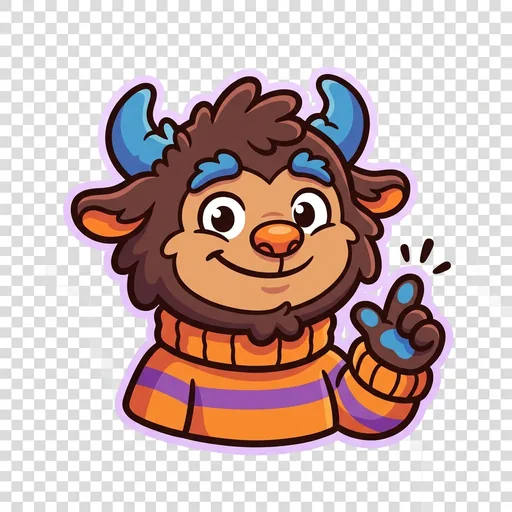
Quirk
Puns and double-meanings
-
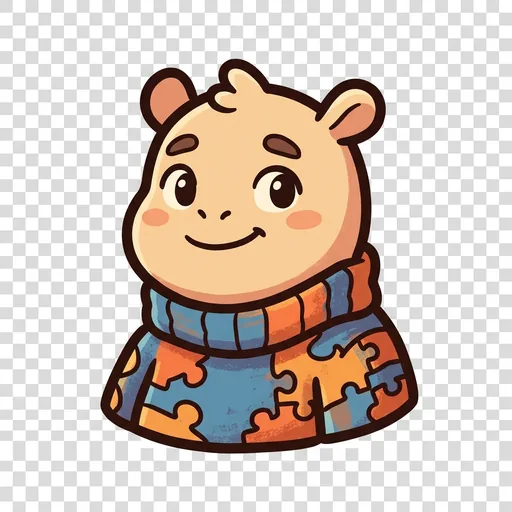
Switch
Anagrams (rearranging letters to form a different word — "listen" → "silent")
-
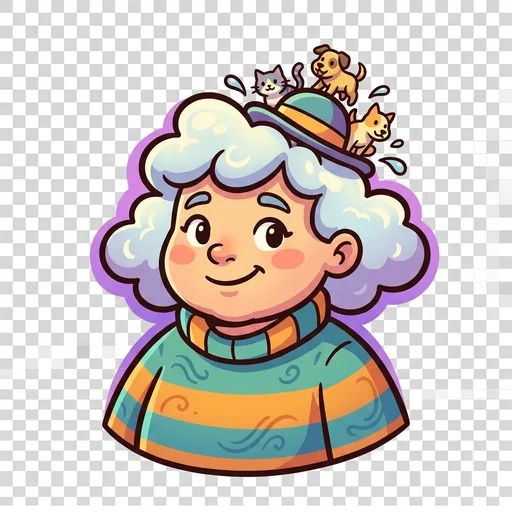
Lilt
Idioms and figurative language (phrases whose literal meaning ≠ their actual meaning — "raining cats and dogs")
-
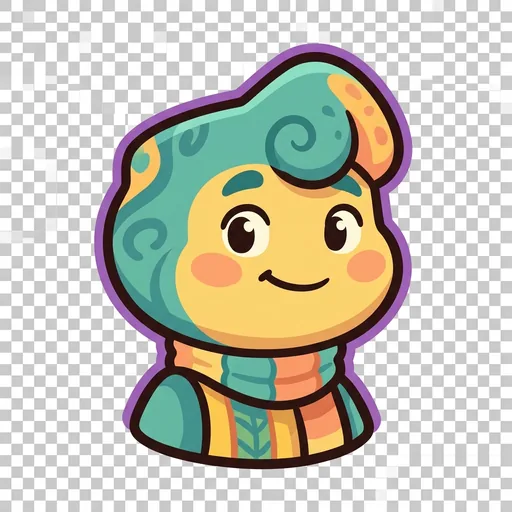
Hop
Lateral thinking (finding a non-obvious angle on a problem; sidestepping the assumed framing)
-
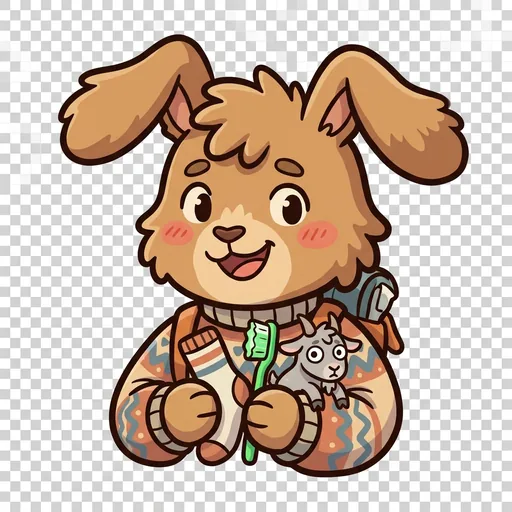
Trip
The rule of three (two beats set a pattern; the third breaks it — the break is the laugh)
-
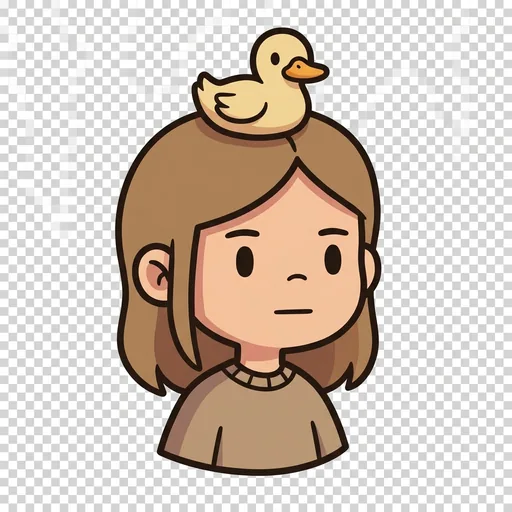
Dry
Deadpan delivery (saying something ridiculous with a calm, serious face — the flat delivery is the joke)
-
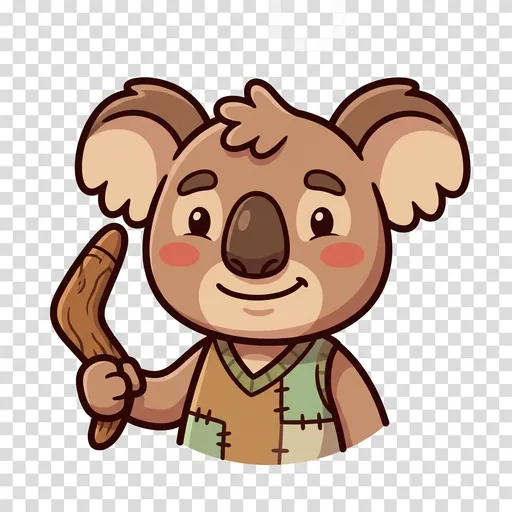
Boomerang
The callback (bringing back an earlier joke later, when it's half-forgotten — funnier the second time)
-
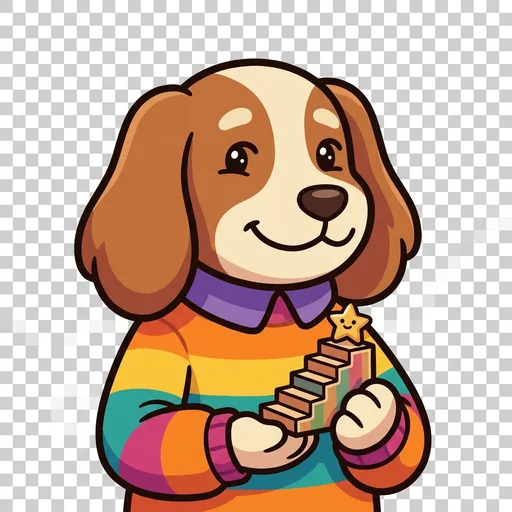
Topper
The topper / escalation (capping a joke with an even bigger one, raising the stakes each time)
-
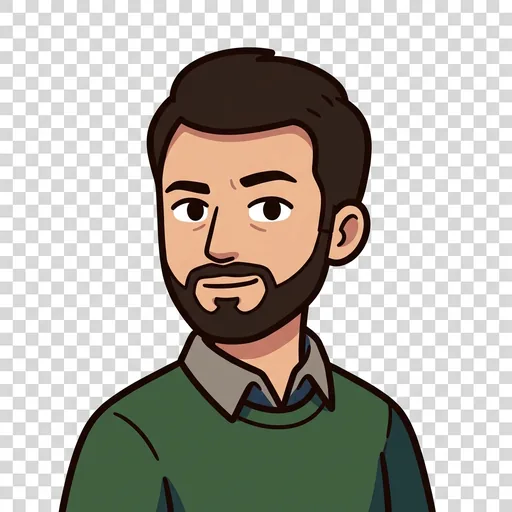
Straight
The straight man / the setup (reacting normally so the absurdity stands out — comedy needs someone to be normal)