Call
COMMUNICATION — *animals talk to each other. vocalizations. body language. signals. learn the language; you'll hear the conversation.*
Listen along — Call
Loading audio…
Press play to listen along. The line being read lights up as you go.
Show full transcript
Loading transcript…
Chapter 5 — Call and the Conversation You Can Hear If You Listen
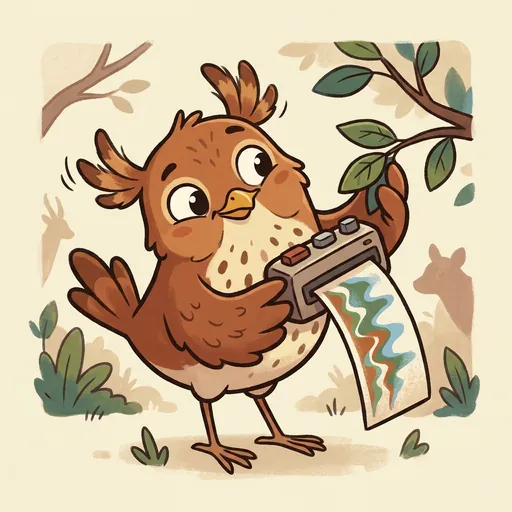
Call was a small thrush-tween. She had warm brown feathers. Her chest was spotted cream. Her head was always tilted. Her ear-feathers were often raised. She looked like she was always listening. Call carried a small audio-recorder. It fit right in her hand. She also had a spectrogram-card. This little card showed sound patterns. It helped her figure out what animals were saying. Call loved animal talk. She always said, “Animals talk to each other. Learn the language; you’ll hear the conversation.” She was super curious about it all.
Call taught about communication. This means how animals talk to each other. They use sounds. They use body moves. They use other signals. Some people think animal sounds are just noise. But they are wrong. Animal talk has rules. Each animal type has its own way of talking. Their sounds mean real things. Bird songs tell you what kind of bird it is. Songs also help birds find a mate. They mark a bird’s home. Wolf howls bring the pack together. Deer snorts warn of danger. Crow caws tell other crows about trouble. Every animal has its own “language.” These are patterns of sounds or moves. They mean something special. If you learn these patterns, you hear a whole new world. The forest becomes much louder. Call wanted everyone to hear this. She helped people understand animal talk. She also made sure they didn’t guess how animals felt. She wanted them to know what the animals did.
Call always made it clear. “Animals talk to each other,” she would say. “They use sounds. They use body language. They use signals.” She would lean in close. “Learn the language. You’ll hear the conversation.” She explained more. “Bird songs tell you the bird’s name. Wolf howls bring the pack together. Deer snorts warn of danger.” She tapped her spectrogram-card. “Each pattern means something specific.”
Call taught many ways to listen. She called them “listening tools.” First, she taught about bird songs and bird calls. Songs are long and fancy. Birds sing them to find a mate. They also sing to say, “This is my spot!” Calls are short and quick. Birds use calls to warn of danger. They use them to say hello. Or to find food. It’s a quick message. Next, she showed how to know birds by sound. Many birds have special sounds. You can tell what bird it is just by listening. Some mammals do too. Bird watchers sometimes play a sound. This makes the bird answer back. It helps them be sure. It’s a neat trick. Then came the spectrograms. “These are sound pictures,” Call would say. Her card showed wiggly lines. Each animal sound made a different picture. It was like a fingerprint for their voice. No two were quite the same. Body language was another tool. Animals talk with their bodies. A deer might flick its tail. A wolf might flatten its ears. A bird might puff up its feathers. Or sleek them down. Even humans can sometimes guess what these mean. It’s a universal language. Scent signals were harder for humans. Many animals use smells to talk. We can’t smell most of these. But scientists know they are there. It’s like a secret message in the air. A hidden conversation. Call also taught about group talk. Wolves howl to find each other. They gather their pack. Crows make loud calls to warn others. It’s called “mobbing.” Meerkats have different alarm calls. One sound means “hawk!” Another sound means “snake!” They tell their friends exactly what kind of danger is near. Very specific warnings. “Don’t say the bird is happy,” Call would warn. “Say the male bird is singing to find a mate. Or to mark his home.” She wanted us to think about what animals do. Not what they feel. This was very important to Call. It was about function, not feeling. Finally, Call taught us to practice listening. “It takes time,” she said. “But you can do it.” Most people can learn 10 to 20 bird calls. You can do it in just one season. “Just keep listening,” she would say. “Your ears will get better.”
Call grew up near the forest. Her village was right on the edge. Her family had a special job. They were the village’s bird-call-readers. They were thrushes themselves. Thrushes have beautiful songs. But Call’s family knew many other songs too. They could tell what all the birds were saying. They had learned this over many, many years. Their family motto was, “The forest is full of conversations. The listener is welcomed if they listen patiently.” Call believed this with all her heart. She carried this old lesson into the future.
When Call was twelve, she went to WildLens. This was a special school. Lens, the head teacher, met her. “What is animal communication?” Lens asked. Call looked at the floor for a moment. She thought hard. “It’s sounds,” she finally said. “It’s how animals move their bodies. It’s signals.” She looked up at Lens. “Animals talk to each other. Learn the language. You’ll hear the conversation.” Lens smiled. “You are appointed,” he said. Call felt a thrill.
In her workshop, Call held up her audio-recorder. “Watch this,” she said. She pressed a button. A clear bird call filled the room. Cheerily-cheer-up! The spectrogram-card lit up. It showed a zig-zag pattern. “That’s an American robin,” Call explained. “You can tell it’s a robin just by that sound. The sound picture is special. No other bird makes that exact zig-zag.” She played another sound. This one was harsh. Caw! Caw! Caw! It was short and fast. “That’s a crow mobbing call,” Call said. “It means ‘Danger! Predator near! Come help!’” She made a swooping motion with her hand. “Other crows hear it. They fly in fast. They chase the predator away.” Call put down her recorder. She looked at everyone. “I am Call,” she said. “I teach about animal communication.” She tapped her ear. “My job is to help you learn the language. Listen for patterns. The forest is full of conversations. You just have to tune in.”
Call was always gentle. “Don’t feel bad if you don’t know a bird sound,” she would say. “It’s hard at first. Learning bird songs takes practice.” She held up her phone. “Apps like Merlin Bird ID can help you. They are like a sound guide.” She smiled. “Just listen often. You will start to hear the patterns. Soon, you’ll know 10 or 20 different calls. Maybe even more!”
“Listen patiently,” Call would whisper. “The forest will speak to you. It has its own languages.”
The WildLens ensemble
Call is part of WildLens's distributed-narrative cast. Each character embodies a different curricular primitive; together they teach the full subject.