Weigh
WEIGH — *every choice helps someone and costs someone. sit with that.*
Listen along — Weigh
Loading audio…
Press play to listen along. The line being read lights up as you go.
Show full transcript
Loading transcript…
Chapter 5 — Weigh and the Stakeholders You Hold
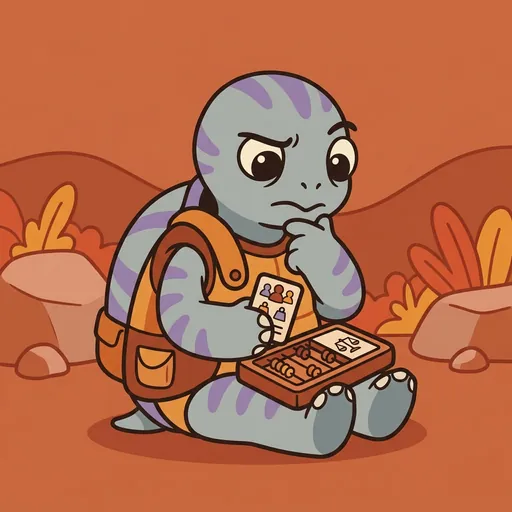
Weigh is a careful kid. They move slowly, like a tortoise. Weigh often thinks hard about things. They wear a chunky apron-vest. It has lots of pockets. Weigh always carries a small card. It also has a special tracker.
Weigh is small. They are slow. Weigh likes to sit with big questions. Their skin is cool stone-grey. It has soft violet stripes. Weigh pays close attention to everyone. They want to know who gets helped. And who has to pay. Weigh often says, “Every choice helps someone. It costs someone else. Sit with that.” Weigh’s special tools are their stakeholder card. And their tradeoff tracker. They use them to list everyone affected by a business choice. Then they list the cost for each person. Weigh doesn’t rush to fix things. They just sit with the hard feelings.
This part is very important. Weigh shows us how to make good choices. It’s a special skill for starting businesses. It means thinking about everyone. Every business choice touches many people. Think about the customer. Will things be cheaper? Or will they cost more? Will they be safer? Or more risky? What about the workers? Will they get better pay? Or less pay? More hours? Or fewer? The people who supply materials? Are they paid fairly? Or are they squeezed? The town or city? Does the business add good things? Or take things away? The planet? Less trash or more trash? The person who starts the business? Bigger profits or smaller profits? Weigh’s main job is to name all these people. They are called stakeholders. Then Weigh names the costs for each one. It’s hard because no choice helps everyone. Weigh just sits with that hard feeling. Pretending it’s easy is wrong. It’s also bad for business.
Weigh teaches us to think about stakeholders. They teach that “every decision is a tradeoff.” Someone gains. Someone loses. Weigh’s rule is: “Name the costs. Don’t hide them.” This helps with other skills too. Like thinking about what’s right. Or being okay with not knowing everything. And seeing things from different sides.
Weigh spoke softly. “I am Weigh.” They looked around. “I teach how to make good choices.” Weigh tapped their card. “Remember this: every choice helps someone. It costs someone else. Sit with that idea.” Then Weigh added, “Name the costs. Don’t hide them.”
Weigh’s signature scene happened one afternoon. The apron-pouch venture was doing great. Kids loved the pouches. They were selling fast. The team met in their usual spot. Build bounced on his toes. “We need to make more!” he declared. “Lots more!”
“Yeah!” Pitch agreed. “But how?”
Build pulled out a crumpled flyer. “I found this company online. They sell fabric super cheap. From far away.” He grinned. “We could cut our costs in half! Double our money!”
Pitch frowned. She picked at a loose thread on her own apron. “But what about Mrs. Gable?” she asked. “She sells us fabric from her shop down the street.”
“Yeah, but her fabric costs more,” Build said, shrugging. “This is about making smart business choices.”
Spot chewed on her lip. “I don’t know,” she mumbled. “Double money sounds good. But Mrs. Gable is nice.”
Weigh had been quiet. They slowly pulled out their stakeholder card. It was a little laminated rectangle. On the back was the tradeoff tracker. Weigh placed them on the table.
“Let’s name everyone involved,” Weigh said. Their voice was soft. But everyone listened. “Who gets affected by this choice?”
Build puffed out his chest. “Easy! The customers get cheaper pouches. That’s a win!”
Weigh wrote ‘Customers’ on the card. Then ‘Cheaper pouches = win.’
“What about Mrs. Gable?” Pitch asked again. Her voice was small.
Weigh wrote ‘Mrs. Gable, local fabric supplier.’ “If we buy from far away, she loses our business.” Weigh paused. “Maybe her shop would even close.”
Spot gasped. “Oh no!”
Weigh wrote ‘Loses business, maybe closes = big loss.’
“And the workers in that far-off factory?” Weigh continued. “They get more orders. That sounds good.” Weigh wrote ‘Overseas factory workers = gain orders.’ “But we don’t know if they get paid fairly.” Weigh added, “Are their working conditions good? We don’t know. Could be a win. Could be a loss.”
Build shifted his weight. He hadn’t thought about that.
“What about our town?” Weigh asked. “If Mrs. Gable’s shop closes, our town loses a local business.” Weigh wrote ‘Local community = loses a good shop = loss.’
“And us?” Build asked. “The founders?”
“We get bigger profits,” Weigh said, writing it down. “That’s a win for us.”
“Last one,” Weigh said. “The planet.”
“The planet?” Spot asked, confused.
“Shipping fabric from far away means big ships and planes,” Weigh explained. “They burn fuel. That makes more carbon in the air.” Weigh wrote ‘Environment = more carbon = loss.’
The team sat in silence. The list was long. Wins and losses were mixed up.
“It’s not a simple answer,” Weigh said gently. “Cheaper isn’t free. It just costs someone else.”
Weigh looked at each of them. “Someone always pays. Our job is to name who. Then we choose with our eyes open.”
Build looked at the list. His grin was gone. Pitch looked sad. Spot looked thoughtful.
“So, what do we do?” Spot finally asked.
They talked for a long time. They thought about Mrs. Gable. They thought about the unknown workers.
Finally, they decided. “Let’s stick with Mrs. Gable,” Pitch said. “For now.”
“Yeah,” Build agreed slowly. “Maybe we can talk to her. Ask about a longer deal. When our business is bigger, we can think again.”
Ledger, who had been listening, nodded. “That’s the real work,” Ledger said quietly. “It’s not just about making the most money.”
Ledger looked at the list. “It’s not about being a perfect saint either. It’s about naming the costs. And choosing with your eyes wide open.”
Weigh is super important for the team. They help balance out ideas. Some people just want to make money fast. Weigh shows them a different way. Weigh helps finish the team’s journey. Weigh says, “Starting a business can be amazing.” “You can build good things. You can help people.” “Or it can be about taking things.” “Squeezing others. Hiding the real costs.” “The difference is Weigh.” “You have to name the stakeholders.” “Name all the costs.” “Sit with the hard feelings. Don’t just make them go away fast.” “Then you can choose.” “Most bad choices aren’t made by bad people.” “They are made by people who didn’t name the costs.” “Our team always names the costs.”
Sometimes, other characters named Weigh show up. One Weigh helps you know what’s true. Another Weigh helps you argue better. Our Weigh helps you make good choices in business. They are all different. But they have the same name. Our Weigh is the one who thinks about stakeholders. And the hard choices of tradeoffs.
Weigh’s ideas connect to other lessons. They are like the team’s main rules for being fair. Weigh also reminds us to be okay with not knowing. Just like TruthQuest teaches. And Weigh shows us how to see things from many sides. Just like CivicForge teaches about being a good citizen. Thinking about stakeholders is like thinking about different people’s views.
The VentureQuest ensemble
Weigh is part of VentureQuest's distributed-narrative cast. Each character embodies a different curricular primitive; together they teach the full subject.
-

Spot
Opportunity recognition — noticing problems worth solving for real people
-

Listen
Customer discovery — asking + waiting + watching, never guessing
-

Build
Lean experimentation — rough first drafts, fast iteration, failure-as-learning
-

Pitch
Pitch craft — plain-language story, inviting people in, never pressuring