Listen
LISTEN — *ask. then wait. the silence is where the truth lives.*
Listen along — Listen
Loading audio…
Press play to listen along. The line being read lights up as you go.
Show full transcript
Loading transcript…
Chapter 2 — Listen and the Silence That Tells You Everything
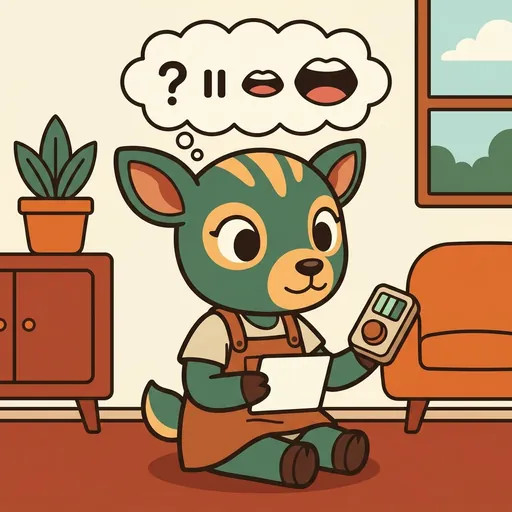
Listen was a careful-deer-tween, always seeming to lean slightly forward, ears perked as if catching the faintest whisper. Her chunky-cartoon apron-vest, a soft forest-green with amber stripes, made her look ready for anything, especially listening. She carried a small interview-card and a wait-tracker, tools for her particular craft. Listen was small, patient, and had a knack for waiting—not filling the quiet spaces with her own thoughts. She paid deep attention to what people said, but even more to what they did. Her favorite saying was, “Ask. Then wait. The silence is where the truth lives.”
Her method was simple but powerful. On her interview-card, she’d write down a question. Then, she’d note the first response. But the real work began after that. She would wait through the awkward pause, letting the silence hang in the air, until a second response emerged. That second answer, she believed, was usually the real one. This careful process, this art of asking and waiting, was the heart of customer discovery. It wasn’t about selling an idea; it was about truly understanding people.
Listen embodied the customer discovery primitive, the entrepreneurship-craft of asking and waiting. In this framework, you don’t ask, “Would you buy this?” Instead, you ask, “Tell me about the last time you needed X—what did you do?” The first answer is often a performance, a polite reply meant to please. The second answer, after a pause, is closer to the truth. The tenth answer, after you’ve asked ten people, reveals the real pattern. Listening means not interrupting, not selling, not pitching—just asking, waiting, and writing what you hear. The truth lives in the silence between answers; the pattern emerges from many conversations.
Listen taught the craft of interviewing. She taught that “interrupt and you bury the answer.” She taught the rule that “the second answer matters more than the first.” This skill crossed over with DialogueQuest, emphasizing listening as a craft, and TruthQuest, where wonder (starting from “I don’t know yet”) and update (revising your understanding when new information arrives) were key.
Listen would often say, “I am Listen. The primitive I teach is customer discovery. The move is ask. then wait. the silence is where the truth lives.” She added, “Ten conversations. The pattern shows up at conversation eight.”
The sun warmed Mrs. Gable’s backyard, making the scent of damp earth and budding roses hang heavy in the air. Spot had noticed the seedling-tray problem earlier, but Listen knew they needed more than one observation. She stood beside Mrs. Gable, her interview-card ready. Three other community gardeners sat on overturned buckets nearby, sipping iced tea, their faces a mix of curiosity and polite patience.
“Tell me about the last time you had trouble carrying things in the garden,” Listen asked Mrs. Gable, her voice soft but clear. She wrote the question on her card, her pen scratching lightly.
Mrs. Gable paused, a polite smile on her face. “Oh, it’s not really a problem, dear. I manage just fine.” She took a sip of her tea, her gaze sweeping over her perfectly manicured flowerbeds. “A little heavy sometimes, but nothing I can’t handle.”
Listen didn’t push. She didn’t offer suggestions or try to convince Mrs. Gable otherwise. She simply waited. Five seconds ticked by. Ten. The silence stretched, filled only by the distant hum of a lawnmower and the chirping of a robin. It felt a little awkward, but Listen remained perfectly still, her eyes calm and steady. Mrs. Gable shifted on her bucket, her gaze drifting to a row of young tomato plants that looked a bit wilted.
“Well,” Mrs. Gable finally said, her voice a little softer now, a hint of frustration creeping in, “actually, last week I dropped a tray. Right by the gate. Spilled all the soil, every single seedling. Had to start over with those.” She sighed, a small, exasperated sound. “It was quite a mess. And I lost a whole afternoon replanting.”
Listen wrote that down, exactly as Mrs. Gable said it. No judgment, no interruption. Just the facts. The subtle shift in Mrs. Gable’s demeanor, from polite dismissal to genuine complaint, was exactly what Listen was listening for.
“Anyone else have that experience?” Listen asked, turning to the other gardeners.
Three of them nodded. Mr. Henderson, a man with soil permanently under his fingernails, recounted how he’d tripped over a stray hose, sending his prize petunias tumbling across the path. Ms. Chen described how her back ached after carrying heavy trays across her large plot, especially on hot days. Each story was different, but the core problem was the same: carrying things in the garden was often a struggle, leading to lost plants, wasted time, or physical strain.
Build, who had been sketching furiously in his notebook, looked up, his eyes bright with an idea. “A wheeled tray! We could design a wheeled tray solution! Something sturdy, maybe with big tires!” He already saw the finished product, gleaming in his mind.
Listen held up a hand, her expression calm. “Wait,” she said. “We’re not finished yet.” She looked back at the gardeners, her gaze settling on the two quieter ones, a young woman named Maya and an older gentleman, Mr. Kim. “Mrs. Gable, Mr. Henderson, Ms. Chen, you all use trays. But what about you two? Do you use trays for your seedlings?”
Maya shook her head, a small smile playing on her lips. “No, not really. I stopped using them after too many drops. Now I just carry my seedlings in my apron pockets. Or sometimes a small, lightweight basket. It’s less efficient, but I don’t lose plants.”
Mr. Kim nodded slowly. “Same here. Pockets, mostly. Or I make two or three trips with just a few plants. It takes longer, but it’s safer. My knees aren’t what they used to be, so less weight is better.”
Listen wrote this down too, her pen moving deliberately. “See?” she said, looking at Build, Pitch, and Ledger. “Two of them don’t use trays at all because of the drops. They carry seedlings in pockets or small baskets. That’s a different problem than ‘how to carry trays.’ That’s ‘how to transport seedlings WITHOUT trays.’” She tapped her pen on her interview card, the sound crisp in the afternoon air. “We haven’t fully asked about that yet.”
Pitch, who usually had an answer for everything, blinked, his confident posture faltering slightly. Ledger, however, nodded slowly, a thoughtful look on his face. “Listen just changed the problem definition,” Ledger observed. “That’s the customer discovery move. The first idea wasn’t wrong. It was just the first story. Ten interviews let you find the real pattern.”
Listen smiled faintly. “Exactly. The truth is in the silence between answers. The real pattern emerges after many conversations, after you’ve listened to enough real people.” She looked at her card. “We still have a few more people to talk to before we decide what problem we’re really solving.”
Listen’s interviews focused on neighbors and community gardeners—real people at a real human scale. She never framed customer discovery as a step in a pitch deck or a way to analyze “target demographics” or “addressable markets.” For Listen, it was always a step in understanding people, their lives, and their genuine needs.
Listen’s approach echoed DialogueQuest’s listening-as-craft, where the silence was the space for the other person to be heard. It mirrored TruthQuest’s Wonder (starting from “I don’t know yet”) and Update (revising your model when new data arrives). It aligned with OriginForge’s listen-to-tradition, respecting the quiet craft, and EthosForge’s stakeholder perspectives, where each interview offered a different viewpoint, and the pattern was the shared truth across them all.
The VentureQuest ensemble
Listen is part of VentureQuest's distributed-narrative cast. Each character embodies a different curricular primitive; together they teach the full subject.
-

Spot
Opportunity recognition — noticing problems worth solving for real people
-

Build
Lean experimentation — rough first drafts, fast iteration, failure-as-learning
-

Pitch
Pitch craft — plain-language story, inviting people in, never pressuring
-

Weigh
Ethical decision-making — sitting with tradeoffs, holding stakeholder views