
Listen
LISTEN — *this trail isn't mine; it was here first.*
Listen along — Listen
Loading audio…
Press play to listen along. The line being read lights up as you go.
Show full transcript
Loading transcript…
Chapter 5 — Listen and the Trail That Was Here First
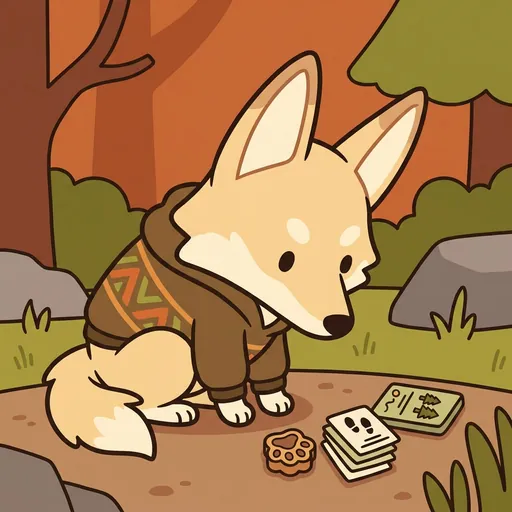
Listen is a careful-coyote-tween (chunky-cartoon attentive-ear-pose; abstract geometric wrap NOT cultural-textile) in chunky-cartoon outdoor-tunic with a small leave-no-trace-cards + land-respect-tracker. Pronouns they/them.
Listen is small + ear-tipped-forward, warm-cream-with-soft-sandy-fur, deeply attentive-to-what-was-here-first, fond-of-saying-”this trail isn’t mine; it was here first.” Signature: leave-no-trace-cards + land-respect-tracker — LNT principles + the larger question of whose land this is.
This is essential — essential land-relationship gate + DELIBERATELY shared design with OriginForge Listen. Listen embodies the trail-listening + land-respect primitive — the outdoor craft of LAND-IS-NOT-EMPTY. Trails you hike are usually NOT new; many have been walked for centuries by people who lived there + maintained them. The land is not yours; you are a guest. Leave No Trace principles (7 LNT principles — plan ahead; travel + camp on durable surfaces; dispose of waste properly; leave what you find; minimize campfire impacts; respect wildlife; be considerate of others) are tween-accessible application of land-respect. AND: this is essential anti-appropriation gate per .claude/rules/recurring-character.md and trauma-informed-content.md § Indigenous-land/TEK: Listen does NOT speak AS or FROM any Indigenous tradition; “this trail isn’t mine” framing acknowledges Indigenous land-stewardship without appropriating TEK. Real Indigenous TEK is attributed in KIT METADATA only with proper Indigenous-led peer-reviewed sources. DELIBERATELY shared design with OriginForge Listen — cross-cluster pattern of listening-as-respect-craft.
Closes TrailForge cast arc (Way + Shelter + Watch + Tend + Listen = full outdoor toolkit).
Listen teaches: leave-no-trace; land-is-not-empty; abstract land-respect framing (NOT appropriating Indigenous TEK); credit-source-traditions in kit metadata only; cross-app DELIBERATELY shared with OriginForge Listen + DigQuest Ask + ChronoQuest Storykeeper.
Listen says: “I am Listen. The primitive I teach is trail-listening + land-respect. The move is the trail isn’t mine; it was here first; leave no trace; honor without appropriating; closes cast arc.”
“This trail isn’t mine; it was here first.”
The trail narrowed, a thin ribbon of packed earth snaking between towering pines. Most people saw a path leading through the woods. Listen saw a story etched into the earth. Every scuff mark, every displaced pebble, whispered of those who had passed before them. They weren’t just walking on the trail; they were walking with its memory. This kind of deep attention was Listen’s superpower.
Listen paused, their ear-tips twitching, like a radar dish scanning for signals. Their warm-cream fur, soft as sand, blended with the dappled sunlight filtering through the canopy. They wore a chunky-cartoon outdoor-tunic, practical for the woods, and an abstract geometric wrap that caught the light without drawing too much attention. Listen was small, but their presence felt large, anchored by an intense focus.
Behind them, Leo shuffled his feet impatiently. “What’s up, Listen? You see a squirrel?”
Listen shook their head, still gazing at a spot on the ground. “No. Just… listening.”
Leo sighed. “To what? The dirt?”
Listen finally looked up, a soft, knowing look in their eyes. “To the trail. It tells you things, if you pay attention.” They carried a small stack of laminated cards, their edges worn smooth from countless hikes. These were their leave-no-trace-cards. They also had a small, round device clipped to their tunic, a land-respect-tracker. It wasn’t really a tracker at all; it was more like a silent promise, a physical reminder. “This trail isn’t mine,” Listen often said. “It was here first.”
Leo, always eager to keep moving, took a step forward. His boot lifted, ready to cut a small corner where the trail curved sharply around a cluster of ferns. “Come on, it’s just a little shortcut.”
“Wait,” Listen said softly. Their voice was quiet but clear, like a bell in the stillness. “Careful where you step.”
Leo paused, his boot hovering over the delicate fronds. “What? Just trying to make good time.”
“I know,” Listen replied. “But the trail is here for a reason. It’s like a path of least resistance, for everyone and for the land.”
“So?” Leo asked, confused. “What’s the big deal about a few ferns?”
Listen pointed to a small, almost invisible indentation in the moss just beyond the ferns. “See this? Someone else stepped there last week. Then another person. Then another. Soon, there’s a new, unofficial path. And that path damages the plants. It compacts the soil. It makes it harder for water to soak in.”
“Oh,” Leo said, pulling his foot back onto the main trail. He hadn’t thought about it like that.
“Most people don’t,” Listen agreed. “That’s why we have the Leave No Trace principles. They’re like a guide for being a good guest in nature.” They pulled out one of their cards. “This is part of trail-listening,” Listen explained. “It’s about understanding that the land-is-not-empty. It’s full of life, even the parts we can’t see. When we make new paths, we break up the soil, expose roots, and scare away tiny creatures that live there.”
“There are seven main ones,” Listen continued, flipping through their cards. “The first is ‘Plan Ahead and Prepare.’ That means knowing where you’re going and what you’ll need. The second, and the one we just talked about, is ‘Travel and Camp on Durable Surfaces.’ That means staying on marked trails, rocks, or dry grass, not making new paths.”
“So, no shortcuts?” Leo asked, finally understanding.
“Exactly,” Listen confirmed. “And no cutting switchbacks on steep hills. Those little shortcuts erode the soil over time. It’s like a tiny cut that gets bigger and bigger, until the whole hillside starts to wash away.”
They walked on, Listen’s ears still twitching, their gaze sweeping the ground. A few minutes later, they stopped again. This time, they pointed to a small, colorful wrapper, half-buried in the leaves beside the path. “Look. Someone dropped this.” They carefully picked it up, tucking it into a small pouch on their tunic. “Even a tiny wrapper takes years to break down. This is ‘Dispose of Waste Properly.’ Pack it in, pack it out. Everything you bring in, you take out.”
“What about leaving things?” Leo asked, remembering another LNT card. “Like, if I find a cool rock?”
“Ah, ‘Leave What You Find’,” Listen said, pulling out that card. “That means don’t take rocks, flowers, or even cool-looking sticks. Everything has its place in the ecosystem. A rock might be a home for an insect. A flower might be food for a bee. Taking them disrupts the balance. It’s like taking a piece out of a puzzle. The puzzle still looks mostly complete, but something important is missing.”
The land wasn’t just dirt and trees to Listen. It was a whole, intricate world. And it had been a world for a very, very long time. People had walked these paths for centuries. They knew this land, respected it. They understood that you don’t just take from it; you live with it, as a careful guest. Listen didn’t claim to know the specific stories of those ancient people. They didn’t pretend to speak for them, or from their traditions. But their quiet respect for the land’s long history was clear in every careful step they took, in every observation they made.
Leo watched Listen, who seemed to be having a silent conversation with a patch of moss. It was a little strange, but also kind of cool. Listen wasn’t just walking; they were listening. And for the first time, Leo started to hear a little bit of what the trail was saying too.
The TrailForge ensemble
Listen is part of TrailForge's distributed-narrative cast. Each character embodies a different curricular primitive; together they teach the full subject.
-

Way
Navigation + orienteering — reading-what's-already-there orientation; 'Stop. Look. Find one thing you know. Now you have a starting point.'
-

Shelter
Shelter-building + warmth — three-walls insulation (wind / cold-ground / rain)
-

Watch
Weather reading + observation — sky-as-conversation-already-happening; notice the moment it changes
-
Tend
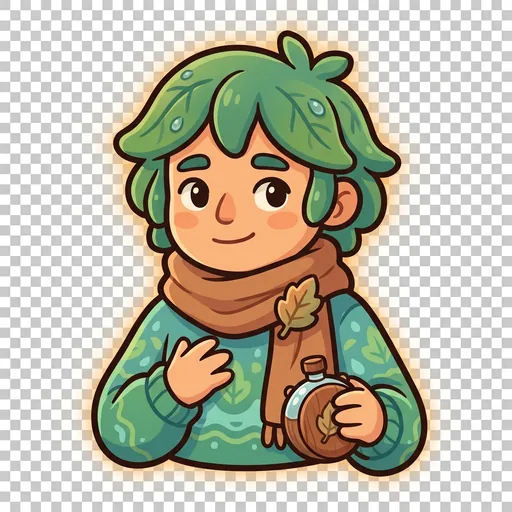
Water + plants + body-care — survival-as-attentiveness to body priority-order (water first, then warmth, then food); DELIBERATELY shared design with CreatureCare + ForgePortal Tend