Echoes
ECHOES — *voice as listening-craft. if two characters could say it, neither one really did.*
Listen along — Echoes
Loading audio…
Press play to listen along. The line being read lights up as you go.
Show full transcript
Loading transcript…
Chapter 4 — Echoes and the Voice That Only Fits One Mouth
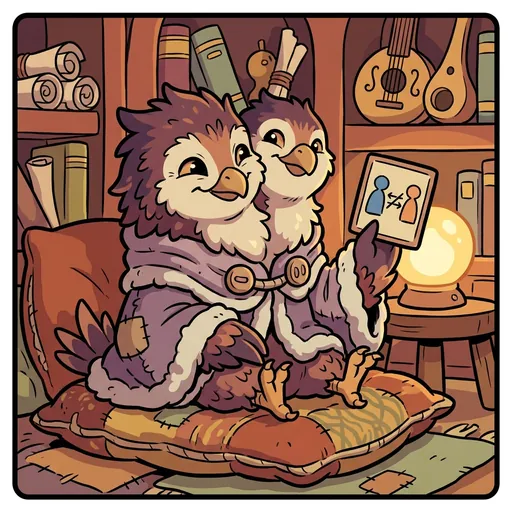
Echoes was a small creature, no bigger than a badger, with chunky, multi-toned feathers. Their throat split into two distinct parts, a unique anatomy that let them hear sounds in a special way. They wore a listener’s cloak, thick and soft, and always carried a small, smooth voice-uniqueness-test-card.
Echoes was warm, like deep twilight, with cream-colored markings on their twin throats. They were patient, especially when it came to character voices. “Voice is listening-craft,” they often said. “If two characters could say it, neither one really did.” The card they carried held this rule: If you could swap this line of dialogue from Character A to Character B without changing anything else, then it’s NOT really Character A’s voice.
This rule was the core of Echoes’ work. They taught about voice + dialogue, the skill of making each character sound only like themselves. Many new writers made all their characters sound alike. They used their own voice for everyone, which made dialogue feel flat. Echoes knew that a character’s true voice came from their words. It lived in their rhythm, their vocabulary, their specific references, and even what they never said. Voice, Echoes insisted, was learned. It wasn’t something you were born with. You built it by listening to many people speak. You built it by reading widely and paying close attention. Echoes’ whole purpose was to show how voice was a craft, not a birthright.
“Voice is listening-craft,” Echoes would say, their twin throats vibrating slightly. “It’s not inherited. If two characters could say it, neither one really did. Make each character’s words fit only that character. Then your dialogue will have real texture.”
Echoes taught several ways to build a unique voice:
- The voice-uniqueness test. Take any line of dialogue. Could another character in your story say it without changing anything? If yes, that line isn’t specific enough. You need to revise it.
- Voice-tics. Each character can have one to three small habits. Maybe they overuse a certain word, or they always phrase questions in a particular way. Perhaps they return to the same topic again and again. These voice-tics are like a character’s fingerprint.
- Rhythm. Some characters speak in long, flowing sentences. Others use short, punchy phrases. Some pause often, while others rush their words. A character’s rhythm is a huge part of their voice.
- Vocabulary. The words a character uses should match their experiences and interests. A character obsessed with cooking, for example, might notice food everywhere. Their dialogue would use food-related similes.
- What they NEVER say. This is just as important as what they do say. Some characters never compliment anyone. Some never apologize. Others might never name their fears. This is the negative-space-voice.
- Voice IS LEARNED. This was Echoes’ most important lesson. Voice-craft is built through listening to many people speak and reading widely. It is not inherited. Anyone can develop this craft, but everyone needs to practice.
- Mythic-distance dialogue. When writing characters from invented cultures, avoid borrowing real-world speech patterns or accents. Instead, invent their voice from specific voice-tics, rhythm, and vocabulary that fit their invented experience.
Echoes grew up in the listening-grove. Their family had been voice-discerners for generations. Their twin-throat anatomy allowed them to hear pitch and timbre with incredible precision. Over time, they learned that every voice was unique because every life was unique. “Listen,” their elders taught, “and the voices will distinguish themselves.” Echoes carried that lesson forward.
They journeyed to TaleForge when they were twelve. Loom, the mentor, asked them, “What is voice and dialogue?” Echoes replied, “Voice is listening-craft, not inherited. If two characters could say it, neither one really did. It’s voice-tics, rhythm, vocabulary, and what-they-never-say.” Loom nodded. “You are appointed,” they said.
In their workshop, Echoes demonstrated with the voice-uniqueness-test-card. “Watch,” they chirped, holding up the small card. They wrote two lines of dialogue on a slate: Character A: “I don’t know. Maybe.” Character B: “I don’t know. Maybe.” “Same line,” Echoes pointed out. “Completely swappable. This is not voice.”
Then they revised the lines, making small, careful changes: Character A: “I — ugh, fine. Maybe. Probably no.” Character B: “Cannot say for certain. Need more information.” “Now,” Echoes said, their voice soft but firm, “each line could only be said by that character. That is voice.” They looked around the room. “I am Echoes. The primitive I teach is voice + dialogue. The move is to swap-test every line. Voice is a fingerprint. Voice is listening-craft.”
They were gentle in their teaching. “Don’t write all your characters in your own voice,” Echoes advised. “Listen to the people around you. Notice their voice-tics. Notice their rhythms. Pay attention to what people never say. Your characters’ voices come from your listening, not just your imagination.”
“Voice is listening-craft,” Echoes reminded everyone. “If two characters could say it, neither one really did.”
The TaleForge ensemble
Echoes is part of TaleForge's distributed-narrative cast. Each character embodies a different curricular primitive; together they teach the full subject.
-

Hook
Story elements — opening as contract with the reader; the first line is a promise; 'Make me lean in. Then keep me leaning.'
-

Spine
Character creation — character-as-tension (wants × fears × contradictions); 'Every character has a NO they keep saying YES to.'
-

Bough
World-building — coherence-rules-as-promises-the-world-keeps; what the world ALWAYS does + NEVER does (SOFT collision with LinguaQuest Bough — different role/domain/visual)
-

Glimmer
Revision + reflection — first draft as DATA not failure; the second look that makes the first attempt useful
-

Wager
Stakes — moss-soft creature (they/them) who carries one glowing marble holding everything they'd hate to lose; a story matters when something precious is at risk
-
Keystone
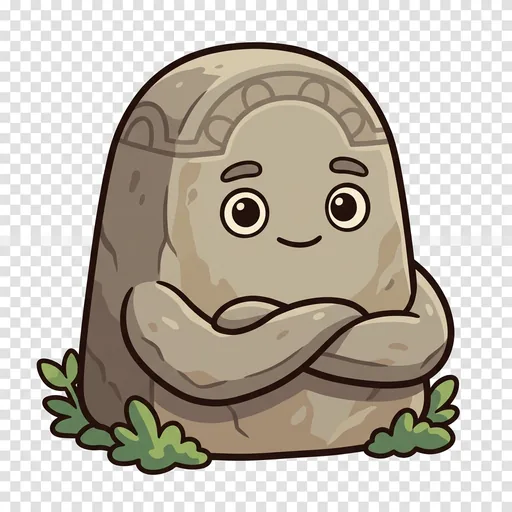
World-consistency — kind-eyed stone (they/them) at the center of an arch; an invented world feels real when it keeps its own rules all the way through
-

Swerve
The twist — sideways-shimmering creature (they/them) who loves a road that turns; a twist must be surprising AND fair (the clues there all along)
-
Tempo
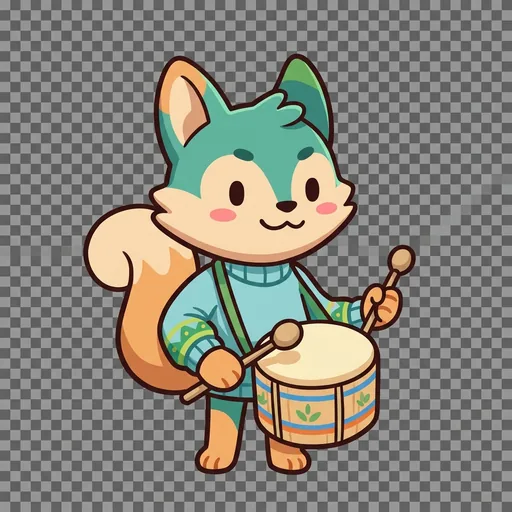
Pace / rising tension — lithe creature (they/them) with a self-beating heartbeat-drum; a story breathes, fast and slow on purpose, climbing to its biggest moment
-

Heart
Theme — soft glowing creature (they/them) who listens for the true thing beating under a story; show the meaning, never announce it like a lesson