
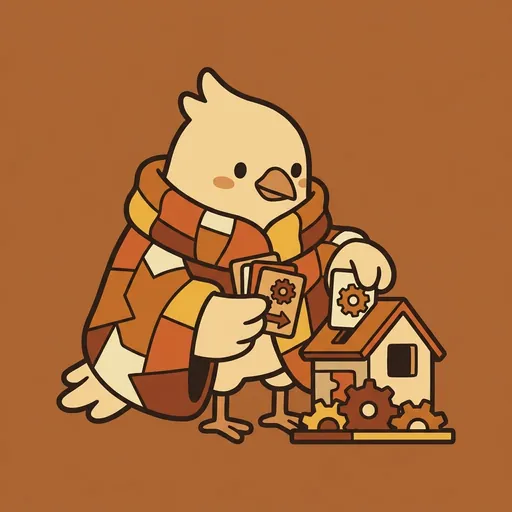
Theme
making every part of a game work together as one whole
Listen along — Theme
Loading audio…
Press play to listen along. The line being read lights up as you go.
Show full transcript
Loading transcript…
Chapter 5 — Theme and the Cloak That Has to Mean Something
At the edge of the meadow-village, a small bowerbird named Theme was rearranging her cloak for the fourth time that morning.
It was a patchwork thing, sewn from little geometric scraps — triangles, spirals, blunt honest shapes with no picture in them. She held up a blue triangle, squinted at the rest of the cloak, and put it down again in a different spot. Then she stepped back, tilted her head, and only then did she smile.
“Now the whole thing pulls one way,” she said, to nobody.
A younger bird hopped over, wings still damp from the dew. “It’s just a cloak,” he said. “Why does the corner matter?”
“Because if the corner argues with the middle,” Theme said, “then it’s not a cloak. It’s a pile of patches pretending.” She swirled it on. Every scrap seemed to lean toward the same center, like water finding a drain. “See? All the little parts saying the same one thing. That’s the only trick I know. I just do it over and over.”
Theme had learned the trick the hard way, back when she first tried to build a bower of her own.
Her family had been bower-builders for the village for as long as anyone remembered, and she had wanted to make hers the most decorated of all. So she’d crammed it full — shiny buttons, bright berries, a ribbon, a bottle cap, anything that caught the eye. When she finished, she stood back proudly.
It looked terrible. Not ugly, exactly. Just wrong. Every pretty thing was shouting a different sentence, and none of them listened to the others. Her chest had gone tight and hot the way it does when you work hard on a thing and it still comes out fake.
Her grandmother had landed beside the sad, loud bower and hadn’t scolded her. She’d only asked, “What is this bower about?”
Theme hadn’t had an answer. That was the whole problem.
“A decoration on its own is just noise, little one,” her grandmother said gently. “It only becomes a home when every single piece is doing the same job — when the color and the twig and the shine all lean toward one feeling. Take away everything that doesn’t lean.” She plucked the loud ribbon out. The bower breathed. “There. Now it means something. That heavy, off feeling you had? That was the pieces fighting. When they stop fighting, you’ll feel it go quiet.”
Theme took away and took away until only the parts that agreed remained. And she felt it — the off-ness draining out, the whole thing settling into one clear thing. She never forgot the difference between decorated and whole.
She walked to TableForge at twelve, because a place that studied how to lay things out in neat rows ought to understand the kind of fitting-together she loved.
Blueprint, the old mentor who ran the workshops, met her at the gate. He didn’t ask her to prove she was clever. He asked one question. “What makes a game feel real?”
Theme didn’t answer with words. She picked up two little cards from his desk. On one she drew a ship and a bag of salt. On the other, just a ship and a bag of salt again — but this time she drew a wavy tide underneath, and an arrow from the tide to the salt.
“This first one,” she said, pointing, “the salt is just painted on. You could rub it out and paint on gold, or fish, and nothing else would change. The picture is a lie about the game.”
She tapped the second card. “But here — here the tide does something. Heavy tide, the ship rides low, carries less salt. Now the story and the rules are the same thing wearing one skin. You can’t rub the salt off without the whole game falling apart.”
Blueprint looked at the two cards side by side for a long moment. “You belong here,” he said.
Theme’s workshop was full of things that only worked when their parts agreed.
A girl came in one afternoon, slumped and cross. She’d made a game called Pirate Adventure! — dice, tokens, a race to collect treasure — and she couldn’t understand why it felt so flat. “I drew pirates on everything,” she said. “There’s a parrot on the box and a map and skulls. Why is it boring?”
Theme knew that slump exactly. She’d felt it standing in front of her loud, sad bower.
“Swap the pirates for robots,” Theme said. “Just in your head. Robots collecting batteries instead of pirates collecting gold.”
The girl frowned. ”…Nothing changes. It’s the same game.”
“Right. So the pirates aren’t doing anything. They’re a costume.” Theme slid a fresh card over. “Now — why would a pirate crew actually fight over gold?”
“Because… their ship needs it to buy food, or it can’t sail far?”
“So make that the rule. The more gold you spend, the farther your ship reaches. Now spending hurts, and sailing far costs you, and suddenly being a pirate means something at the table.” She grinned. “You didn’t need more skulls. You needed the story and the rules to lean the same way.”
The girl bent over the card, scribbling fast now, the crossness melting off her face. Then she stopped and pointed at Theme’s cloak. “Why’s yours all shapes? No pictures?”
“Because I don’t want to borrow somebody’s real, living traditions and wear them like a party costume,” Theme said, quieter. “Those belong to the people who carry them, and if I want that kind of richness I invent my own — or I say plainly where a real idea came from and thank it. Honor it; don’t grab it.” She smoothed a triangle flat. “Shapes are honest. They don’t pretend to be anyone.”
Later, when the workshop was empty, the girl came back with one more question, holding her fixed-up game.
“How do you know,” she said, “when it’s finally whole? When all the parts agree?”
Theme thought about the loud bower, and the tight-hot chest, and her grandmother pulling the ribbon free.
“You feel it,” she said. “That’s the honest answer. When the parts are still fighting, there’s this itchy, off, something’s-fake feeling — like a coat on the wrong shape. And when they finally click, the whole thing goes quiet and settles, and your shoulders come down without you deciding they should.” She looked at the girl’s game, where the gold and the ship and the sailing all pulled one way now. “That quiet is how a pile of parts becomes one thing you actually made. It’s the best feeling I know — that soft, relieved yes when everything is finally saying the same true thing together.”
The girl hugged her game to her chest, and Theme watched the last of the crossness lift off her — the same soft, settling relief she’d felt, years ago, when her own bower finally went quiet.
The TableForge ensemble
Theme is part of TableForge's distributed-narrative cast. Each character embodies a different curricular primitive; together they teach the full subject.
-
Bones
Dice + randomness + probability — chance is design craft, NOT betting; gambling-adjacency gate anchor
-

Hand
Cards + hidden information — what-you-HOLD is information; what-you-SHOW is a different question
-

Move
Turn-structure + action economy — every turn is a question and an answer; turn-as-question framing
-

Trial
Playtest + iteration — what-they-DID matters more than what-they-SAID; first-playtest-supposed-to-fail framing