
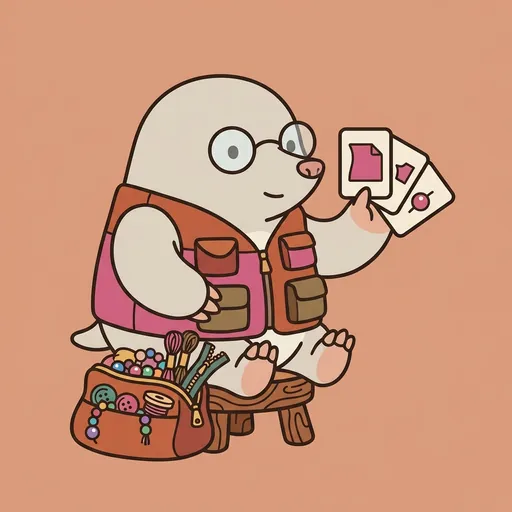
Trim
big shapes finish first and tiny details finish last — hem the edges before you add a single bead
Listen along — Trim
Loading audio…
Press play to listen along. The line being read lights up as you go.
Show full transcript
Loading transcript…
Chapter 4 — Trim and the Order That Finishes the Whole
In the finishing room at Styleforge, a mole-tween named Trim sat with a half-made jacket in his lap and did not add a single bead.
He wanted to. There was a whole pouch of them beside him — beads and sequins and a coil of gold floss, all glinting, all begging to be sewn on right now. But the jacket’s bottom edge was still raw, the threads fraying like a scruffy little beard. So Trim pushed the shiny pouch aside, took a breath, and folded the raw hem under instead. Slow, even stitches. The boring part.
A younger student flopped down across from him, holding her own dress, which was already covered in beads. “You’re just doing the edges,” she said, like it was a waste. “The plain edges. Aren’t you going to put anything pretty on it?”
“Not yet,” Trim said. “I’m getting it ready to be pretty.”
She squinted at him.
Trim held the jacket up and ran his round paw along the hem he’d just finished — smooth, tucked, tidy. Then he pointed at her dress, where a line of beads sat right on top of a still-raw edge. “Watch what happens when I fold your hem now,” he said gently, and folded it. The beads bunched. Three popped loose and rolled across the floor. “See? The pretty part got in the way of the finishing part. Because it came first, when it should have come last.”
The girl chased a bead under the table, cheeks pink.
“Big shapes finish first,” Trim said, mostly to himself. “Tiny details finish last. Hem, then bead.”
Trim had learned the order the hard way, when he was small.
He grew up in the burrow village, in a family of finishers — the moles who came in at the very end of any tunnel, when the digging was done, to smooth the walls and shape the doorway and add the little comfort-things that made a hole in the ground feel like a home. Trim had always thought that was the slow, forgotten job. The afterward job.
The first door he was ever allowed to finish, he raced. He carved the pretty scrollwork around the entrance first, because it was the fun part, and left the rough edges of the doorway for after. But you cannot smooth a wall without knocking against it, and by the time he’d finished the boring smoothing, his beautiful scrollwork was scraped and chipped and half rubbed away. He’d sat down in the dirt, chest tight, throat aching, sure he’d ruined the whole thing.
His grandmother had crouched beside him. She didn’t scold him. She just looked at the scraped scrollwork for a long time and said, “You did the last thing first, didn’t you.”
Trim had nodded, miserable.
“The pretty part isn’t wrong, little one. It’s just last.” She smoothed a paw over the raw doorway. “You finish the big shape — the edges, the frame, the strong tidy bones of the thing. Only when all of that is done and can’t be bumped anymore do you add the small beautiful things on top. Then nothing scrapes them off. Then they stay.”
Trim didn’t fix the door that day. But the tight, ruined feeling in his chest turned into something quieter. The order had a shape now, and he could feel it: bones first, jewels last. Somehow that made the mistake bearable.
He walked to Styleforge at twelve, because a place that made beautiful things ought to understand the humble order that lets beauty last.
Stitch, the old mentor who ran the workshops, met him at the gate. She didn’t ask him to prove he could sew something fancy. She asked one question. “What is finishing?”
Trim didn’t answer with words. He picked up a scrap of cloth from her bench, folded the raw edge under, and hemmed it with three neat stitches. Then, and only then, he took one single bead from his pouch and set it above the finished hem. He held it up for her to see — plain edge made tidy first, one small jewel resting safe on top.
“It’s not fancy,” Stitch said, testing him.
“It’s ready,” Trim said. “The big shape gets finished — the hems, the edges, the closures — so it’s strong and can’t be knocked about anymore. Then the little details go on. In that order, nothing gets scraped off. Everything stays.”
Stitch turned the scrap over in her hands for a long moment, tugging the hem, testing the bead. It held.
“You belong here,” she said.
Trim’s workshop was full of half-made things waiting for their turn.
A boy came in one afternoon, red-faced and rushing. He had a vest he’d covered in sequins that very morning — and now he was trying to sew up the still-open side seam, and every time the needle went in, sequins snagged and tore and skittered across the bench. “I did the best part first,” he said, near tears. “Now it’s all wrecking itself.”
Trim knew that feeling — the pretty-part-first scramble, the chest going tight as it all came undone.
“Take a breath,” he said. “Pull the loose sequins off that seam. Just the seam. Leave the rest.”
The boy did, sniffling.
“Now sew the seam shut. All the way.” Trim waited while the boy stitched, clumsy but careful, until the vest was whole. “Now press it flat.” He handed over the warm iron and watched the boy run it along the seam until the fabric lay calm and smooth. “There. The big shape is finished. It’s strong now. Nothing you do next can bump it apart.”
The boy looked at the tidy, pressed vest like it was a stranger.
“Now the sequins,” Trim said, and slid the pouch across. “One at a time, on top of a shape that’s already done. Go on.”
The boy sewed one. It sat perfectly, glinting, safe. He sewed another. He started to grin. Trim watched his shoulders come down from around his ears.
“That’s the whole secret,” Trim said. “It isn’t that the pretty things don’t matter. They matter so much you have to protect them — by finishing everything underneath first, so the beautiful part goes on last and never gets torn back off. Hem, closures, press. Then bead.”
Later, when the workshop was empty, the boy came back with his finished vest, quieter now.
“When you’re just doing the boring edges,” he said, “and nobody’s even going to look at the hem… how do you not just skip it?”
Trim thought about the scraped scrollwork in the burrow. About the tight chest and his grandmother’s slow, warm voice.
“You feel it,” he said. “That’s the honest answer. There’s a nervous itch that wants to jump to the fun part right away — and if you follow it, you get that awful scraped-off, wrecked feeling later, when the pretty thing won’t stay on. But if you do the plain slow bones first, there’s this settled, unhurried feeling instead. Like the thing is safe. Like it’s going to keep being beautiful, not just look beautiful for one minute.” He ran his paw along the boy’s pressed seam. “Nobody claps for the hem. But the hem is what lets the beads stay put. And when you finally add them last, onto something already whole, you feel calm the whole time — because nothing can come undone anymore.”
The boy nodded slowly, holding his vest a little closer.
Trim didn’t say the rest out loud, but he thought it, warm and sure: the small beautiful things last the longest when you have the patience to make them wait. And that patient, settled feeling in his chest — that was the part he was really glad to teach.
The StyleForge ensemble
Trim is part of StyleForge's distributed-narrative cast. Each character embodies a different curricular primitive; together they teach the full subject.
-
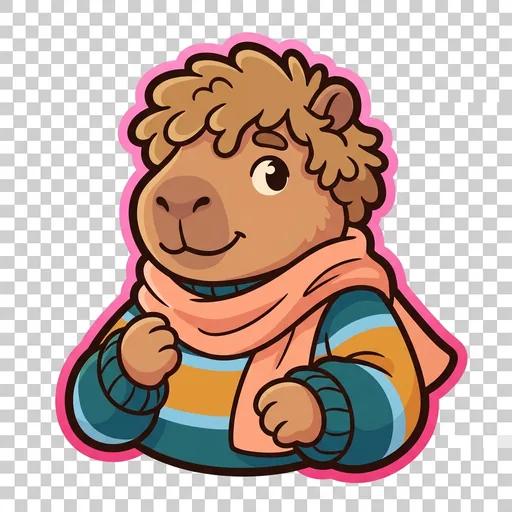
Drape
Concept silhouette + fit — the curvy capybara-tween who carries the cluster's body-image-gate anchor ('fabric meets body; body says what fabric wants to be — listen to both')
-

Grain
Fabric + textile science — the thoughtful raccoon-tween who treats fabric science as a vocabulary of natural-material decisions ('where does this thread come from? where does it go after? fabric has a beginning and an after')
-
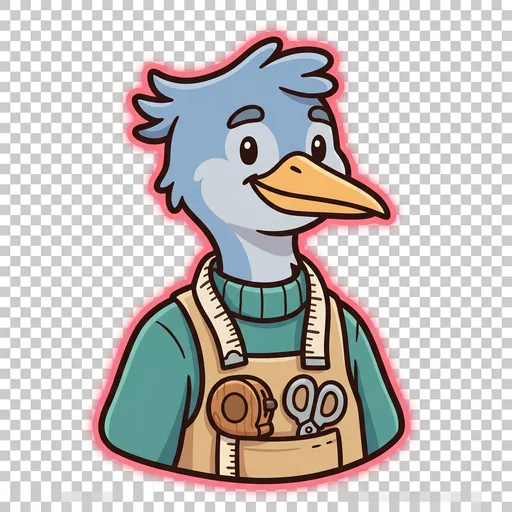
Cut
Pattern-making + construction — the precise heron-tween who treats pattern-cutting as careful measure-twice-cut-once practice ('measure first, cut once — the pattern is the promise')
-

Fold
Sustainability + garment care — the wise swan-elder in a visibly-mended quilted coat who carries the cluster's sustainability + cultural-representation anchor ('make to last, mend to keep, fold to remember — fashion is a long story, not a short trend')