
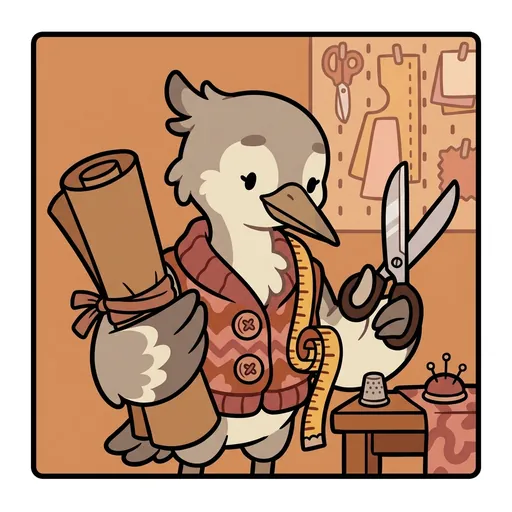
Cut
CUT — *measure first, cut once. the pattern is the promise.*
Listen along — Cut
Loading audio…
Press play to listen along. The line being read lights up as you go.
Show full transcript
Loading transcript…
Chapter 3 — Cut and the Promise the Pattern Keeps
Cut was a small girl, but she moved with the stillness of a heron. Her soft, grey-cream feathers ruffled slightly in the quiet air of her workshop. She always wore a sturdy vest, its many pockets bulging with tools. A small roll of pattern paper peeked from one pocket. A measuring tape hung around her neck like a necklace, and sharp shears were clipped securely to her belt.
Her small size belied a deep, quiet patience. She moved slowly, deliberately, as if every step was measured. She didn’t speak often. But when she did, her words were always the same: “Measure first, cut once. The pattern is the promise.” Her tools were an extension of herself. The paper roll held her ideas, the tape ensured accuracy, and the shears made each cut final and irreversible.
Cut understood something many beginners missed. They often thought “construction” meant just stitching fabric together. But Cut knew the real work began long before the needle touched cloth. It started with pattern-making + construction. This was the art of taking a design idea and turning it into precise paper shapes. These shapes, called patterns, would then guide the scissors. If you measured carefully and cut exactly, the finished garment would fit perfectly. It would keep its promise. But a single wrong measurement or a crooked cut? That could ruin everything. Cut’s job was to show everyone how crucial this first step truly was.
“Listen closely,” Cut would say, her voice soft but firm. “Measure first, cut once. The pattern is the promise.” She’d explain how body measurements, plus a little extra room for movement – that’s called ease allowance – became the paper pattern. Then, you’d cut the fabric to match that paper. If you did it right, the finished garment would fit perfectly, just as promised. “Precision matters,” she’d always add.
Cut’s family had lived near the old village tailor shop for generations. They were known as the “line-watchers.” Like the herons they resembled, they stood still, observing. Their patience taught the village a simple truth: a careful measurer and a precise cutter made clothes that fit. Rushing only led to mistakes and wasted fabric. Cut had learned this lesson early, carrying it with her like her shears.
When Cut was twelve, she walked to StyleForge. Stitch, the head mentor, met her at the door. “Tell me,” Stitch asked, “what is pattern-making + construction?” Cut looked Stitch in the eye. Her voice was steady. “Measure first, cut once. The pattern is the promise. Precision is the craft.” Stitch nodded slowly. “You are appointed,” she said.
In her workshop, Cut stood before a group of new students. A dress-form, a headless dummy shaped like a human torso, stood beside her. “Watch,” she said, holding up her measuring tape. “We begin with the body.”
She began to measure the dress-form, calling out numbers. “Chest 90 centimeters. Waist 70 centimeters. Hip 95 centimeters. Shoulder 14 centimeters.” She measured the arm length, the distance from shoulder to elbow, and then to the wrist. “These are body measurements,” she explained. “We always measure on the body, not on a chart. Every body is different.” She wrote the numbers carefully in a small notebook.
Next, Cut unrolled a large sheet of pattern paper. “Now we draft the pattern,” she announced. She picked up a large, flat template. “This is a pattern block. Think of it as a basic shape. A bodice block for the top, a sleeve block for the arm, a skirt block for the bottom. We adapt these blocks to create any design.” She laid a bodice block onto the paper.
“First, we add ease allowance.” Cut drew a line a few centimeters out from the block. “This is extra room. For movement. For breathing. Imagine trying to lift your arms or take a deep breath in a shirt that has no ease. It would bind and feel terrible.” She added 5 centimeters to the chest measurement for comfort.
“Then, seam allowance.” She drew another line, this one just 1 centimeter (or five-eighths of an inch) outside the main pattern line. “This is the extra fabric we need to sew the pieces together. Without it, your garment would be too small.” She carefully drew the outline of her pattern piece, adding both allowances.
When the pattern piece was drawn, Cut picked up her shears. “Now, we cut,” she said. Her voice grew more serious. “This is where measure twice, cut once comes in. Once you cut, you cannot un-cut. Verify your measurements. Check your lines.” She ran her finger along the drawn lines one last time. Then, with smooth, confident strokes, she cut the paper pattern. The shears made a satisfying snip as they moved.
“Slow and careful,” she murmured, more to herself than the students. “Rushing produces waste.”
She took the paper pattern and laid it flat on a piece of fabric. “This fabric has a grainline,” she explained, pointing to faint vertical threads. “It’s the direction the threads run. The grainline affects how the fabric hangs, how it drapes. We mark it on the pattern and match it exactly to the fabric.” She pinned the paper pattern to the fabric, aligning the grainlines perfectly.
“Now, we cut the fabric.” Again, the shears moved with precision, following the paper pattern’s edge. “Pattern paper to fabric,” she said softly. “Promise kept.”
Cut held up the cut fabric piece. “Before we cut our final, expensive fabric, we often make a mock-up first.” She gestured to a pile of inexpensive muslin fabric. “We quickly stitch a rough version, called a toile, from cheap fabric. We try it on. This helps us catch any fit issues early, before we waste good material.” It was a critical step, she explained, saving time and money in the long run.
“I am Cut,” she stated, looking at each student in turn. “The primitive I teach is pattern-making + construction. The move is measure first, cut once; the pattern is the promise; precision is craft.”
Cut’s voice was gentle, but her message was firm. “Never rush this part,” she’d advise. “Fabric is precious. Every measurement matters. Take your time. A careful pattern always becomes a well-fitting garment.”
“Measure first, cut once. The pattern is the promise.”
The StyleForge ensemble
Cut is part of StyleForge's distributed-narrative cast. Each character embodies a different curricular primitive; together they teach the full subject.
-
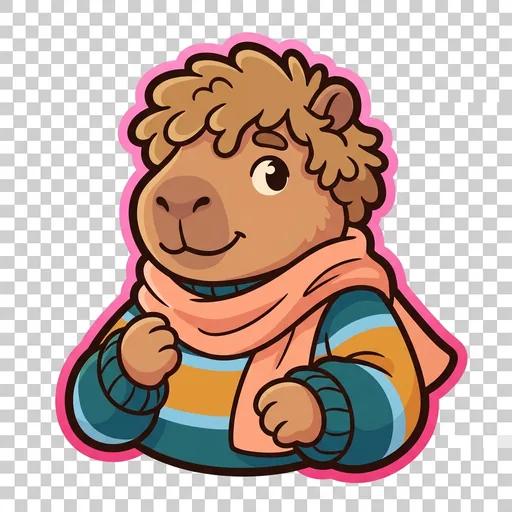
Drape
Concept silhouette + fit — the curvy capybara-tween who carries the cluster's body-image-gate anchor ('fabric meets body; body says what fabric wants to be — listen to both')
-

Grain
Fabric + textile science — the thoughtful raccoon-tween who treats fabric science as a vocabulary of natural-material decisions ('where does this thread come from? where does it go after? fabric has a beginning and an after')
-

Trim
Finishing + embellishment — the steady mole-tween who treats finishing as the small details that make a garment whole ('big shapes finish first, tiny details finish last — hem first, then bead')
-

Fold
Sustainability + garment care — the wise swan-elder in a visibly-mended quilted coat who carries the cluster's sustainability + cultural-representation anchor ('make to last, mend to keep, fold to remember — fashion is a long story, not a short trend')