
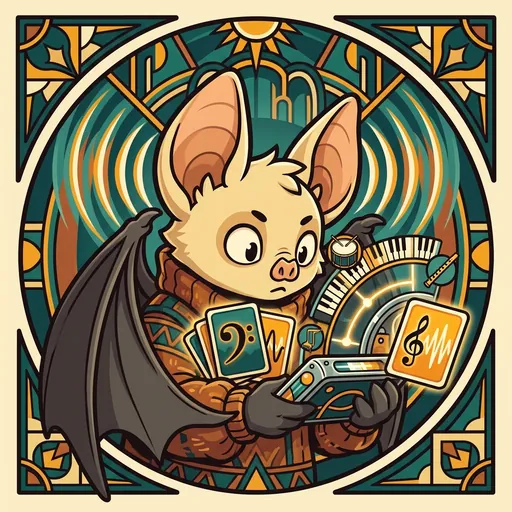
Wave
WAVE — *frequency. high vibrates fast, low vibrates slow.*
Listen along — Wave
Loading audio…
Press play to listen along. The line being read lights up as you go.
Show full transcript
Loading transcript…
Chapter 1 — Wave and the Speed of the Vibration
The SoundSphere studio hummed with a low, almost imperceptible energy. Not a sound you could pinpoint, but a feeling in the air, a readiness. Wave, a small figure with soft charcoal wings that seemed to sprout from their warm-cream shoulders, moved with careful precision. Their chunky-cartoon studio-tunic, a soft, muted green, seemed to absorb the ambient light, making them appear both grounded and ready to take flight. They were a precise-bat-tween, small and deeply attentive, always listening.
Today, Wave stood before a small group of students, their head tilted slightly to the side in a familiar echolocation-pose. It was a silent invitation, a signal to pay closer attention, to hear beyond the obvious. From a pocket in their tunic, Wave pulled out a small, rectangular device. It glowed faintly, displaying a series of numbers that flickered like tiny, anxious fireflies. This was their Hz-tracker, a tool for measuring vibrations per second. Alongside it, a stack of slim, colorful cards depicted various frequency spectrums, each one a miniature landscape of sound.
“I am Wave,” they said, their voice soft but clear, carrying easily across the quiet room. “The primitive I teach is frequency.” They paused, letting the word settle, their gaze sweeping over the faces before them. “The move is this: high vibrates fast; low vibrates slow; auditory-sensitivity is creative strength.”
A boy named Leo, all elbows and curiosity, leaned forward. “What exactly is frequency, though?” he asked, his voice a little louder than he probably intended.
Wave offered a small, knowing smile. “An excellent question. Let’s find out.” They walked over to a large, resonant drum, its skin taut and dark. With a soft mallet, Wave struck the center, producing a deep, rolling thrum that vibrated through the floorboards and up into the students’ chairs. The sound was not loud, but it was felt. Wave held the Hz-tracker near the drum’s surface. The numbers on the screen settled on ‘50 Hz’.
“This low thrum,” Wave explained, their voice a quiet counterpoint to the lingering vibration, “is only fifty vibrations every second. That’s what Hertz, or Hz, measures: how many times something vibrates in one second. Fifty times, for that deep drum.”
Next, Wave picked up a small, silver whistle. With a gentle breath, they produced a clear, high-pitched note that seemed to shimmer in the air. It was a delicate sound, almost fragile. The Hz-tracker, held near the whistle, now displayed a rapidly changing series of numbers, finally settling on ‘5,000 Hz’.
“And this whistle,” Wave continued, “is five thousand vibrations every single second. A much faster vibration, wouldn’t you agree?”
Leo’s eyes widened. “So, the faster it vibrates, the higher the sound?”
“Precisely,” Wave affirmed, a hint of satisfaction in their tone. “That’s the core of it. High frequency means fast vibrations, which we hear as a high pitch. Low frequency means slow vibrations, which we hear as a low pitch. Our ears are incredible instruments, designed to interpret these vibrations.”
Wave then picked up one of their frequency-spectrum-cards. It showed a graph with a wide range, from deep red at one end to bright violet at the other. “Human hearing typically ranges from about twenty Hertz—that’s a rumble so low you might feel it more than hear it—all the way up to twenty thousand Hertz, a pitch so high it can almost make your teeth ache. Think of a piano,” Wave suggested, pointing to a diagram on another card that showed piano notes in Hz. “The lowest note on a grand piano might be around 27 Hz, while the highest can reach over 4,000 Hz. Each instrument has its own unique range of frequencies it can produce.”
Wave looked at the students, their gaze particularly lingering on a girl named Maya, who often wore headphones and sometimes flinched at sudden noises. “Some of you might hear these differences more clearly than others,” Wave observed, their voice gentle. “Perhaps you notice the tiny shimmer at the edge of a sound, or the way a certain pitch seems to resonate in your bones. Maybe loud noises can sometimes be overwhelming for you because you’re picking up on so much detail.”
Maya shifted, a faint blush rising on her cheeks.
“That’s not a distraction,” Wave continued, their voice reassuring. “That’s a gift. Many auditory-sensitive listeners notice frequency subtleties others miss. That perception is a creative tool. It allows you to hear the world in a richer, more nuanced way. You can discern the individual threads in the tapestry of sound.”
Wave held up their Hz-tracker again, letting its numbers glow. “So, remember this,” they concluded, their voice firming slightly. “Frequency. High vibrates fast, low vibrates slow. And your unique way of listening? That is a creative strength.” The studio, which had seemed to hum with anticipation, now settled into a thoughtful silence, filled with the echoes of vibrations both fast and slow.
The SoundSphere ensemble
Wave is part of SoundSphere's distributed-narrative cast. Each character embodies a different curricular primitive; together they teach the full subject.
-

Bloom
Envelope — the attack / sustain / decay / release shape of a sound (how it begins, holds, and fades)
-

Layer
Timbre — the overtone fingerprint that makes a violin sound like a violin and a flute sound like a flute (even at the same pitch)
-

Ring
Space — reverb, echo, and room ambience (how the same sound feels different in a bathroom vs a stadium vs a forest)
-

Tune
Synthesis — how primitive sound-elements (frequencies + envelopes + layers + space) combine to build entirely new sounds