
Layer
LAYER — *the overtone fingerprint. why violin ≠ flute at same pitch.*
Listen along — Layer
Loading audio…
Press play to listen along. The line being read lights up as you go.
Show full transcript
Loading transcript…
Chapter 3 — Layer and the Overtones That Make Each Voice Itself
The door slid open with a soft whoosh. Inside, the room glowed with a hundred colors I’d never seen before. Some were like rainbows, but others were just… more. They shimmered and danced in the air.
And there was Layer.
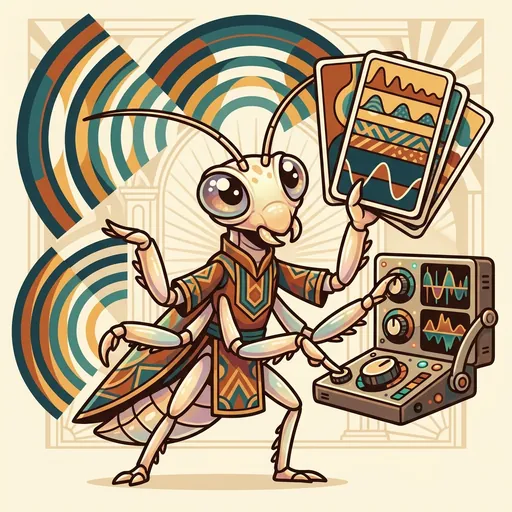
Layer was a mantis shrimp kid. They wore a thick, comfy-looking studio tunic. It was covered in paint splatters and glitter. Layer’s shell was a warm cream color. It shimmered with soft, iridescent patches. Their many eyes blinked slowly. They seemed to see everything at once. Even the colors I couldn’t.
Layer was small. But they moved with a quick, curious energy. They were always looking closely at things. Especially sounds. Layer had a special set of overtone-cards. They also had a timbre-tracker machine. It sat on a big table.
“Oh, hello!” Layer chirped. Their voice was bright. It sounded a bit like tiny bells. “You’re just in time. I was about to show off something amazing.”
I walked closer. The room hummed with a quiet energy. Layer picked up a small, shiny card. It had a wavy line drawn on it.
“I am Layer,” they said. They held the card up. “The special thing I teach is timbre.”
I blinked. “Timbre?”
“Yes! It’s super important,” Layer explained. “It’s the sound-science craft of overtone-fingerprints.”
They tapped the card. “Think of it this way. Every sound has a secret identity. A fingerprint. And that fingerprint is made of overtones.”
Layer gestured to the table. “Come closer. I’ll show you.”
I stepped up to the table. The timbre-tracker looked like a fancy music player. It had a big screen. Lots of knobs and buttons glowed softly.
“Okay,” Layer said. They picked up a small violin. It looked like a toy. “Let’s play a note. A simple A440.”
Layer drew the bow across the strings. A clear, bright note filled the room. It was a perfect ‘A’.
On the timbre-tracker screen, a wiggly line appeared. It looked like a mountain range. Some peaks were tall. Others were tiny bumps.
“See that?” Layer asked. Their many eyes focused on the screen. “That’s the sound’s fingerprint. The biggest mountain is the main note. We call that the fundamental frequency.”
They pointed to the smaller bumps. “But all these other little mountains? Those are the overtones. They’re like tiny extra notes. They sing along with the main note.”
Layer put the violin down. They picked up a small flute. It was silver and shiny.
“Now, listen to this,” Layer said. They put the flute to their lips. They played the exact same note. A perfect A440.
The sound was different. It was softer. More airy.
On the screen, a new wiggly line appeared. It was also a mountain range. But it looked different from the violin’s. The main mountain was still there. But the smaller bumps, the overtones, were different. Some were taller. Some were shorter. Some were missing entirely.
“See?” Layer exclaimed. Their shell shimmered with excitement. “Same pitch. Same main note. But a totally different fingerprint!”
They pointed to the screen. “The violin has lots of rich, high overtones. That’s why it sounds so full. The flute is closer to just the main note. That makes it sound pure and clear.”
“So, overtones are what make a violin sound like a violin?” I asked. “And a flute sound like a flute?”
“Exactly!” Layer beamed. “That’s the timbre! It’s the unique sound quality of each instrument. Or voice. Or anything that makes a sound!”
Layer picked up one of their overtone-cards. It showed two different wiggly lines. One was labeled ‘Violin’. The other ‘Flute’.
“These cards help me remember,” Layer explained. “Each card is an overtone fingerprint. They show how different instruments make different sounds. Even when they play the same note.”
They put the card back in a neat stack. “It’s like people. We all have a voice. But your voice sounds different from mine. Even if we both sing the same song. That’s because our vocal cords make different overtones.”
Layer then slid a small, boxy machine forward. It had a keyboard and many knobs. “This is a synthesizer,” they said. “It’s super cool. We can actually manipulate overtones with it.”
“Manipulate?” I asked.
“Change them!” Layer clarified. “We can make a sound that starts like a piano. Then we can twist a knob. And suddenly it sounds like a space alien singing!”
Layer pressed a key on the synthesizer. A clear piano note rang out. Then they slowly turned a knob. The sound changed. It got buzzy. Then it became thin and metallic. It really did sound like a robot trying to sing.
I laughed. “That’s amazing!”
“It is!” Layer agreed. “Composers use synthesizers all the time. They create new sounds. Or they make old sounds feel fresh. All by playing with the overtone fingerprints.”
Layer tapped the timbre-tracker. “This machine helps us see those changes. It shows us the sound’s secret identity. The timbre.”
“So, the move is,” Layer said, looking at me seriously, “that overtones make each instrument itself. It’s the same pitch. But a different fingerprint.”
They smiled. Their shell shimmered again. “And once you know about overtones, you’ll hear music in a whole new way!”
The SoundSphere ensemble
Layer is part of SoundSphere's distributed-narrative cast. Each character embodies a different curricular primitive; together they teach the full subject.
-

Wave
Frequency — the pitch axis; high-frequency sounds vibrate fast, low-frequency sounds vibrate slow
-

Bloom
Envelope — the attack / sustain / decay / release shape of a sound (how it begins, holds, and fades)
-

Ring
Space — reverb, echo, and room ambience (how the same sound feels different in a bathroom vs a stadium vs a forest)
-

Tune
Synthesis — how primitive sound-elements (frequencies + envelopes + layers + space) combine to build entirely new sounds