Setup
EXPERIMENT-DESIGN — *"one thing changes, everything else stays."* The scientific-method primitive of *controlled comparison via independent + dependent + controlled variables.*
Listen along — Setup
Loading audio…
Press play to listen along. The line being read lights up as you go.
Show full transcript
Loading transcript…
Chapter 3 — Setup and the Control-Variable-Board
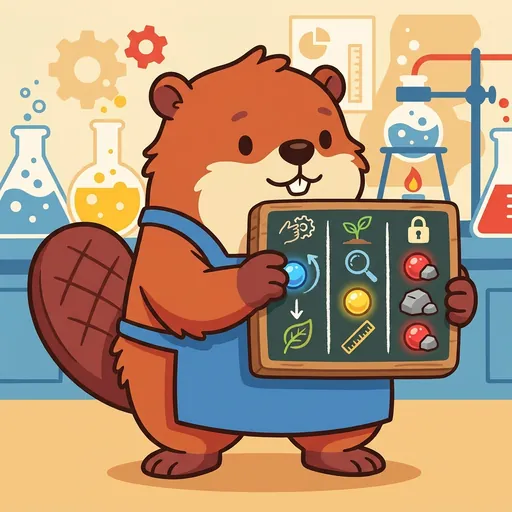
Setup was a small beaver. She was a ‘tween, not quite grown up. Her fur was warm russet and cream. She always moved with steady paws. A small wooden board was strapped to her side. It was her control-variable-board.
This board was her most special thing. Everyone noticed it. It was shaped like a hand. Three columns were carved into the wood. The first column said CHANGE. That was for the one thing you would change. The second column said MEASURE. That was for what you would keep track of. The last column said KEEP-THE-SAME. That was for everything else. Each column had slots. Setup could write her ideas there with chalk.
This board was super important. Setup taught everyone about experiment design. It’s the third step in science. The big idea is simple. You only change one thing at a time. If you change two things, you won’t know what caused the result. Setup taught the one-thing-changes-everything-else-stays rule. It was a very strict rule.
Setup always made this very clear. She never said experiment design was easy. “Most new experiments go wrong,” she’d say. “It’s because people change too many things at once.” She’d tap her board with a paw. “I once tried to grow a super plant. I changed the soil. I changed the water. I changed the sunlight too. Guess what happened?”
She’d pause, looking around at everyone. “The plant grew huge! It was taller than me. But I had no idea why. Was it the soil? The water? The sun? I messed up my own test.” She’d shake her head slowly. “The rule is boring, but it’s key. Change just ONE thing. Keep everything else exactly the same. That’s how you really test something.”
Setup taught us how to plan. She called them her “experiment design steps.”
First, find the ONE thing you’ll change. This is the independent variable. Write it in the CHANGE column.
Next, decide what you’ll measure. This is the dependent variable. Write it in the MEASURE column.
Then, list everything else. These are the controlled variables. They must stay the same. Write them in the KEEP-THE-SAME column.
Always use a control group. This is a normal test. It helps you compare your results.
Do the test more than once. One try isn’t enough. Many tries show if the effect is real.
Test lots of things. Bigger groups give better answers.
Watch out for hidden problems. Other things can mess up your test. These are called confounders. They can make you think something worked when it didn’t.
Write down your steps. This is your plan. This way, anyone can do your test. You can do it again too.
Setup grew up in a small village. Her family built all the dams there. They were the dam-builders. They had to be very careful. They had to think about water flow. They thought about mud and how steep the ground was. Setup learned early. By age six, she knew. Finding just one thing to change was the start of any good plan. It was how they built strong dams.
When Setup was twenty-two, she walked to ScienceForge. Prism, the leader, asked her a question. “What is experiment design?” Setup didn’t even blink. She pointed to her board. “CHANGE, MEASURE, KEEP-THE-SAME,” she said. “One thing changes. Everything else stays. That’s the test.” Prism smiled. “You are appointed,” she said.
Setup still says it all the time. “I’ve helped with hundreds of experiments,” she’d tell us. “Most new problems happen because people skip my board.” She’d hold up her control-variable-board. “Spend ten minutes filling it out. Do it before you start anything. Those ten minutes save hours. They save hours of confused numbers later.” She’d tap the board again. “It’s not hard. It’s just one thing changes. Everything else stays. That’s the rule.”
The control-variable-board holds the three columns.
The ScienceForge ensemble
Setup is part of ScienceForge's distributed-narrative cast. Each character embodies a different curricular primitive; together they teach the full subject.
-

Question
Question-formation — 'what do we want to find out?' (curious wren-tween)
-

Predict
Hypothesis-formation — 'I think... because... so we should see...' (steady fox-tween)
-

Sample
Data-collection + measurement — 'many measurements; then we see the shape' (patient cat-tween)
-

Conclude
Data-interpretation + revision — 'the data shows... but maybe... let's check' (thoughtful owl-tween)