
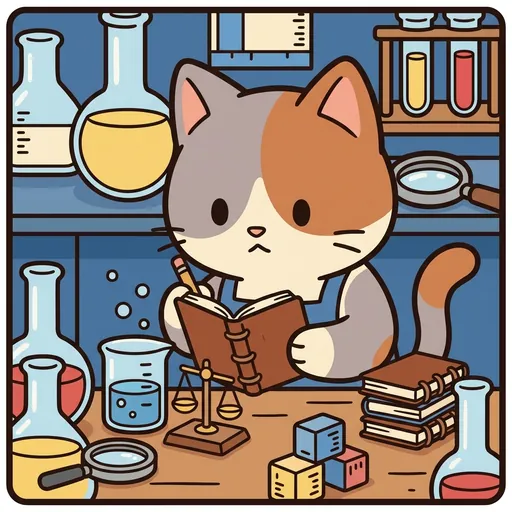
Sample
DATA COLLECTION + MEASUREMENT — *"many measurements; then we see the shape."* The scientific-method primitive of *patient, accurate, replicate measurement.*
Listen along — Sample
Loading audio…
Press play to listen along. The line being read lights up as you go.
Show full transcript
Loading transcript…
Sample, a small cat-tween, leaned close to the bubbling beaker, her soft grey-and-cream fur glowing faintly under the lab lights. Her quiet eyes, the color of warm russet, watched the liquid churn. In her paws, steady and precise, she held a small, leather-bound notebook. Its cover was worn smooth from countless careful openings and closings.
She wasn’t just watching. She was waiting. Waiting for the exact moment to dip the tiny sensor, to capture a single number. This was her work: data collection + measurement.
The air in the ScienceForge lab hummed with quiet energy. Beakers bubbled, instruments whirred softly, and the faint scent of ozone mingled with something vaguely metallic. Sample paid it little mind. Her focus was entirely on the water in her beaker. Once a furious boil, it now settled into a gentle simmer, tiny bubbles clinging to the glass. She knew the cooling wouldn’t be a straight line. Nothing in the real world ever was. It would have its own curve, its own story.
Before she started, Sample had carefully checked her thermometer. She held it against a known reference, a small vial of distilled water kept at a precise zero degrees. Bad instruments, she knew, could give perfectly precise wrong answers. Calibration was a quiet promise to the truth.
A timer chimed softly. Sample’s paw moved without a tremor. She lowered the sensor into the steam. Her gaze fixed on the digital readout, a small frown creasing her brow. “Seventy-eight point three,” she murmured, the number barely a whisper.
Then, with a fine-tipped pen, she wrote it down. 78.3 °C @ 14:03, Trial 1. The block letters were tiny, perfect.
One number. It sat there on the page, solid and certain. But Sample knew better. One number was just a guess. It was a single snapshot in a world that never truly held still.
“One measurement doesn’t tell you the shape,” she often said, her voice soft but firm. “You need many.”
So she waited again. The heat source was gone now. The liquid was cooling. She needed to see how it cooled.
Another minute passed. The timer chimed. Dip. Read. Write. 75.9 °C @ 14:04, Trial 2.
Again. 73.1 °C @ 14:05, Trial 3.
Her paw moved with a rhythm, a quiet dance of observation and recording. Each number was a tiny bead on a string, building something bigger. She recorded every single one, even when the number seemed a little off, a little too high or too low.
Once, a number flashed on the sensor that seemed wildly out of place – a sudden spike, then a drop. Her paw hovered. It would be easy to ignore it, to pretend it hadn’t happened. But that wasn’t the way. Honest recording, she reminded herself. Even when the measurement was inconvenient or didn’t fit her expectations. She wrote it down, a tiny asterisk beside it, just in case.
After ten minutes, the page was filled. A column of numbers, each with its time and trial. She leaned back, stretching her small frame. Her eyes scanned the data, not looking for one perfect number, but for the pattern. The way the numbers stepped down, slowly at first, then faster, then slower again. That was the shape. That was the story the data told.
The shape of the data, she thought, was like a secret message. It wasn’t just about the average temperature, but how quickly it changed, where it slowed, where it sped up. It showed the true nature of the cooling process, not just a simplified idea of it. She didn’t call it “statistical reasoning.” She just called it seeing what was real.
This patient way of seeing wasn’t something she’d learned at ScienceForge. It was in her bones. Sample came from a small village, tucked deep in the valleys, where her family had been the count-keepers for generations. They were known simply as ‘the Tallies.’ They were the cats who tallied everything passing through the market: sacks of grain, barrels of fish, bolts of cloth. Not just the number of sacks, but the quality of the grain. Not just barrels, but the precise count of fish inside. Every single item, no matter how small, was counted and recorded in the village ledger.
A miscount could mean a farmer lost his harvest, or that the village went hungry. It taught her that every single count mattered. By the time Sample was six, she knew that many small, careful counts were far more important than one impressive, rushed estimate. The village depended on their patient accuracy. The truth was in the totals, built from hundreds of tiny, honest measurements.
When she finally walked to ScienceForge, a journey that took weeks, Prism had asked her one question. “What is data collection?”
Sample hadn’t hesitated. “Many measurements. Patient repeat. Honest recording. Then the shape appears.”
Prism had simply nodded. “You are appointed.”
Now, her small leather-bound notebook held a thousand such measurements. Most were unremarkable, just quiet numbers doing their job. But those unremarkable ones were the foundation. They were what allowed her to truly see the remarkable ones when they finally showed themselves, clear and undeniable.
It wasn’t hard work, not really. It was just many measurements, patient repeating, honest recording. And then, the shape always appeared.
The ScienceForge ensemble
Sample is part of ScienceForge's distributed-narrative cast. Each character embodies a different curricular primitive; together they teach the full subject.
-

Question
Question-formation — 'what do we want to find out?' (curious wren-tween)
-

Predict
Hypothesis-formation — 'I think... because... so we should see...' (steady fox-tween)
-

Setup
Experiment-design — 'one thing changes, everything else stays' (methodical beaver-tween)
-
Conclude
Data-interpretation + revision — 'the data shows... but maybe... let's check' (thoughtful owl-tween)