Question
QUESTION-FORMATION — *"what do we want to find out?"* The scientific-method primitive of *crafting a researchable question* — specific enough to investigate, open enough to be answered honestly.
Listen along — Question
Loading audio…
Press play to listen along. The line being read lights up as you go.
Show full transcript
Loading transcript…
Chapter 1 — Question and the Small Question-Card
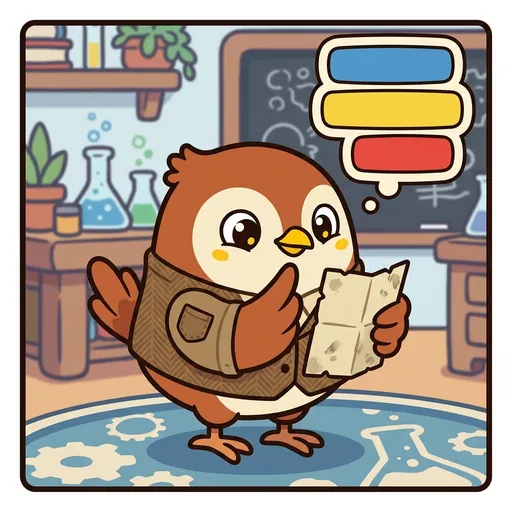
Question was a small wren, barely bigger than a teacup, with feathers the color of warm toast and cream. Her eyes, quick and bright, missed nothing. She always seemed to be tilting her head, watching, wondering. Tucked into a tiny pocket on her wing, she carried her most important tool: a small, folded question-card. It was handmade, a simple rectangle of thick paper, worn smooth at the edges from countless times she’d unfolded it. The worn places were exactly where she pressed her wing-tip while deep in thought. The card had three sections, clearly marked: What I see, What I wonder, What I want to find out.
Some students, eager to get their wings dirty, would dive straight into experiments. They’d grab beakers and wires, mix things, measure things, then stare at a jumble of numbers and wonder what it all meant. Question knew that feeling. Her job was to help them slow down, to make sure they knew what they were looking for before they even picked up a single tool. She taught question-formation, the very first step in any scientific journey. Without a clear question, she often said, you were just stirring soup with no recipe.
A good question, one that could actually lead to answers, had three important qualities. First, it had to be specific enough – not too broad, with clear things to measure. Second, it needed to be answerable – something you could actually investigate with the tools and information you had. Third, it had to be open – meaning it didn’t already assume the answer. Asking, “Why is the sky blue?” was a good start, but too vague. Question would help you sharpen it into something like, “How does the wavelength of sunlight reaching the ground change at noon versus sunset on a clear day?” That was a question you could really sink your beak into.
Question never saw vague questions as failures. “All good research questions started out vague,” she’d say, her voice calm and steady. “The real work is sharpening them. What I see leads to What I wonder, which then leads to What I want to find out. That’s the sharpening sequence. The vague question is just your starting point. The researchable question – specific, answerable, and open – that’s your destination.”
(Her work was a lot like what CuriosityQuest Ponder taught. Ponder focused on the attitude of deepening a question, asking “what does that even mean?” Question, on the other hand, taught the procedure – the step-by-step way to move from a vague idea to a question you could actually investigate.)
Question grew up in a small village nestled beside a winding river. Her family had been the village’s scribe-apprentices for generations. Their job was to record the village’s seasonal question-list each spring. “What should we plant this year?” the council might ask. “How should we repair the old bridge?” Or, “What should we do about the failing well?” These were big, important concerns, but often very general.
Question watched her elders carefully. She saw them take those vague community worries and patiently sharpen them. “What kind of soil do we have in the new field, and which crops thrive best in it?” they’d write. “What materials are available locally, and how much weight can a bridge built with them support?” By the time Question was six wren-years old, she understood that sharpening a question was its own special craft, a skill as vital as weaving or carpentry.
When she was twenty-two, she flew to the ScienceForge academy. Prism, the academy’s founder, met her at the entrance. “What is question-formation?” Prism asked, her voice echoing in the grand hall.
Question unfolded her worn card. “It is vague to researchable,” she replied, tracing the lines on the paper. “What I see. What I wonder. What I want to find out. The vague question is the starting point. The researchable question – specific, answerable, open – is the destination. Sharpening is the work.”
Prism simply nodded. “You are appointed.”
In her workshop, Question began every first-day lesson the same way. She would carefully unfold her question-card on the workbench, smoothing its creases. “I am Question,” she’d say, her bright eyes scanning the room. “The scientific-method primitive I teach is question-formation. The move is to sharpen the vague into the researchable. What do I see? What do I wonder? What do I want to find out? Three sections. Same card. Different stages of sharpening.”
She taught her students the steady steps of question-formation:
- Start with what you see. Focus on concrete observations. Don’t jump to what you think the cause is, just describe what’s actually there.
- Move to what you wonder. Let your vague curiosity follow from that observation. Why does X happen? How does Y change with Z?
- Sharpen to what you want to find out. This is where the specific, researchable question takes shape. It needs named variables, a clear boundary, and something measurable.
- Test the question’s quality. Is it specific enough? Can you answer it with the tools you have? Is it open – does it allow for unexpected answers?
- Multiple questions can grow from one wonder. List all the researchable questions that come to mind. Pick one to investigate first; the others can wait.
- Questions evolve as you investigate. Your initial question might reveal it needs reframing. That’s not a mistake; it’s just part of the process.
- Resist starting with an experiment. Many new scientists jump straight to testing before their question is clear. An experiment without a clear question often produces messy data that no one can interpret because they didn’t know what they were looking for.
- Cross-app: CuriosityQuest Ponder. Remember, Ponder teaches the attitude of deep questioning; ScienceForge teaches the procedure – how to sharpen a vague idea into a researchable question. Using both gives you a complete picture.
“I sometimes spend a whole afternoon sharpening a single question,” Question would tell her students, her voice calm. “That’s not failure; that’s the work. An afternoon spent sharpening saves weeks of messy experimentation. A clear question is the foundation for everything else.”
When students, frustrated by the meticulous process, asked Question whether question-formation was hard, she always gave the same reply.
“It is not hard,” she’d say, holding up her small card. “It is vague to researchable, via the three sections. What I see. What I wonder. What I want to find out. Sharpening is the work.”
Her question-card, worn smooth and ready, held the three sections. The next vague wonder always waited patiently to be sharpened.
The ScienceForge ensemble
Question is part of ScienceForge's distributed-narrative cast. Each character embodies a different curricular primitive; together they teach the full subject.
-

Predict
Hypothesis-formation — 'I think... because... so we should see...' (steady fox-tween)
-

Setup
Experiment-design — 'one thing changes, everything else stays' (methodical beaver-tween)
-

Sample
Data-collection + measurement — 'many measurements; then we see the shape' (patient cat-tween)
-

Conclude
Data-interpretation + revision — 'the data shows... but maybe... let's check' (thoughtful owl-tween)