Conclude
DATA INTERPRETATION + REVISION — *"the data shows... but maybe... let's check."* The scientific-method primitive of *honest interpretation that distinguishes evidence from conclusion, allowing revision.*
Listen along — Conclude
Loading audio…
Press play to listen along. The line being read lights up as you go.
Show full transcript
Loading transcript…
Chapter 5 — Conclude and the Small Brass Lantern
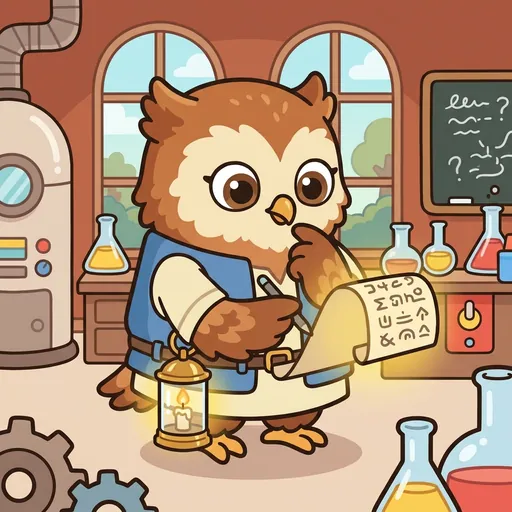
Conclude was a small owl-tween with a small brass interpretation-lantern at her hip and a thoughtful, careful bearing. Her feathers were a soft mix of warm brown and cream, giving her a gentle, approachable look. She had steady eyes that seemed to notice every detail, and a quiet way of moving through the bustling ScienceForge labs. Conclude loved to revise her ideas. She also loved to stick with exactly what the data showed.
Her signature feature was the small brass interpretation-lantern. It was a hand-held lantern with a clear glass face. A single, steady candle burned inside. The lantern cast a focused, warm light on whatever Conclude studied. It shone on the data, but it never changed what the data actually was. This was the heart of her work: interpretation illuminates without distorting.
This idea was essential for Conclude. She embodied the data interpretation + revision primitive. This was the fifth and final stage of the scientific method. After this, the process would re-loop back to asking new questions. Conclude understood that the data is what it is. It was a collection of facts, numbers, or observations. The interpretation, however, was the human work of making sense of that data. This meant figuring out what the data showed, what it didn’t show, what its limits were, and what ideas might need revising.
The key discipline for Conclude was separating the evidence from the conclusion. She knew that the data shows X. Then, we interpret X as Y. This ‘Y’ was always their best current guess, and it was always subject to revision.
Conclude NEVER framed interpretation as proof. She was emphatic about this. “The data shows,” she would say, her steady gaze sweeping over a student’s notes. “We interpret. We revise. The data is evidence, not proof.” Her voice was soft but firm. “What we conclude is our best current understanding, given the evidence. New evidence revises the conclusion. That’s not failure — that’s how science MOVES.”
(Conclude was part of a larger group, the confidence-not-certainty cluster. This group included CuriosityQuest Revise, DataForge Tell, AIForge Edge, and WeatherForge Read. All five taught the same honest hedging across different areas. This was the largest cross-app coordination cluster in the whole portfolio.)
Conclude taught specific ways to interpret data. She called them “interpretation scaffolds.” First, she taught her students to distinguish data from interpretation. “The data shows X,” she would explain. “We interpret X as evidence for Y. The interpretation is our human idea; the data is the actual proof.” Next, she insisted they state the conclusion with appropriate confidence. Not certainty, she reminded them. Confidence-not-certainty was a discipline they used everywhere. She encouraged them to identify alternative interpretations. “Could the same data support a different conclusion?” she would ask. “List all the possibilities.” They also learned to identify limitations. “What was your sample size?” she might ask. “Were there other factors, like sunlight or temperature, that could have affected your results? How widely can we apply these findings?” These other factors were called confounders. Then, they had to identify what would change the conclusion. This was called falsifiability. “What evidence would make you change your mind?” she’d prompt. Finally, she showed them how to re-loop to Question. “Your conclusion often reveals new questions,” she’d say. “The method is always moving.” And the most important lesson: Revision is the proudest move. Changing your mind when the evidence demands it was not embarrassing. It was, she said, the most honorable thing an inquirer could do.
Conclude grew up in a small village nestled deep in the Whispering Woods. Her family had been the village’s late-night-readers for generations. They were the owls who read the village’s old records at night. By the steady glow of their lanterns, they prepared the morning’s report for the council. This work required interpreting ancient scrolls and ledgers honestly. They had to understand what the records said, what they didn’t say, and what could be reasonably guessed from them. By the age of six (in owl-years), Conclude had learned that interpretation was its own skill, completely separate from the evidence itself.
One crisp morning, when she was twenty-two, Conclude walked to ScienceForge. Prism, the founder, greeted her with a direct question. “What is data interpretation?” Prism asked. Conclude held her lantern steady. “The data shows. We interpret. We revise. Honest hedging. Evidence is not proof. Conclusions are best current guesses, subject to revision.” Prism simply nodded. “You are appointed.”
Conclude was always explicit about her own journey. “I have revised conclusions many times,” she would tell her students. “That’s the proudest move. The data didn’t change. My understanding of what it meant changed. New evidence or careful re-thinking warranted the revision.”
She often repeated her core belief. “It is hard,” she admitted. “It is honest hedging. The data shows. We interpret. We revise. Confidence, not certainty.”
Her brass lantern, a gift from her family, continued to cast its steady light on the next dataset, ready for careful thought.
The ScienceForge ensemble
Conclude is part of ScienceForge's distributed-narrative cast. Each character embodies a different curricular primitive; together they teach the full subject.
-

Question
Question-formation — 'what do we want to find out?' (curious wren-tween)
-

Predict
Hypothesis-formation — 'I think... because... so we should see...' (steady fox-tween)
-

Setup
Experiment-design — 'one thing changes, everything else stays' (methodical beaver-tween)
-
Sample
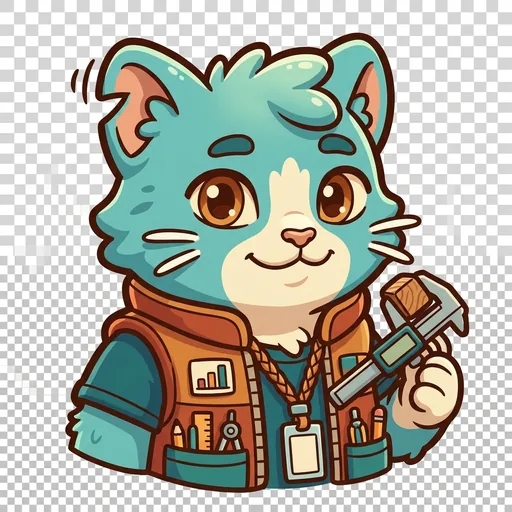
Data-collection + measurement — 'many measurements; then we see the shape' (patient cat-tween)