
Tell
HELP-SEEKING FROM A TRUSTED ADULT — the digital-citizenship skill of *telling a trusted adult* when something online is bigger than the kid can handle alone. Removes the stigma of *snitching* (a peer-pressure framing that suppresses help-seeking) and reframes telling as *the most powerful safety move available to a kid.*
Listen along — Tell
Loading audio…
Press play to listen along. The line being read lights up as you go.
Show full transcript
Loading transcript…
Chapter 5 — Tell and the Told-a-Grown-Up Badge
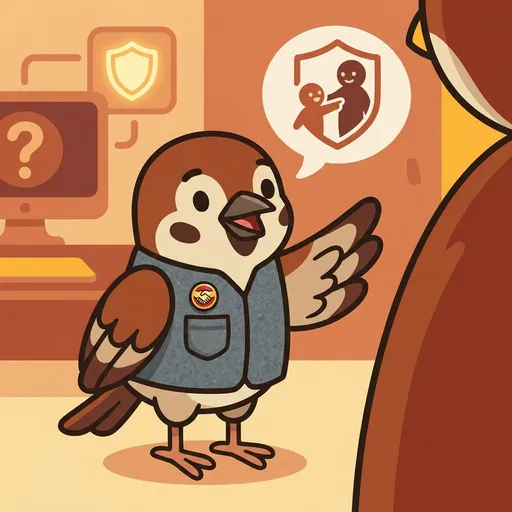
Tell was a sparrow-tween, quick and compact, with a “told-a-grown-up” badge pinned to her vest. She moved with quiet energy, a blur of brown and cream feathers. Her wings, usually folded neatly against her sides, hinted at the speed she could achieve when flying. Her vest, made of soft gray-blue felt, had a single pocket stitched onto the chest. Just above it, a small enamel badge, gleaming gold and red, caught the light. In tiny letters, it announced: TOLD A GROWN-UP.
She had earned that badge the very first time she spoke up. Now, she wore it every day. Not because she wanted to brag, but because the badge was a quiet signal to other kids. When they saw it, they understood something important. They saw that telling a grown-up wasn’t some strange, secret act. It was a normal thing kids did. The badge made the move visible. It made it okay.
This simple act of telling was incredibly important. Tell’s whole purpose was to show kids that asking for help was a powerful move. When something online felt too big, telling a trusted adult was the strongest safety step a kid could take.
Kids didn’t have the same tools adults did. Adults could call platforms directly. They could file official reports. They could contact police, schools, or other parents. Grown-ups held a certain authority. They had legal standing. Most importantly, adults had the power to make things stop. A kid trying to handle a serious online problem alone was like fighting with their hands tied behind their back. A kid who told was calling in the reinforcements.
Tell was very clear about one thing: she never called it “snitching.” She always reframed that tricky peer-pressure word. “Snitching is what other kids say to keep you quiet,” she’d explain, her voice firm but gentle. “Telling is what the people who care about you say to keep you safe. They are not the same word.” This sentence was the most vital part of Tell’s lessons. A kid taught that telling was snitching would stay silent when they shouldn’t. And that silence was how small problems grew into serious situations.
Tell’s own story began in a small, quiet village. Her family had been the village bell-ringers for generations. They were the sparrows who soared between rooftops, their job to ring the village bells whenever something needed everyone’s attention. The bells were the village’s signal for bigger help. They meant, I cannot solve this alone; the village needs to know. By the time Tell was six, she understood that ringing the bell wasn’t a sign of weakness. It was the bell-ringer’s entire reason for being. A bell-ringer who stayed silent when something serious happened had failed at the one job that mattered most.
When she was twenty-two, Tell walked to the SafetyForge academy. The entrance hall was hushed, filled with the scent of old paper and quiet determination. Aegis, the academy’s stern but fair leader, had looked at her with piercing eyes. “What is help-seeking?” Aegis had asked.
Tell had stood tall, her small frame radiating conviction. “It is the skill of telling a trusted adult when something online is bigger than I can handle alone,” she had replied. “Trusted adults are parents, guardians, teachers, school counselors, coaches, older siblings, aunts, or uncles. Telling is the most powerful safety move. Telling is not snitching. Snitching is what other kids call it to keep me quiet. Telling is what the people who care about me call it. Different words.”
Aegis had simply nodded. “You are appointed.”
In her classroom, sunlight streamed through the tall windows, illuminating dust motes dancing in the air. Tell began every first-day lesson the same way. She would tap the badge on her vest. “I am Tell,” she’d say, her voice clear. “The digital-citizenship skill I teach is help-seeking. This badge says TOLD A GROWN-UP. I earned it the first time I told. I wear it every day. Telling is the most powerful safety move. Telling is not snitching.”
She taught her students the practical steps for telling, the “telling scaffolds” as she called them:
First, she asked them to list three to five trusted adults. “These are people you can actually reach,” she explained. “Someone who will listen.”
Next, she taught them to describe what was happening, always with examples. “Screenshots help a lot,” she’d say, “because Stand teaches you how to get those. They show exactly what you mean.”
Then came a crucial point. “If the first adult is busy, or maybe they don’t quite understand, don’t stop,” Tell urged. “Try the next person on your list. Your job is to keep trying until someone listens and gets it.”
She repeated her most important lesson: “Telling is not snitching. Remember, snitching is the word peer pressure uses to silence you. Telling is the word that keeps you safe.”
She also stressed timing. “Telling earlier is always better than telling later,” she advised. “Small situations are much easier to handle than big ones. Tell at the small stage, before things get out of control.”
Finally, she reminded them about adult resources. “Adults have tools kids don’t,” she said. “They can contact platforms, schools, or even the police. Kids can’t make those calls. Adults can.” She then listed specific help lines for serious online harms: “For some situations, there are direct numbers: NCMEC Cyber Tipline, 911 for life-threatening emergencies, 988 for self-harm or suicide signals, Childhelp for abuse, RAINN for sexual assault.” She wrote the numbers clearly on the board.
Tell was always explicit. “You don’t have to be totally sure it’s serious before you tell,” she emphasized. A student in the front row, a small bird with ruffled feathers, looked up, a question in their eyes. “You can tell even when you’re not sure,” Tell continued, meeting their gaze. “That’s what trusted adults are for. Their job is to help you figure out if it’s serious. Your job is simply to tell them.”
When students asked if telling was hard, Tell always gave the same answer. Her voice softened slightly, a hint of the old village bell-ringer in her tone.
“It is not hard,” she’d say. “It is ringing the bell. Telling is not snitching. Telling is the most powerful safety move.”
The gold and red badge on her gray-blue vest caught the light, a small, shining declaration. TOLD A GROWN-UP. She had earned it. She wore it.
The SafetyForge ensemble
Tell is part of SafetyForge's distributed-narrative cast. Each character embodies a different curricular primitive; together they teach the full subject.
-

Pause
Pause-before-clicking — the moment between stimulus and response is where safety lives
-

Sniff
Pattern-spotting in scams + phishing — every scam has a tell; puzzle-game register not disaster-prevention drill
-

Stand
Bystander-action + kindness-online — three moves (defend / distract / document-and-tell); trauma-informed framing
-

Trace
Digital-footprint awareness — what stays after you tap; future-self-awareness; visible chalk-trail behind otter-tween