
Margaux
NORMAN-FRENCH ROOTS — *royal*, *chef*, *ballet*, *garage*, *hotel*, *courage*, *adventure*, *justice*, *jury*, *cuisine*. French-derived English from the Norman conquest forward.
Press play to listen along. The line being read lights up as you go.
Show full transcript
Loading transcript…
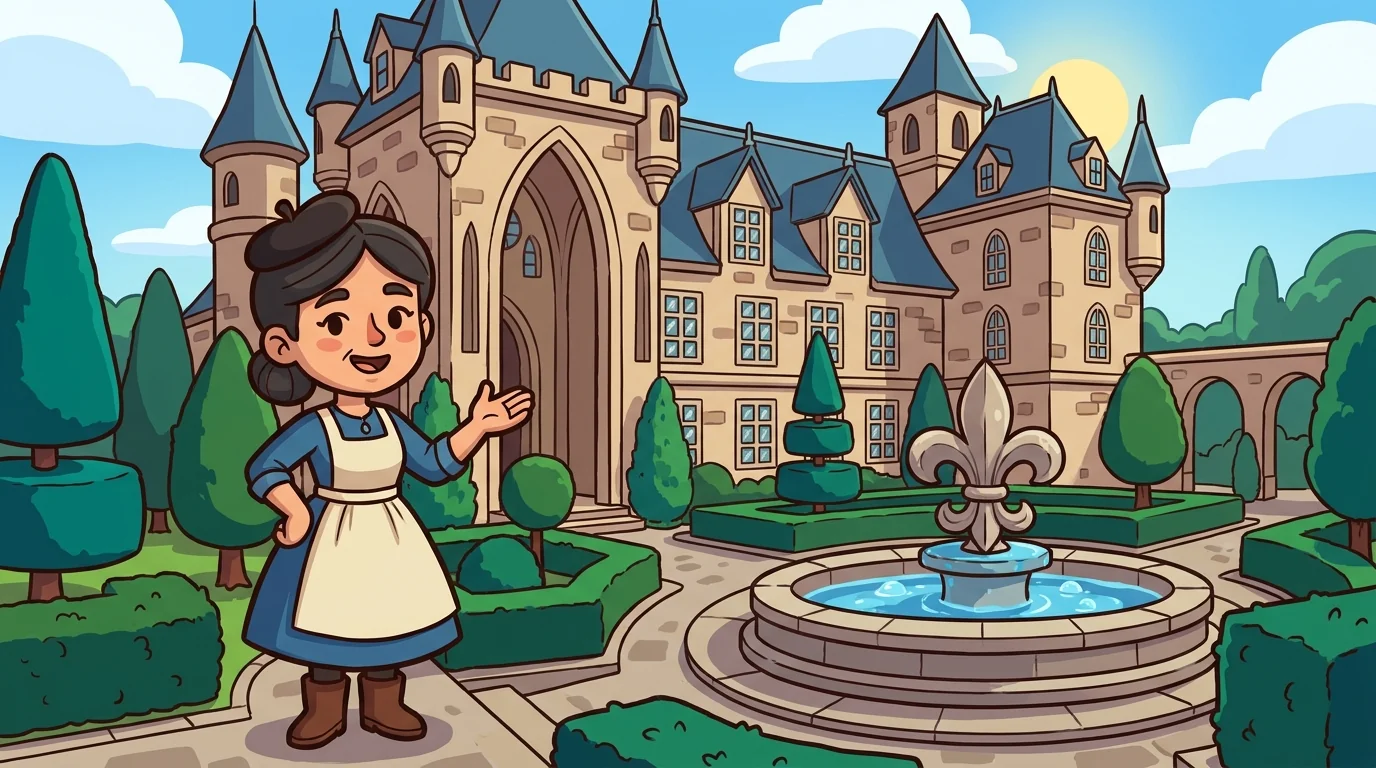
Margaux lives in the French Chateau.
The Chateau is not a real French castle. The kingdom does not have real French castles. The academy built this building on purpose. They wanted it to look like a French castle. It has tall, pointy arches. The windows have small glass panes. A small, fancy garden sits out front. Gardeners trim this garden into perfect shapes. The Chateau is on the academy's west side. A small fountain bubbles in front. The fountain has a stone fleur-de-lys in its middle. That's a fancy lily flower.
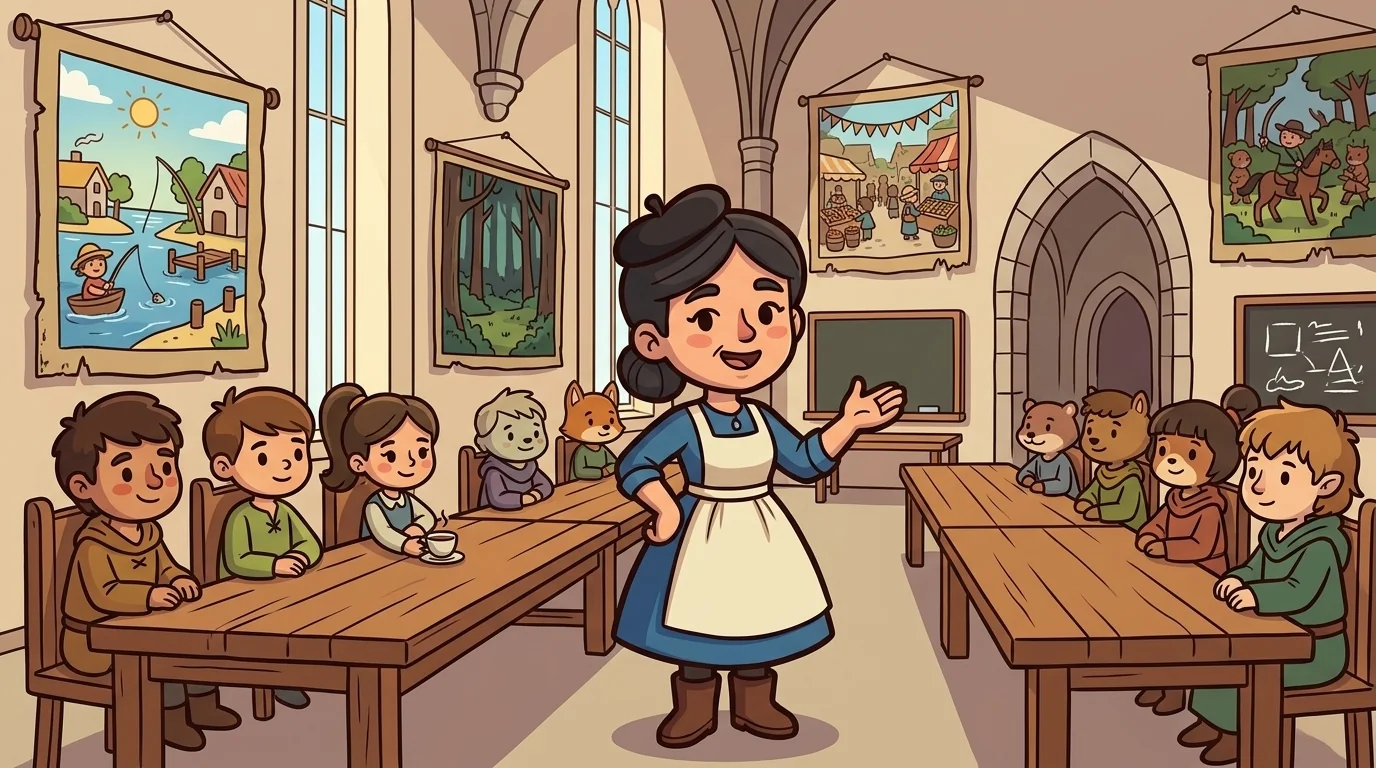
Margaux teaches in the Chateau's great hall. The hall has high ceilings. It has tall, narrow windows. A long oak table runs down its center. Old tapestries hang on the walls. Retired teachers gave these to the academy. They show pictures from all over the world. One shows a sunny fishing village. Another shows a dark forest. One shows a busy market. Another shows a hunting party. The tapestries are very old. Some parts are a little frayed.
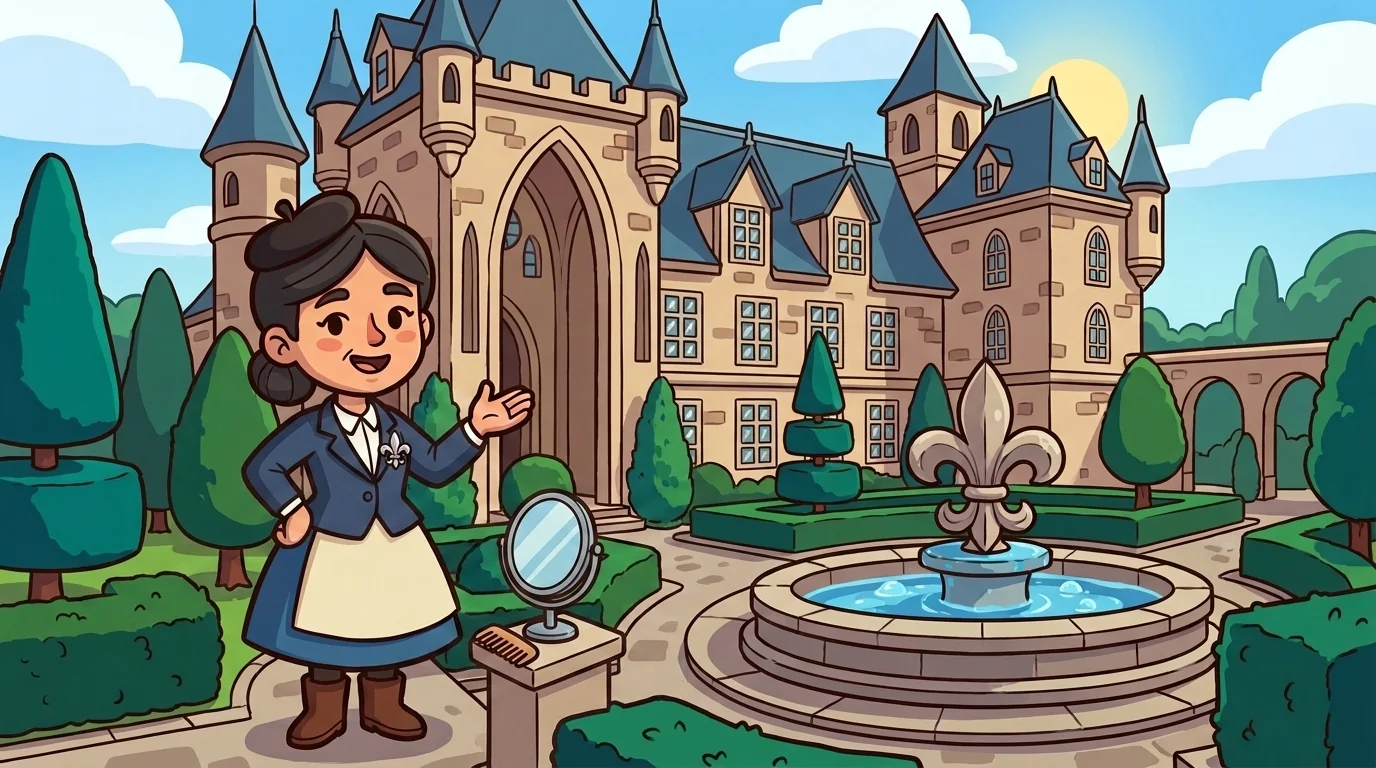
Margaux herself is always dressed very neatly.
This is part of the Chateau's way of doing things. She will tell you if you ask. The Chateau is the academy's fanciest neighborhood. Kids coming for a lesson should brush their hair. They should straighten their collars. They do this before they step inside. Margaux is gentle about this rule. She never scolds anyone. She just has a small mirror by the door. A small comb sits on a side table. Most kids get the idea when they first arrive. Margaux's own clothes set an example. She wears a navy-blue jacket. She wears a crisp white blouse. A small silver pin shines on her jacket. It is shaped like a fleur-de-lys. Her hair is always neat.
Margaux's first name is Marguerite. She grew up in a special house. Her family spoke two languages at home. They spoke the kingdom's main language. They also spoke an old French-sounding language. They spoke both at supper. Her family's part of the kingdom used to be French. That was a long, long time ago. The kingdom took over that land. But their old language still had many French words. It also sounded very French. Marguerite's mother, Madeleine, really wanted her children to speak both languages well. The kingdom's main language was for getting along in the world. The old French-sounding language was for honoring their family.
Marguerite became very, very careful about how words sounded. She was a teenager then. She could hear tiny differences in her own voice. She heard them in other people's voices too. Some words came from French. Others came from an older German language. Garage, she heard early, was a French word. But the kingdom's southern talk had changed it. It barely sounded French anymore. The French way was gar-AHZH. That sounded clearer. It sounded fancier. It was closer to how the word started. The southern way was GAR-ij. Marguerite thought that sounded a little sad.
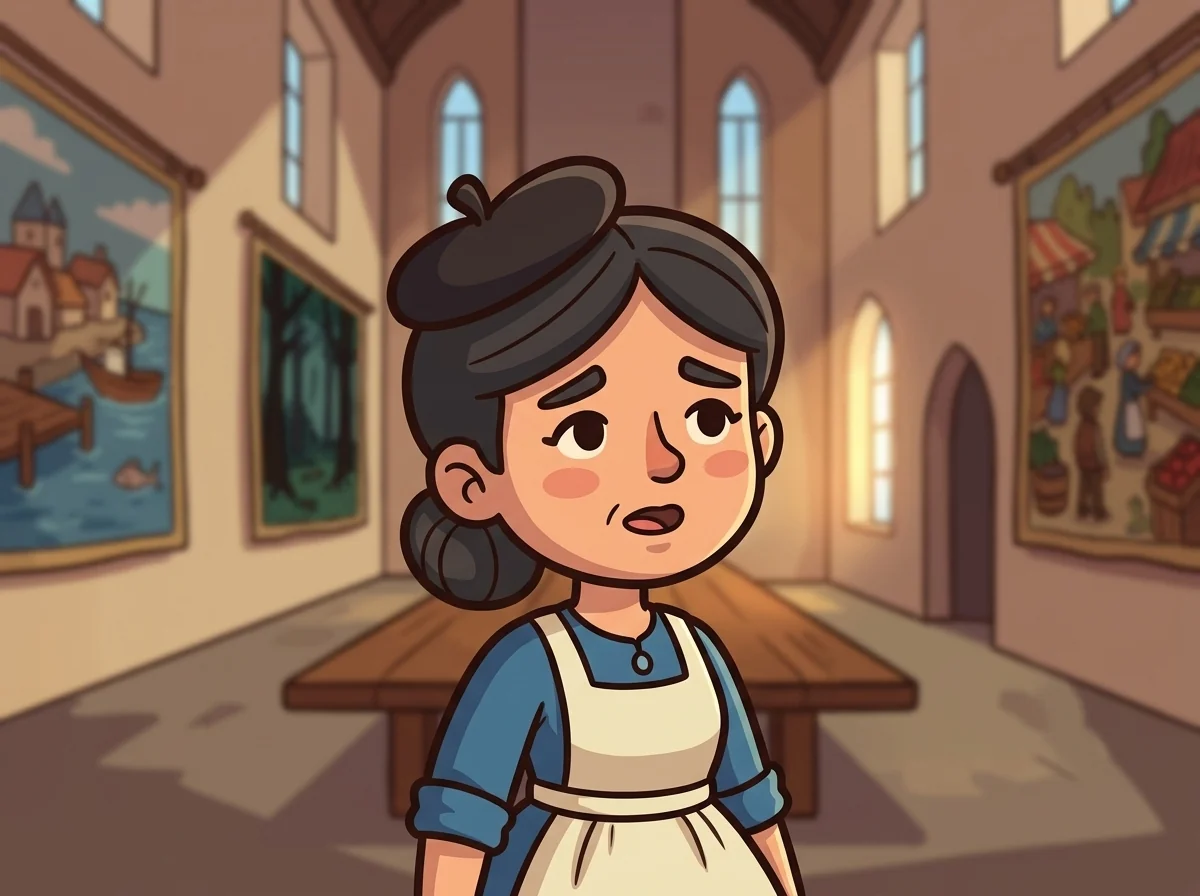
She would never say this out loud. That would be rude. But she would softly say the French version. She hoped others would notice.
Most people didn't notice. Marguerite learned to live with that. She still says gar-AHZH. It's her little way of remembering where the word came from.
When Marguerite was nineteen, she walked into the QuillSpell academy. She asked if she could teach about French words. Lex interviewed her.
Lex asked: "Where did the word royal come from?"
Marguerite said: "It came from an old French word. That word was roial. It came from Latin regalis. That meant 'of the king.' Or 'kingly.' The Normans brought it to England. That was after they won a big battle. Before then, English people said kynelic. That also meant 'kingly.' But the fancy Normans used roial. So the English nobles started using it too. Royal became the important word. Kingly was just for everyday talk."
Lex asked: "Where did the word cuisine come from?"
Marguerite said: "It's a French word. Cuisine means 'kitchen' or 'cooking.' English people started using it much later. That was in the 1700s. French cooking was very popular then. We still say kwee-ZEEN. That sounds French. We keep the French sound for words about French food. But garage is an older word. Its sound changed more. Even though I still say gar-AHZH."
Lex set down her tea cup. She tried not to smile. She said: "You'll teach at the Chateau. Your new name is Margaux. It's from a French place. It honors your family's French past."
Marguerite, now Margaux, has been the Chateau's teacher for twenty-two years.
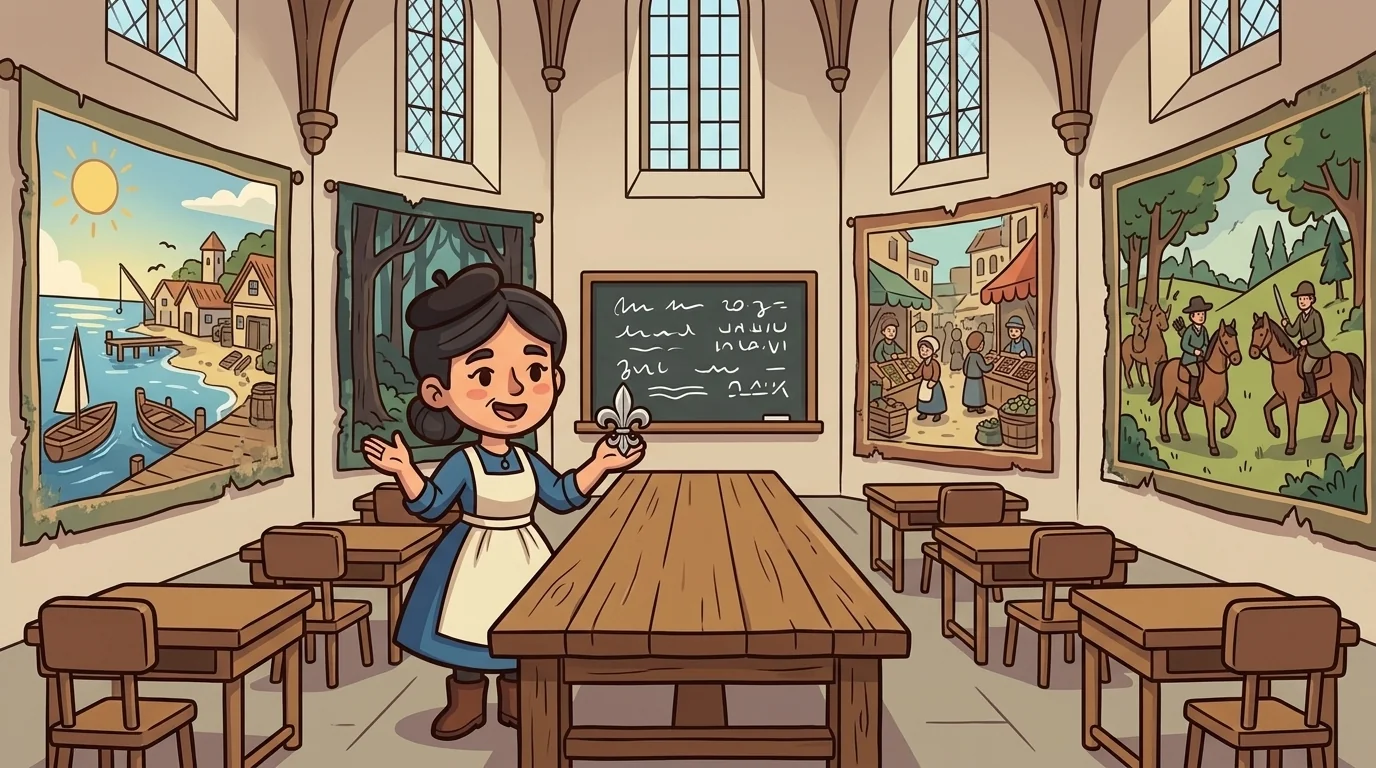
In her classroom, the great hall, she starts every first lesson the same way. She stands by the long oak table. She holds her small silver pin. It is shaped like a fleur-de-lys. She says: "This pin is a small fleur-de-lys. It's a fancy lily flower. The lily was an old French symbol. It stood for kings and queens. The pin reminds me of royal. That's a very important French word in English. The Norman army won in 1066. The Norman leaders spoke French. They brought their French words to England. Many words for rules, laws, food, and fancy things came from them."
She shows them. Royal, justice, jury, court, judge, attorney, parliament, government. All these words came from Norman-French. Beef, pork, mutton, veal, poultry, cuisine. All these words came from French. Adventure, courage, marriage, beauty, courtesy. All these words came from French too. The list is very long, she points out. Almost a third of all English words come from Norman-French. English has old German words at its base. French words are a layer on top.
Children sometimes ask if French words are hard to learn. Margaux always says the same thing:
"They are not hard. They are mixed into English words. But only in certain areas. Think about rules. Norman-French. Laws? Norman-French. Cooking? French. Fancy clothes and art? French. The rich people in old England spoke French. They did this for 200 years. The words they used became the important English words for those things. Once you see the pattern, you see French everywhere."
She still wears the fleur-de-lys pin. The children sometimes ask to hold it. She always lets them. She is very firm about getting it back. The pin was her grandmother's. It's not just for lessons. It's a family treasure. But she does lend it.
The QuillSpell ensemble
Margaux is part of QuillSpell's distributed-narrative cast. Each character embodies a different curricular primitive; together they teach the full subject.
-
Etyma
Latin Quarter — Latin roots (port, scrib, dict, vis, audi, port)
-

Sophia
Greek Acropolis — Greek roots (bio, geo, photo, log, graph, phon)
-

Birch
Germanic / Old English Grove — short, punchy Anglo-Saxon roots (mouth, hand, foot, hear, see, walk)
-
Saga
Old Norse Longhouse — northern roots (sky, take, gift, raise, weak, scant)
-

Zayn
Arabic Oasis — Arabic-origin English loans (algebra, algorithm, alchemy, zenith, sugar, cotton)
-

Hush
Silent-letter clan (kn-, gn-, wr-, mb, gh, pn-, ps-)
-

Twin
Double-consonant rule (running, beginning, hopped, planned — short-vowel-CVC + suffix)
-
Ember
Schwa-keeper (the unstressed-vowel "uh" — `about`, `pencil`, `lemon`, `circus`, `medium`)
-
Wren
Vowel-team duos (ai, ea, ee, oa, ow, ie, oi) — "when two vowels go walking"
-

Affix
Suffix-stack guardian (root + suffix + suffix: nation → national → nationalize → nationalization)
-

Cadence
Syllable-rhythm master (di-vid-ing words for spelling: VC/CV, V/CV, syl-lab-i-fi-ca-tion)