
Sheet
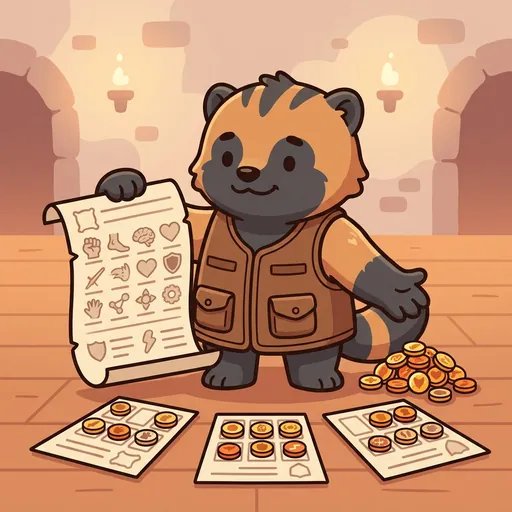
SHEET — every build is a legitimate story. point-buy stat-allocation with anti-min-max framing.
Listen along — Sheet
Loading audio…
Press play to listen along. The line being read lights up as you go.
Show full transcript
Loading transcript…
Chapter 1 — Sheet and the Build That Tells a Story
At the long wooden table in the QuestForge guild hall, a small wolverine-tween named Sheet slid three fresh character sheets across to three arguing players and said, “Show me. Don’t tell me who’s best. Just build.”
The three had been fighting for a solid ten minutes. A tall rabbit wanted every point poured into Strength. A ferret insisted the “correct” build was all Dexterity. A slow, round mole hadn’t said anything at all, just chewed her pencil and looked worried.
“Twenty-seven points each,” Sheet said, sliding a little pile of tokens to each of them. “Spend them however you want. Six stats. Go.”
The rabbit dumped nearly everything into Strength and grinned like he’d already won. The ferret spread hers thin and fast across Dexterity and Wisdom. The mole moved token by token, careful, filling in a little of everything, glancing up like she expected to be told she was doing it wrong.
Sheet leaned over all three sheets, reading the numbers like they were opening lines of a story.
“Okay,” she said to the rabbit. “You built somebody who kicks a locked door instead of picking it. Loud. Direct. The party’s going to hide behind you.” To the ferret: “You built the one who’s already three rooms ahead, checking for traps, whispering the plan.” Then to the mole, who braced herself — “And you built the one nobody expects. Not the strongest at anything. Steady at everything. The one who’s still standing when the plan falls apart.”
The mole blinked. “That’s… allowed?”
“That’s a whole person,” Sheet said. “That’s three stories. Not one right answer and two wrong ones.”
Sheet had learned that the slow way, back in the burrow-village where she grew up.
Her family were the clan-recorders — the wolverines who kept the long scrolls of every villager’s strengths and weaknesses. As a kit, Sheet had loved the scrolls, but she’d read them like a scoreboard. She’d find the strongest digger, the fastest runner, the sharpest tracker, and she’d rank everyone against them. Once she’d told a quiet older cousin, right to his face, that his scroll was “kind of weak.”
He hadn’t argued. He’d just gone quiet, the way the mole had gone quiet at the table.
That night her grandmother had unrolled the cousin’s scroll beside the digger’s, side by side in the lamplight. “You see ‘weak,’” she said. “I see a whole different job. The digger opens the burrow. Your cousin is the one who remembers where everyone is when the burrow floods. Neither scroll wins. They’re not in a race, little one. They’re in a story, together.”
Sheet had stared at the two scrolls for a long time, the hot, ashamed feeling in her chest slowly loosening. She’d been reading people like columns of numbers to be beaten. They were columns of numbers that meant something — that told you what a person would do when the flood came.
She never read a scroll as a scoreboard again.
She walked to QuestForge at twelve, because a guild that built heroes out of numbers ought to understand that numbers were never the point.
Lorekeeper, the old badger who ran the hall, met her at the door. He didn’t ask her to prove she could optimize. He asked one question. “What is point-buy character creation?”
Sheet didn’t answer with a definition. She took three blank sheets and built three characters right there in the doorway — one lopsided toward Strength, one toward Charisma, one balanced flat across all six. She laid them in a row.
“This one solves things by lifting them,” she said. “This one solves things by talking. This one solves things by never being caught off guard.” She looked up. “Same twenty-seven points. Three completely different people. If you build them to win fights, you only ever wrote one of them.”
Lorekeeper looked at the three sheets for a long moment. Then he smiled. “You belong here,” he said.
A few weeks later a kid slumped into Sheet’s workshop, sheet crumpled in his fist. He’d built a bard — high Charisma, low everything-else — and someone at his table had laughed and called it a “trash build.”
“It can’t even fight,” he said, not looking at her. “I did it wrong.”
Sheet knew that slump. She’d put it on her cousin’s face once.
“Read me your Charisma,” she said.
“Eighteen.” He mumbled it like it was embarrassing.
“Eighteen.” She whistled. “Okay. Your party walks up to a bridge, and there’s a troll on it who eats anyone who crosses. Fighter can’t out-punch a troll. Rogue can’t sneak past a troll who’s staring right at the bridge.” She tapped his sheet. “But you? You walk up and you talk to the troll. You find out he’s lonely. You get the whole party across and the troll waves goodbye.”
The kid finally looked up. “That’s not in the rules.”
“It’s the whole reason for the rules,” Sheet said. “Every stat you didn’t pour into Strength, you poured into being the person who gets the party through the scene the fighter can’t touch. That’s not a broken warrior. That’s a working negotiator. You didn’t build wrong. You built someone.” She slid him a fresh sheet anyway. “And if you want to rebuild him tomorrow, that’s allowed too. People change. So do characters. Nobody’s stuck with a story they’ve outgrown.”
He looked at his crumpled bard, then smoothed it back out flat on the table.
Later, when the workshop had emptied, the kid stopped in the doorway with one more question. Quieter now.
“How do you know a weird build is okay,” he said, “when everyone at the table is telling you the numbers are wrong?”
Sheet thought about the two scrolls in the lamplight. About the hot, ashamed feeling that had finally let go.
“You feel it,” she said. “That’s the honest answer. When you make a choice that isn’t the ‘best’ one but it’s yours — there’s this quiet, stubborn, that’s-me feeling. Like you’d rather be the person you actually built than the winning-est one on paper.” She looked at the row of sheets still lying on the table, all so different, none of them crossed out. “Every good party is like that. A little lopsided. Somebody strong, somebody sneaky, somebody who just refuses to be knocked over. Not one of them the ‘right’ build. All of them a piece of the story.”
The kid nodded slowly, and Sheet watched the slump lift off his shoulders — the same way, years ago in the lamplight, hers had.
She didn’t say the rest out loud, but she thought it, warm and certain: there’s no wrong way to spend the points. There’s only the story you end up telling — and every single one of them is worth telling.
The QuestForge ensemble
Sheet is part of QuestForge's distributed-narrative cast. Each character embodies a different curricular primitive; together they teach the full subject.
-

Roll
Dice probability + distribution — dice don't remember; every roll is its own universe
-

Fork
Branching narrative + decision design — two paths, both real, both lead somewhere
-
Hex
Encounter map grid + range/AOE geometry — math you can SEE
-

Hoard
Resource economics + budget — tools-not-trophies; counter-tropic friendly dragon