
Skip
SKIP-COUNTING AND MULTIPLES — counting forward by fixed steps (2, 4, 6, 8…) instead of by ones. Multiplication is skip-counting compressed into a single operation: 4 × 7 means counting by sevens, four times.
Press play to listen along. The line being read lights up as you go.
Show full transcript
Loading transcript…
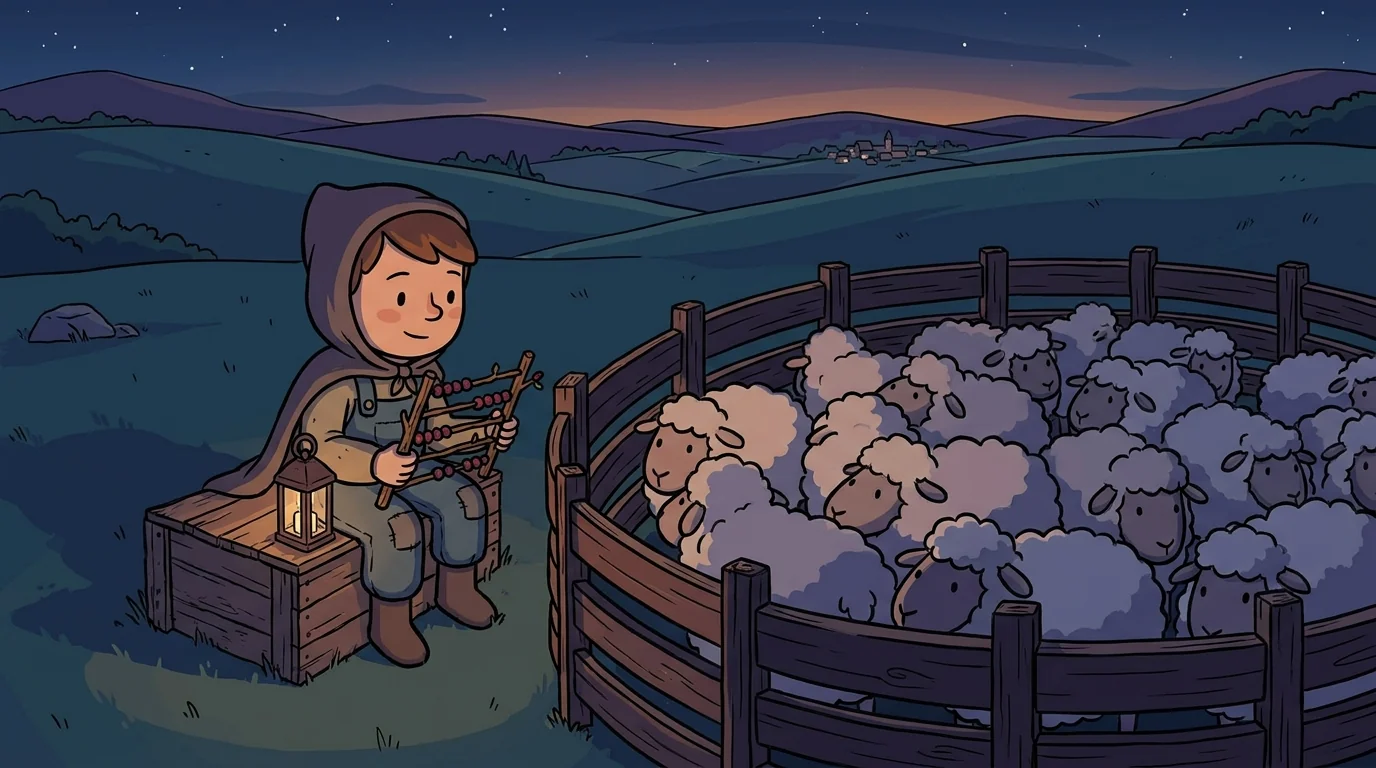
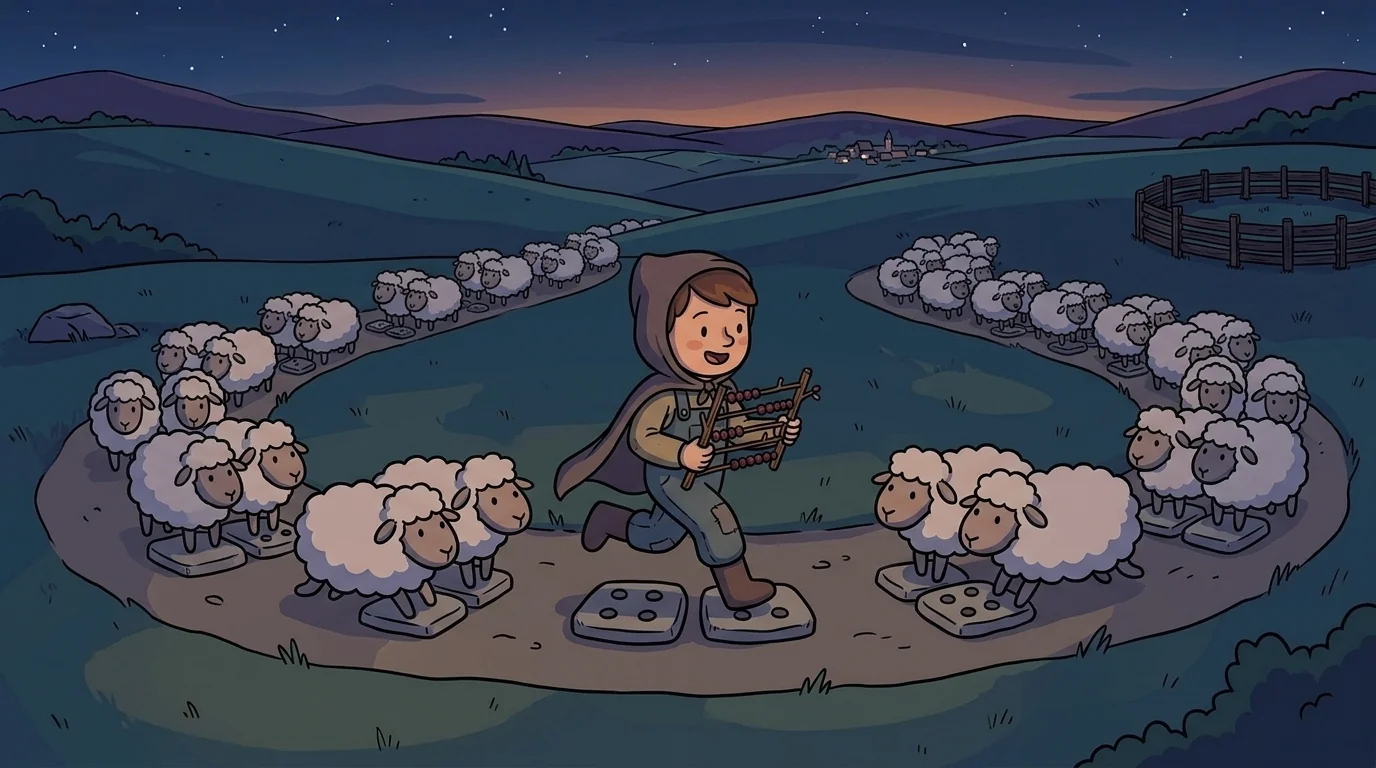
Skip grew up as a shepherd.
This is, in the kingdom — which has more towns than fields and more shopkeepers than farmers — unusual. Most academy children grow up in towns. Most academy faculty grow up in counting-houses, scribe-halls, or workshop families. Skip grew up in open hill-pasture, ten miles east of the small village of Tally, with her family's flock of three hundred and forty-two sheep.
She does not, even today, remember a time when she did not count sheep.
The job of counting the sheep fell to whichever family member was awake first, which from the time Skip was six was always Skip. Sheep, in the family's tradition, were counted in the pre-dawn dark — before they left the night-pen, before they spread out across the pasture, when they were still bunched together and could be counted accurately.
Three hundred and forty-two sheep is a lot of sheep to count.
In the pre-dawn dark.
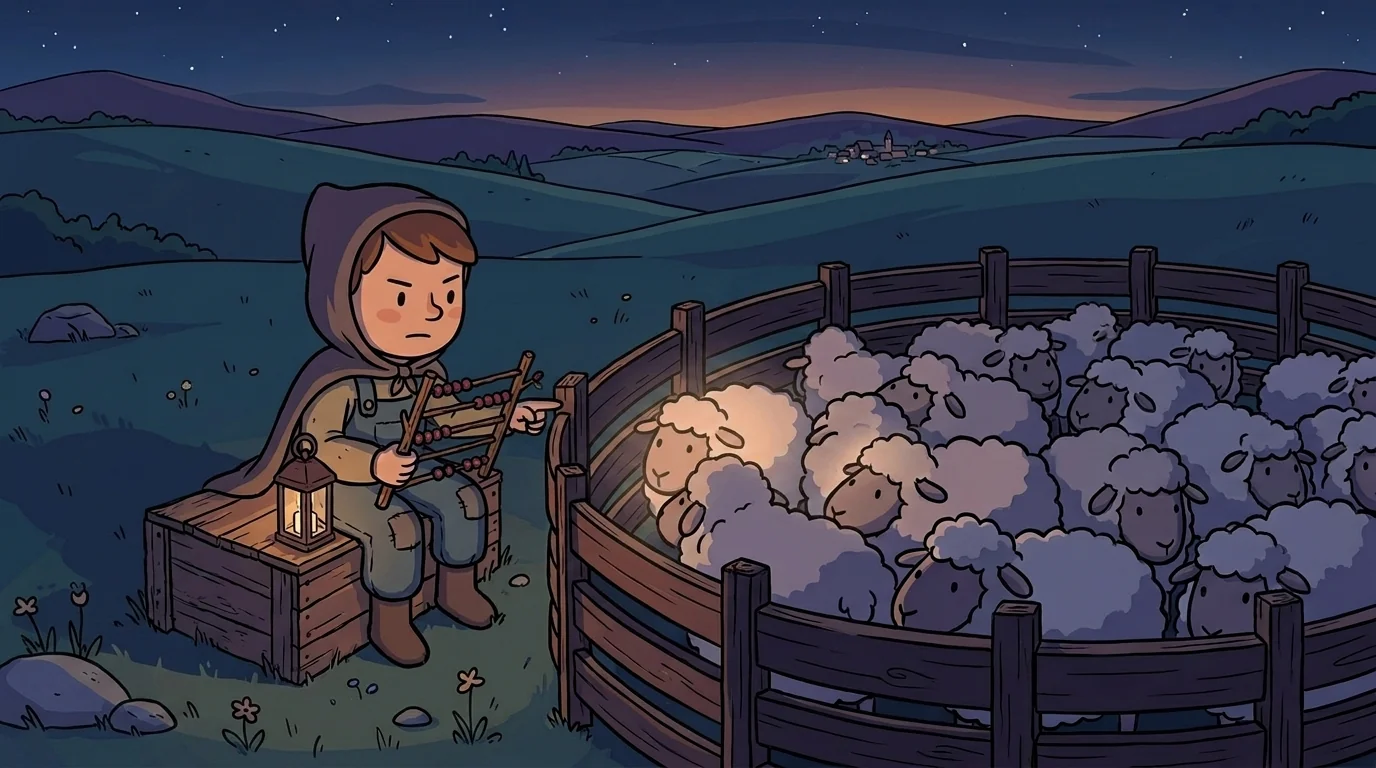
When you are six.
Skip — whose given name was Wren, though she had been called Skip since she was nine — started out, of course, counting one at a time. One, two, three, four, five… The sheep moved. The count was easy to lose. The count was hard to recover. By the time Wren was eight she could count to a hundred reasonably well, but she was bored.
She started to cheat. She did not, at first, call it cheating. She called it speeding up.
She would count one, two, then point at the next two sheep and say three, four. Then she would point at the next two and say five, six. The sheep had not changed. The count had changed. She was counting two at a time. By twos.
She tried it the next morning. It worked. She got to a hundred sheep in fifty counts. She still got to a hundred. The sheep had not noticed.
She tried counting by threes. She tried counting by fives. By the time she was nine her father — who had thought about teaching Wren formal arithmetic and had decided she did not yet need it — heard her one morning at the night-pen reciting:
"Seven, fourteen, twenty-one, twenty-eight, thirty-five, forty-two, forty-nine, fifty-six, sixty-three, seventy, seventy-seven —"
He stopped. He listened. He had never heard a nine-year-old count by sevens at speed.
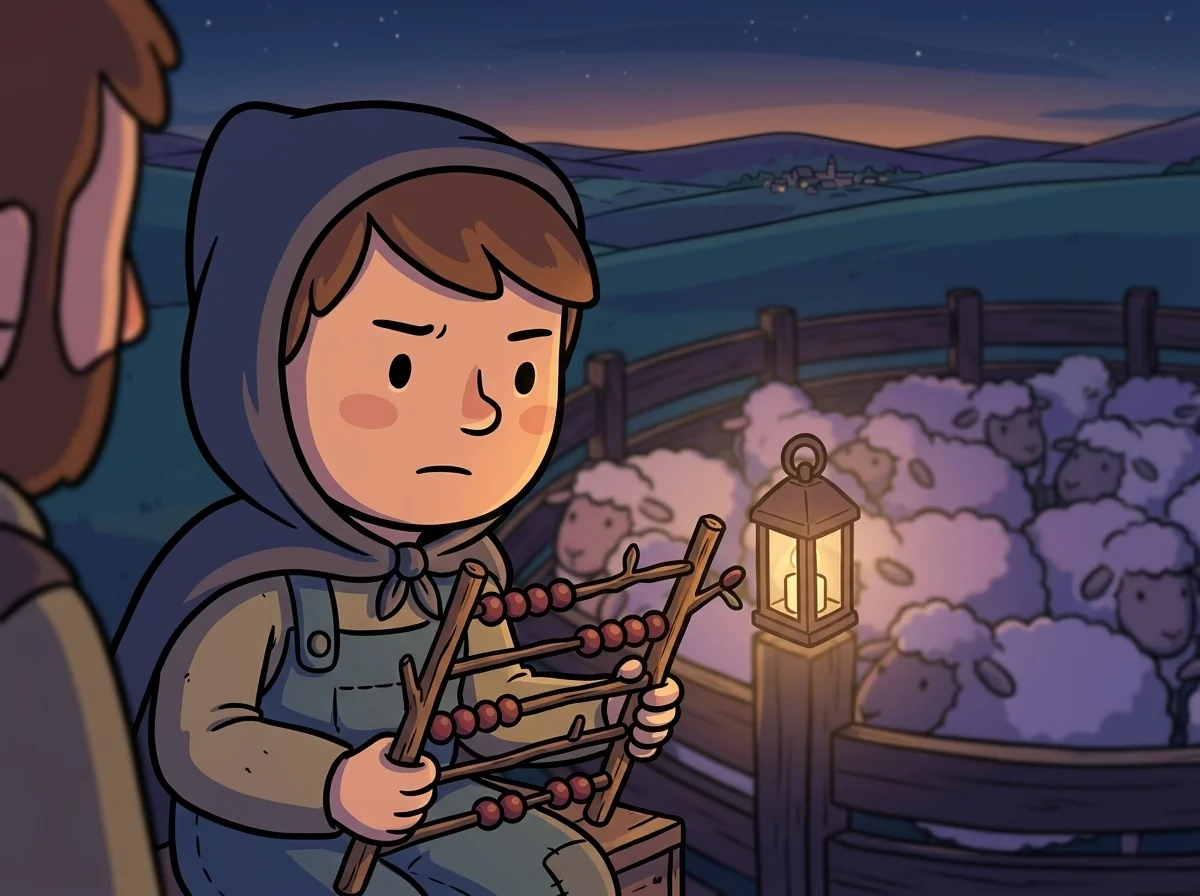
He said: "Wren. How did you learn that?"
Wren said: "It is faster. The sheep do not know the difference. I count by sevens. I get to three hundred and thirty-six in forty-eight counts. Then I count the last six sheep one at a time. The whole flock takes me about half as long."
Her father, who was not an academy man but was a thinking man, sat down on the night-pen fence. He said: "Wren. You are doing multiplication."
Wren did not know this word. She said: "What is multiplication?"
Her father said: "It is when you count one number a certain number of times. Forty-eight sevens is three hundred and thirty-six. Which is what you just said. You are multiplying forty-eight by seven without writing it down."
Wren said: "I am only skipping."
Her father smiled. He said: "Yes. Skipping is multiplication. They are the same thing. The academy people write it 48 × 7 and they get the same answer. You are doing it in your head while you count sheep. That is the same operation."
Wren considered this. She said: "What about 48 × 8?"
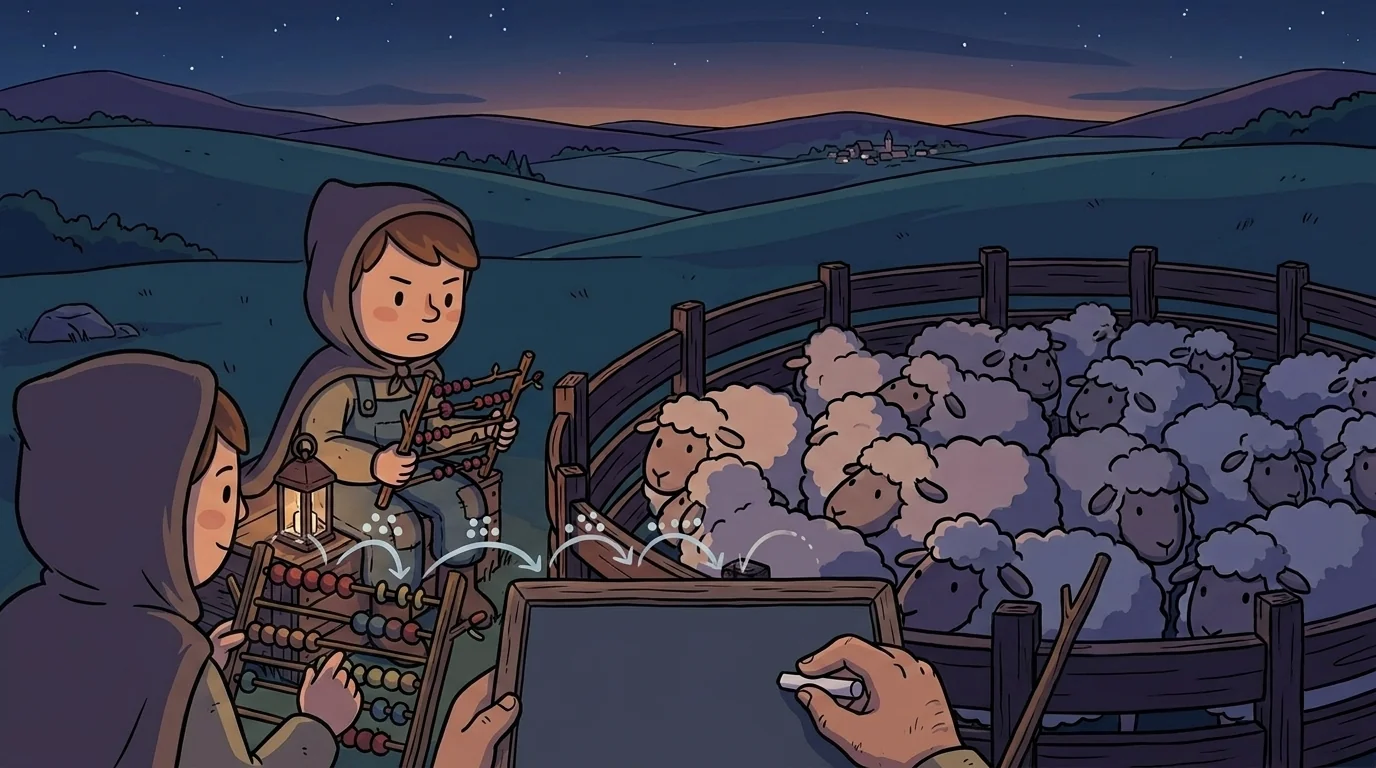
Her father said: "Try it. Count by eights forty-eight times."
Wren did. She got to three hundred and eighty-four. (She started over twice; eights are harder than sevens.) Her father wrote 48 × 8 = 384 on a slate. The two answers agreed.
Wren was hooked.
By the time she was thirteen she could count by any number up to twelve. By the time she was fifteen she could compute any times-table answer for digits one through twelve, in her head, without paper. The family stopped asking her to count sheep; they had her compute the family's grain requirements instead.
When she was eighteen she encountered the academy through a travelling scholar. The scholar said: "You should not be counting sheep. You should be teaching multiplication." Wren had not thought of this. She thought about it. The next year she walked the ten miles to Tally, took the wagon to the next town, then a boat to the academy capital. She arrived. She demonstrated. She was admitted.
She has been at the academy for thirteen years. She is now called Skip — even by her father, who visits twice a year. She still calls multiplication skipping. The academy has, over the years, come to use her terminology with younger children, because younger children understand skip-counting before they understand multiplication. It is the same operation. Skip's word is the kinder one.
In her classroom, she begins every first-day lesson the same way. She writes on the board: 2, 4, 6, 8, 10. She says: "What comes next?"
The children — always — say twelve.
Skip says: "Yes. How did you know?"
The children — always — say they were skipping by twos.
Skip says: "That is multiplication. Multiplication is skipping. Two times five is ten, because you skip by two, five times, and you land on ten. There is no other secret. The whole times-table is built this way."
The children — always — look surprised. They had been told multiplication was a difficult thing. Skip is telling them it is just skip-counting, which they have been doing since they were five.
Skip smiles. She is energetic, forward-leaning, often counting under her breath when she is bored. She says: "It is not a difficult thing. It is just faster than counting one at a time. Sheep taught me. The sheep are still in the hills counting themselves, very slowly, one by one. They do not yet know about skipping."
When children ask whether multiplication is hard, Skip always says the same thing:
"It is not hard. It is just skipping. Pick a number to skip by. Count how many skips. The landing place is the answer. That is everything about multiplication."
She still goes home to Tally twice a year. She still counts the sheep — but only at supper, with her father, and only as a joke. The sheep, she has noticed, are very much the same.
The Numberverse ensemble
Skip is part of Numberverse's distributed-narrative cast. Each character embodies a different curricular primitive; together they teach the full subject.
-

Tenfold
Place value — powers of 10, positional notation
-

Zeph
The zero placeholder — its load-bearing role in positional notation
-

Mirror
Negative numbers — reflection across zero on the number line
-

Tug
Inverse operations — addition ↔ subtraction (and the same idea for × ↔ ÷) as opposite pulls on the same line