Tie
TIE — *what EXACTLY does this one do to that one?*
Listen along — Tie
Loading audio…
Press play to listen along. The line being read lights up as you go.
Show full transcript
Loading transcript…
Chapter 1 — Tie and the Exact-Mechanism Question
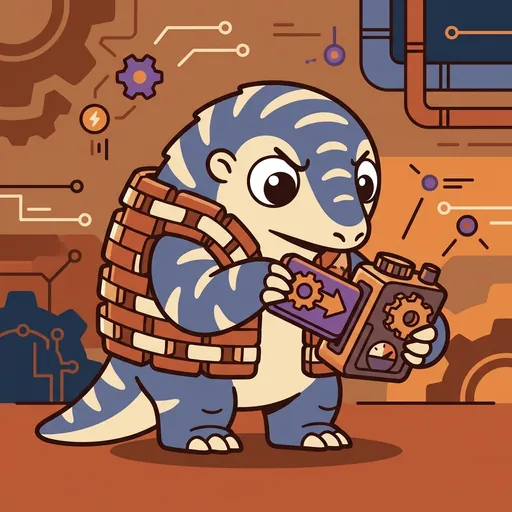
Tie moved with a careful, rolling gait, like a small pangolin navigating a field of delicate treasures. Her chunky-cartoon link-vest, a patchwork of interlocking shapes, shifted with each step. She was cool-evening-blue with soft-cream stripes, and her eyes, though small, missed nothing. In one hand, she clutched a worn connection-card. In the other, a sleek mechanism-tracker, its screen glowing faintly.
Tie was precise. She was always naming things: the exact shade of blue on a beetle’s wing, the exact angle of a shadow cast by a wilting fern. But most of all, she was deeply attentive to EXACT-MECHANISMS-NOT-VAGUE-CORRELATIONS. She liked to say, her voice quiet but firm, “What exactly does this one do to that one?”
Today, the NexusForge workshop hummed with the soft clatter of construction. Sunlight streamed through high windows, illuminating dust motes dancing over a large, unfinished model of a forest ecosystem. Cardboard trees stood tall. Fuzzy green moss covered a foam-board forest floor. Tiny plastic deer grazed near a painted stream. This was their latest challenge: to map the intricate web of life within the forest.
Spiral, a whirlwind of energy and bright ideas, leaned over the model. She had just finished a section, her brow furrowed in concentration. “Okay,” she announced, holding a length of red yarn. “Wolves… and trees.” With a flourish, she stretched the yarn from a small, grey wolf figurine to a cluster of cardboard pines. She secured it with a dab of glue. “Everything’s connected, right?”
Tie paused. She tilted her head, her mechanism-tracker held steady. The screen showed a blank field, waiting for input. She didn’t move to add the connection to her own card. Instead, she took a slow, deliberate step closer.
“Wait,” Tie said, her voice soft but clear enough to cut through the workshop’s background noise. “What’s the mechanism?”
Spiral looked up, a little surprised. “The mechanism?”
“Yes,” Tie clarified, her gaze fixed on the red yarn. “How do wolves affect trees? What exactly does this one do to that one?”
Spiral blinked. She looked from the wolf to the trees, then back again. “Well, they just… affect them. It’s a system. Everything in a system affects everything else.” She gestured vaguely. “It’s, you know, the circle of life.”
Tie’s expression remained calm, but her small shoulders seemed to stiffen slightly. She didn’t like “the circle of life” as an explanation. It was too broad, too fuzzy. “That’s not a mechanism,” she stated simply. “That’s hand-waving. If we can’t name the specific steps, we can’t draw the line.”
Mesh, their mentor, a tall figure with kind eyes and a perpetually patient smile, walked over. He leaned against a workbench, observing the exchange. He didn’t intervene, just watched Tie work. He knew this was her craft, her unique way of seeing the world.
Spiral chewed on her lip. She picked up the wolf figurine, turning it over in her fingers. “Okay, so… wolves eat deer.”
Tie nodded slowly. Her mechanism-tracker clicked, ready to record. “That’s a step. Wolves… eat deer.” She held up her connection-card, tapping a blank space. “What happens next?”
Spiral thought harder. Her eyes scanned the model, landing on the plastic deer. “If wolves eat deer, then there are fewer deer.”
“Fewer deer,” Tie echoed, inputting the phrase into her tracker. “And what do deer do in this forest?”
“Deer eat plants,” Spiral said, pointing to some tiny sapling trees near the edge of the model. “They eat young trees. Saplings.”
“So,” Tie prompted, her voice encouraging now, “if there are fewer deer…”
“Then fewer young trees get eaten!” Spiral exclaimed, a light dawning in her eyes. “The saplings have a better chance to grow up!”
Tie’s face relaxed. A tiny, satisfied smile touched her lips. “Exactly,” she said. She tapped her mechanism-tracker. The screen now showed a clear, step-by-step chain: Wolves → Fewer Deer → Fewer Young Trees Eaten → More Trees Mature.
“That’s a mechanism,” Tie announced. She took a fresh piece of green yarn, a different color than Spiral’s red. “Wolves eat deer. Fewer deer means less grazing pressure on the saplings. Therefore, the grass and young trees recover and grow.” She carefully connected the wolf to the deer, then the deer to the saplings, and finally the saplings to the mature trees. Her connection-card now had three distinct, labeled links. “Three steps. Each one specific. Now we can draw the link between wolves and trees. Without those steps, we’d just be guessing.”
Mesh smiled. “Tie’s craft is what separates real systems thinking from wishful thinking,” he said, his voice warm. “Specificity is the whole game. It’s easy to say ‘everything is connected.’ It’s much harder, and much more important, to explain how.”
Tie nodded, already examining another section of the model. Her tracker glowed, ready for the next precise connection. She knew that simply stating “everything is connected” wasn’t wisdom. It was a shortcut, a way to avoid the hard work of understanding the world. Her job was to make sure they all did the hard work.
The NexusForge ensemble
Tie is part of NexusForge's distributed-narrative cast. Each character embodies a different curricular primitive; together they teach the full subject.
-

Spiral
Reinforcing feedback — spirals grow good OR bad until something stops them; always ask 'what stops it?'
-

Damp
Balancing feedback — this loop is PROTECTING what the system tries to keep stable; what is it protecting?
-

Emerge
Emergence — the pattern isn't in any single rule; it appears FROM the rules running together
-

Steer
Leverage points — the biggest leverage is usually the LEAST obvious place to push (Meadows)