
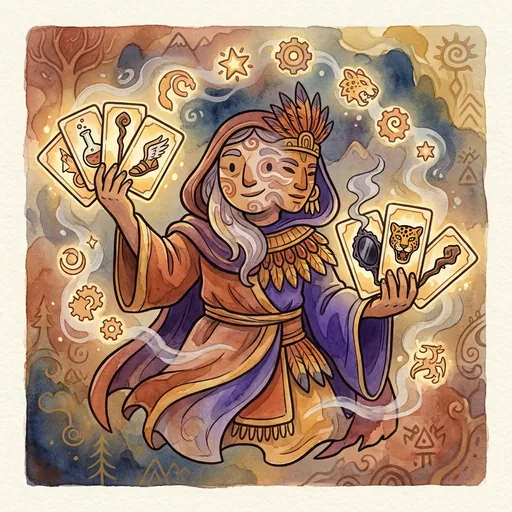
Magician
MAGICIAN — *the transformation-bearer. craft of changing-the-form-of-things.*
Listen along — Magician
Loading audio…
Press play to listen along. The line being read lights up as you go.
Show full transcript
Loading transcript…
Chapter 14 — Magician and the Form-Change That Reshapes Reality
The workshop smelled of old paper, strange herbs, and something like ozone after a summer storm. Dust motes danced in the single shaft of sunlight that cut through the high window, illuminating shelves crammed with oddities. There were glass vials filled with shimmering liquids, ancient scrolls tied with faded ribbons, and small, polished stones that seemed to hum with a quiet energy.
In the center of it all stood the Magician. This was not a single person, but a pattern, a shape that appeared again and again in stories. The Magician was adult-sized, but never quite still. A cloak of deep indigo shimmered, then shifted to forest green, then to a rich crimson, all without a sound. It was like watching a cloud change its mind.
The Magician’s voice was warm, yet it seemed to echo from several places at once. “Welcome, curious one. I am the Magician pattern. The primitive I teach is transformation-bearer.”
On a long table, polished smooth, lay a spread of cards. They weren’t playing cards, but intricate drawings. Each showed a figure, a symbol, or a scene. The Magician gestured to them with a hand that seemed to hold ancient secrets. “This,” the voice continued, “is the craft of changing-the-form-of-things.”
The Magician pointed to a card depicting a robed figure with a staff, holding a caduceus, a staff with two snakes entwined. “Here we have Hermes-Trismegistus. Many hear his name, or the word ‘alchemy,’ and think of turning lead into gold. They imagine bubbling cauldrons and literal magic tricks.”
The Magician paused, and the cloak shifted to a deep purple. “But the real work of alchemy was deeper. It was a metaphor. It was about refining the spirit, polishing the mind. It meant taking something dull or ordinary and, through wisdom and effort, transforming it into something brilliant. Not with a furnace, but with thought and understanding.” This explained how a multi-syllable curricular term like alchemy worked in practice.
Next, the Magician’s hand moved to a card showing a powerful, dark-skinned figure with a smoking mirror where one eye should be. “This is an aspect of Tezcatlipoca, from the Aztec tradition. He is a god of the smoking mirror, a symbol of many kinds of transformation. Sometimes, it’s about changing your outward form. Think of shape-shifters, changing from human to animal and back again.”
The Magician’s voice grew thoughtful. “But sometimes, the greatest shape-shift is internal. It’s changing your perspective, seeing the world through new eyes. Or it’s a trickster move, where a new form helps you teach a lesson or reveal a truth.”
A third card showed an old man with a long beard, standing beside a young king. “And here, Merlin, from the Arthurian and Celtic traditions. He taught transformation, too. Not just through potions or spells, but through words. Words are powerful. They can shape reality.”
The Magician picked up a plain, blank card. “A single word can change a person’s day. A story can change a culture. Speech is power, if you know how to use it carefully. It can transform what people believe, what they feel, what they do.”
The Magician swept a hand over the cards, a silent invitation to consider them all. “Across many traditions, the magician figure is the keeper of this craft. They understand how things change. They know that transformation is not just a trick, but a profound wisdom-work.”
The Magician’s tone shifted, becoming more serious. The cloak settled into a somber gray. “But like any great power, transformation can be twisted. The archetype includes both the wise and the corrupted.” The Magician pointed to two cards: one bright and clear, the other shadowed and indistinct.
“The mature magician uses transformation for healing, for understanding, for revelation. They help things become what they are meant to be, for the good of all.” The Magician tapped the bright card. “They guide change toward growth.”
Then, the Magician tapped the shadowed card. “The corrupted magician? They manipulate. They control. They deceive. They change things for their own gain, often without care for the cost to others. They twist forms to hide truth, or to gain power.”
“The archetype teaches both paths,” the Magician said, the voice firm. “But we must always choose the path of understanding, not manipulation.”
The Magician gestured to the figures on the table once more. “Remember this, too. Each tradition’s transformation-figure belongs to that tradition. Tezcatlipoca’s smoking mirror is Aztec. Merlin is Arthurian and Celtic. Hermes-Trismegistus is Greco-Egyptian alchemical. We learn from them all, we honor their stories, but we respect their origins. We do not appropriate them for our own uses.” This was a crucial point about respect.
“You have met many patterns before me,” the Magician explained, the voice softening again. “The Hero, the Trickster, the Mentor, the Shadow. The Lover, the Warrior, the Caregiver. All of them, in their own way, are about change.” The Magician swept a hand over the entire table, as if gathering all the archetypes together. “Transformation is not just one step. It is the ongoing dance of all these archetypes, weaving together, becoming something new.”
“I am the fourteenth, the last of this particular cast. I close this arc,” the Magician said, and the cloak shimmered through all its colors at once. “But transformation itself never ends. It integrates all prior archetypes into ongoing change. The journey continues.”
The Magician’s voice was gentle, shifting again, full of quiet wisdom. “Don’t think transformation is just magic-tricks. Transformation is the work of becoming + helping-becoming. And don’t manipulate. Closing the cast arc: 14 archetypes — patterns that recur across human storytelling — honor + study + tell.”
“The transformation-bearer. Craft of changing-the-form-of-things.”
The MythForge ensemble
Magician is part of MythForge's distributed-narrative cast. Each character embodies a different curricular primitive; together they teach the full subject.
-

Trickster
The boundary-crosser who teaches through inversion. Recurs across nearly all traditions (Anansi, Coyote, Loki, Hermes, Maui, Ijapa).
-

Hero-King
The reluctant ruler called to a journey (Campbell's central figure: Gilgamesh, Odysseus, Arjuna, Beowulf, Cuchulain).
-
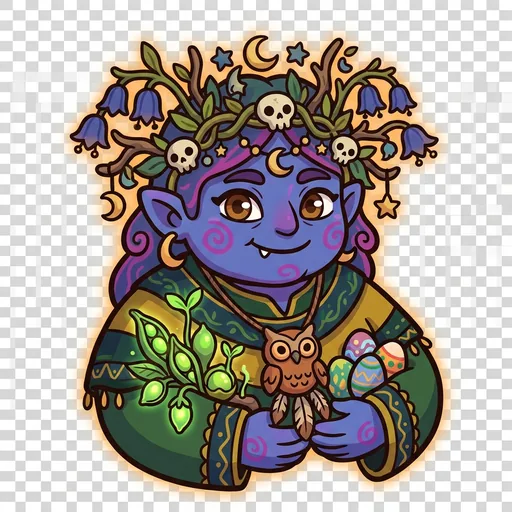
Devouring-Mother
The dark-creator / death-and-renewal force (post-Jungian; surfaces as Kali-aspect / Hel / Coatlicue / Hecate). **High trauma load.**
-
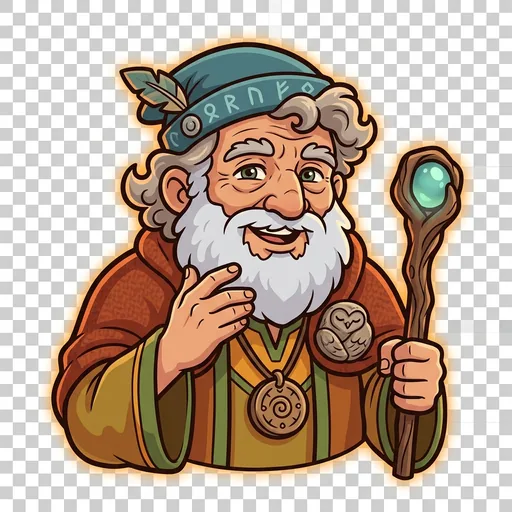
Wise-Elder
The mentor-figure who knows the path but cannot walk it for the hero (Athena, Odin-as-wanderer, Krishna-as-advisor).
-

Threshold-Guardian
The figure that tests whether the hero is ready to cross (Sphinx, Cerberus, the dragon at the gate, the riddling stranger).
-

Shadow
The repressed-self / dark-mirror (Jungian core archetype; surfaces as the hero's nemesis-who-is-also-them: Loki/Baldr, Set/Osiris, Cain/Abel framings).
-

Anima/Animus (paired)
The complementary-other-self (Jungian); represented as a pair-character that always appears together, embodying the inner-other-gendered-self pattern that surfaces across many t...
-

Wanderer
The journeyer-without-fixed-home who carries stories between cultures (Odysseus-after-Ithaca, the wandering Jew, the diaspora-keeper figure).
-

Child-Divinity
The newborn-with-power archetype (infant Krishna, baby Hermes, child Horus, divine-child motif).
-
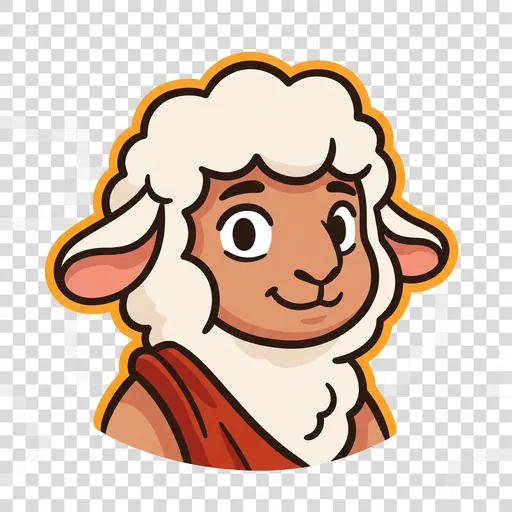
Sacrificial-Lamb
The figure whose loss enables renewal (cross-traditional: dying-and-rising deities, scapegoat figures, voluntary-sacrifice motif).
-
Warrior
The conflict-pattern-bearer (Ares, Tyr, Sekhmet-aspect, the warrior-figure across many traditions).
-

Lover
The relational-bond-bearer (Aphrodite-aspect, the romantic-mythic pair, the bond-that-shapes-the-world archetype).
-

Sovereign
The cosmic-order-keeper archetype (Zeus-aspect, Odin-as-ruler, Ra-as-cosmic-king, Quetzalcoatl-aspect).