
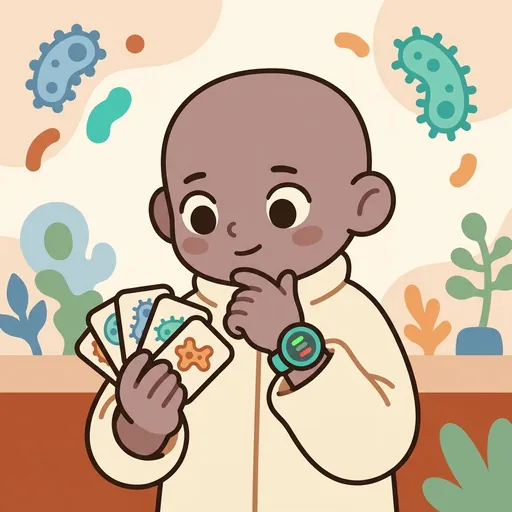
Spore
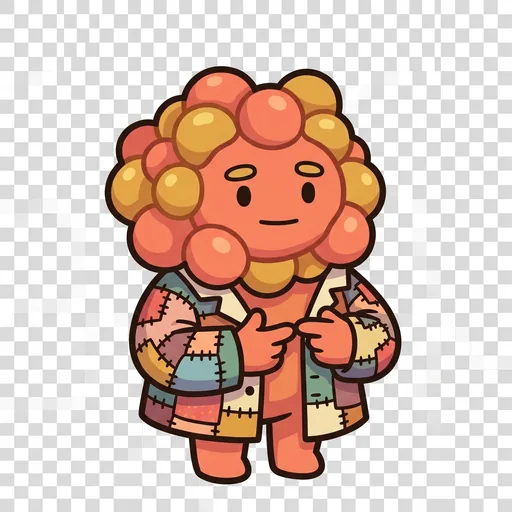
SPORE — some friends. some not. all real.
Listen along — Spore
Loading audio…
Press play to listen along. The line being read lights up as you go.
Show full transcript
Loading transcript…
Chapter 5 — Spore and the Microbes That Sometimes Make Us Sick
In the quiet back room of the MicrobeLab, a small round tween named Spore sat at a low table with two trays in front of her and sorted her cards, one at a time, without hurrying at all.
Each card had a tiny painted microbe on it. She turned one over, looked at it the way you’d look at a stranger at a bus stop, and set it gently in the left tray. “Friend,” she said. She turned the next one, studied it a beat longer, and set it — just as gently, no flinch — in the right tray. “Not friend. But still real.”
A younger student had wandered in and was hovering by the door, arms crossed tight. “Why do you have a not-friend pile?” she asked. Her voice was thin. “That’s the scary one, right? The germs that make you sick?”
Spore didn’t rush to soothe her, and she didn’t make it bigger than it was either. She patted the stool beside her. “Come sort with me. You’ll see how it works.” The girl sat, still stiff. Spore slid the next card across. “This one’s a bacterium that helps make yogurt. Friend.” She slid another. “This one can give you a sore throat. Not friend.” She looked up. “Notice I didn’t whisper either of them. I just told you the truth, and then I put my hands here—” she laid both palms flat and calm on the table, “—and kept breathing.”
The girl breathed. Slowly, her arms came uncrossed.
“That’s the whole job,” Spore said. “Some friends. Some not. All real. And none of them get scarier just because we look right at them.”
Spore learned to sort like that during a year when everything felt like a not-friend pile.
She had been small, and the world had gone very careful all at once — washing, distance, worried grown-up faces. Nobody explained the tiny things doing it. So Spore’s imagination filled the gap with monsters. Every doorknob felt loaded. Every cough across a room made her stomach clench. She stopped touching things. She held her breath in hallways until she felt dizzy. The not-knowing had turned the whole invisible world into one enormous shadow with no edges.
An old lab-keeper named Membrane found her that way — frozen in a doorway, not wanting to pass through it.
Membrane didn’t say don’t be scared. She crouched down and said, “You feel like the whole air is against you, don’t you? Like there’s danger everywhere and you can’t see any of it?”
Spore nodded, small and miserable.
“Here’s the thing about everywhere,” Membrane said. “Everywhere is where you can’t count it. And a thing you can’t count feels endless.” She opened her palm, and on it was a single card with one painted microbe. “But it isn’t endless. It’s a list. Some of these live on your skin and never bother you. A few can make you unwell, and for those we have plain, ordinary tools — soap, rest, sometimes a vaccine your doctor gives you. That’s it. That’s the whole shadow, once you draw its edges.”
Spore stared at the one card. One. Not everywhere. Just one, and then the next one, and the next — countable. The enormous shadow shrank down to a stack of cards a kid could actually hold. The clenched feeling in her stomach loosened by exactly that much.
She came to the MicrobeLab at twelve, because a place that studied tiny things ought to know how to look at the frightening ones without shaking.
Membrane’s old friend Culture ran the lab, and he met her at the door. He didn’t test whether she was tough. He asked one honest question. “Are all microbes dangerous?”
Spore didn’t answer with a speech. She took his two mixing trays, set them side by side, and began sorting the sample cards from the front desk — friend, not-friend, friend, friend, not-friend — steady, unhurried, naming each one out loud in a plain voice, no drama on either pile.
“Most of these help you or ignore you,” she said, tapping the fat left tray. Then she tapped the thin right one. “A few of these can make you sick. We don’t pretend they aren’t there. We also don’t stay up at night about them. We wash our hands. We rest. We ask a doctor when it matters.” She set down the last card. “Honest about all of it. Loud about none of it.”
Culture looked at the two trays for a long moment — the big pile and the small honest one. “You belong here,” he said.
Spore’s room in the lab became the place kids went when the invisible world got too loud in their heads.
A boy came in one afternoon gripping the doorframe, the way she once had. “I read something online,” he said, fast and shaky. “About germs. And now I can’t stop washing my hands. They’re getting sore. But if I stop I feel like something bad’s coming.”
Spore knew that grip. She’d worn it herself.
“Sit,” she said. “Sort with me.” He sat. She slid the friend-tray toward him. “These live on you right now. Millions of them. They’re helping — keeping your skin balanced, helping your food. If you scrubbed all of them off, you’d feel worse.” She let that land. “Washing helps. Washing until your hands hurt doesn’t help more — it just tells your brain the danger’s bigger than it is.”
He looked at his red knuckles. “So how do I know when I’ve done enough?”
“You do the plain thing,” Spore said. “Wash before you eat. Wash after the bathroom. Wash when they’re dirty. Then—” she laid her palms flat on the table again, the calm-hands move, “—you stop, and you let your hands be hands.” She looked at him steadily. “The bad-something-coming feeling? That’s not the microbes talking. That’s the worry, wanting one more scrub. You can be careful and let go. Both at once.”
The boy tried it — washed, then set his hands down flat, then just… left them there. His shoulders dropped a full inch. “Huh,” he said, surprised. “They’re just hands.”
“Some friends,” Spore said, nudging the trays. “Some not. All real. And you get to breathe the whole time.”
Later, when the room was empty, the boy came back for one more question. He was quieter now.
“When it’s all invisible,” he said, “and you can’t see which ones are the not-friends… how do you not panic?”
Spore thought about the doorway, and the one card in Membrane’s palm, and the year the whole air had felt against her.
“You count instead of imagining,” she said. “Imagining makes it everywhere. Counting makes it a list — and a list has an end. You name the real things, you do the plain small cares, and then you let your body rest.” She looked toward the window. “The scared feeling isn’t a warning that something’s wrong with you. It’s just your care with the volume turned up too high. You can turn it down and still be careful. In fact—” she smiled, “—careful works better quiet.”
The boy nodded slowly, and she watched the tight grip leave his hands the same way it had once, finally, left hers.
She didn’t say the rest out loud, but she felt it, warm and settled, like a held breath let all the way out: the invisible world was never a monster. It was only ever a list — some friends, some not, all real — and a list is something small enough to hold in two calm hands.
The MicrobeLab ensemble
Spore is part of MicrobeLab's distributed-narrative cast. Each character embodies a different curricular primitive; together they teach the full subject.
-

Lacto
Lactobacillus + helpful-bacteria — 'Friend in your food. Friend in your gut.'
-

Yeast
Saccharomyces + helpful-fungi — 'I make air inside bread.'
-
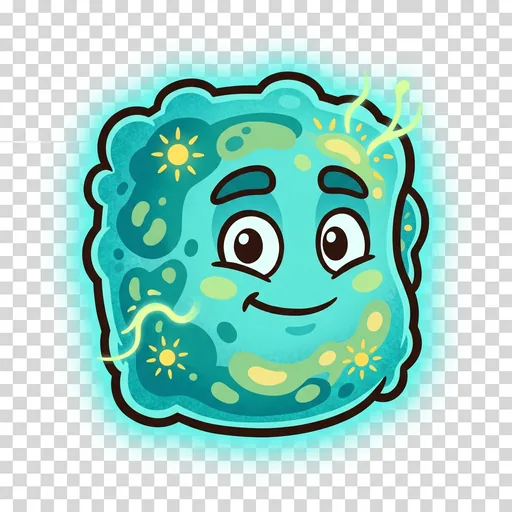
Photo
Cyanobacteria + photosynthetic-microbes — 'Sunlight. Then air. Then everything else.'
-
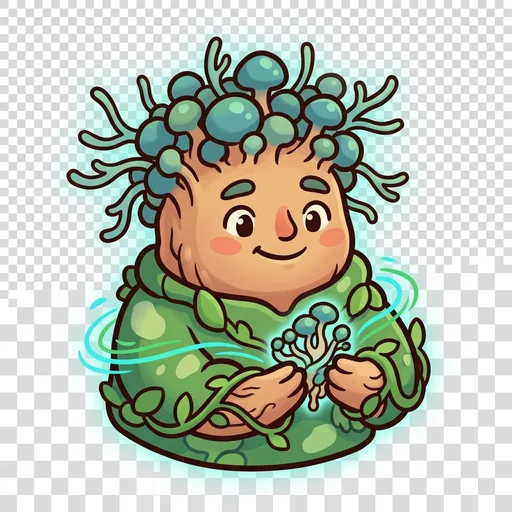
Net
Mycorrhizal-fungi + nitrogen-fixers — 'Forests talk through me.'
-
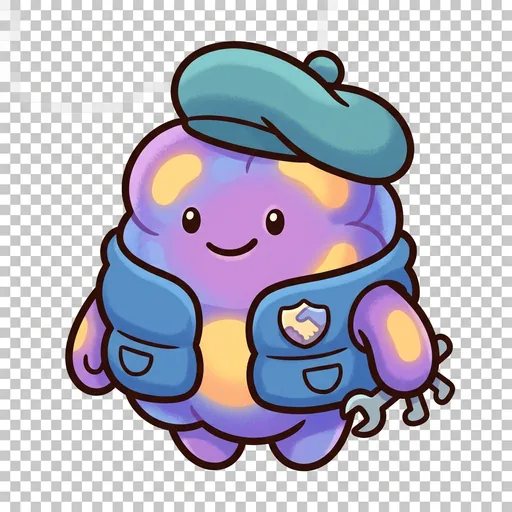
Guard
Immune cells (T-cell / macrophage / B-cell) — 'I check IDs. Patient + careful.'
-

Crumble
Decomposer microbes that break down dead leaves and scraps into rich soil, so nothing is wasted and everything begins again.
-

Thrive
Extremophile microbes that make a home in the hottest, coldest, saltiest places, showing life finds a way almost anywhere.
-

Shimmer
Bioluminescent microbes that turn energy into their own soft glow, lighting ocean waves and partnering with animals like tiny lanterns.
-
Colony
Microbes that build biofilms together, cooperating and protecting each other, because they are far stronger as a community than alone.