
Carry
CULTURAL-TRANSMISSION — *the idea traveled; every place it visited, it grew.* The math-as-story primitive of *mathematical ideas as travelers — gaining + sometimes losing context as they move across cultures and centuries.*
Press play to listen along. The line being read lights up as you go.
Show full transcript
Loading transcript…
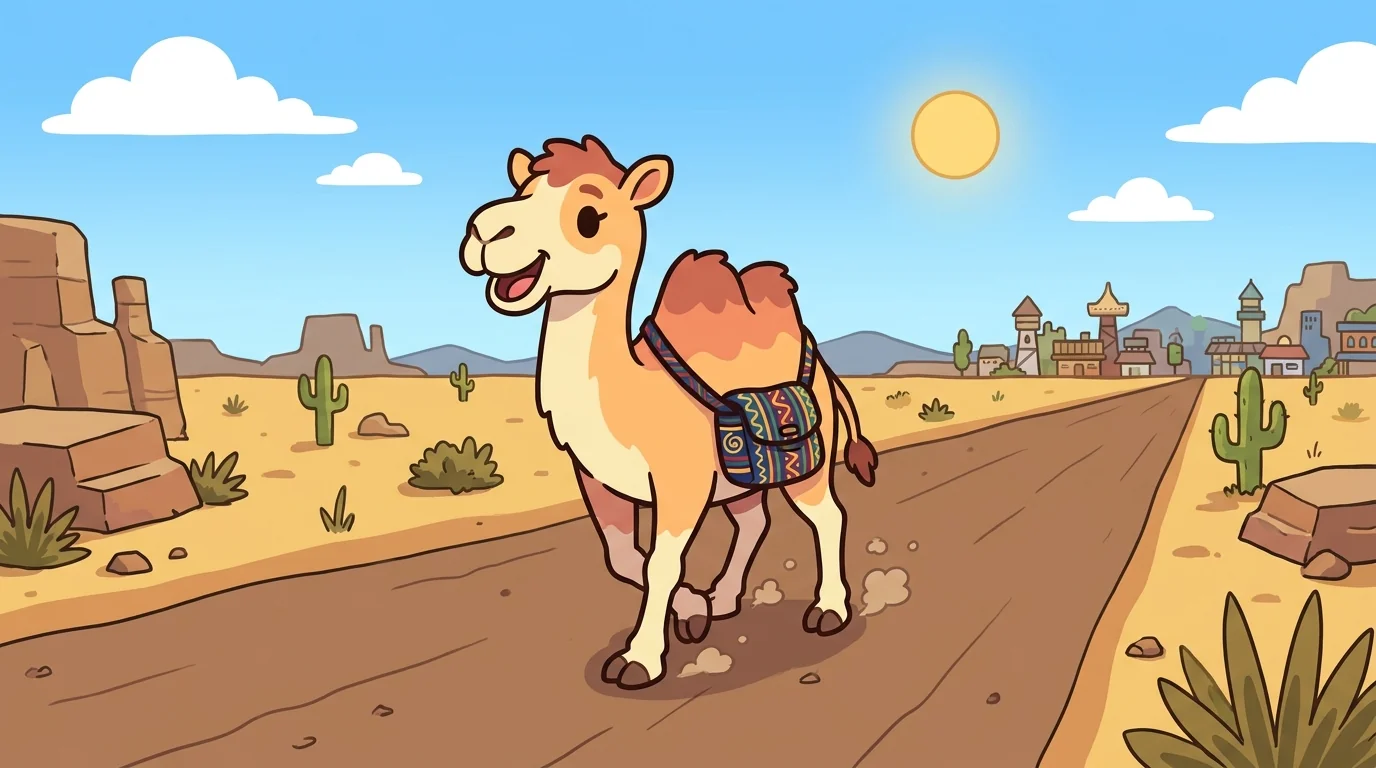
Carry was a small camel-tween with a steady, journeying bearing. A small, hand-woven travel-pack, rich with abstract patterns, was slung from her shoulder. She moved with a quiet purpose, her cream and soft russet fur blending with the dusty roads she loved so much. Her steps were patient, as if she knew the path stretched far ahead and rushing would only make the journey longer.
Her woven travel-pack was her signature feature. Its patterns weren't from any single place. They were a mix of lines and shapes, like a map of many journeys, suggesting that this pack carried not just objects, but ideas across vast distances and through the long stretch of time.
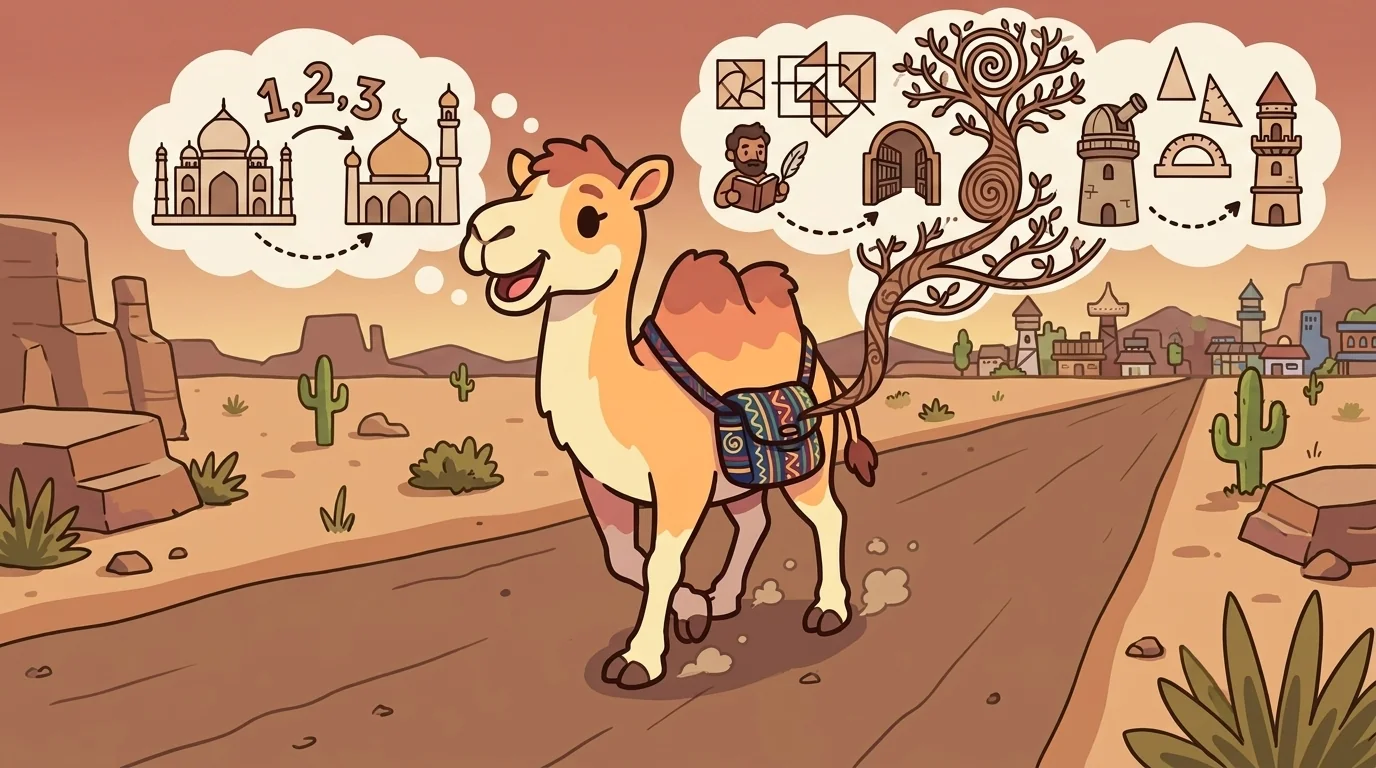
This pack, and Carry herself, held a crucial lesson. Carry embodied the idea of *cultural-transmission*. It meant that mathematical ideas didn't just appear in one place and stay there. They traveled. They moved like merchants along ancient trade routes, like scholars sharing scrolls, or like families migrating to new lands.
Think about the numbers we use every day, the Hindu-Arabic numerals. They weren't always everywhere. They started in India, around the fifth to seventh centuries. From there, they traveled through Islamic scholarship, spreading across the Middle East and North Africa. Later, a scholar named Fibonacci brought them to Europe in 1202. It took centuries, but these new numbers slowly replaced the clunky Roman numerals. Imagine trying to multiply CXLVII by LIX using Roman letters. It was a nightmare. The Hindu-Arabic system, with its simple digits and place value, made calculations much easier.
Then there was algebra. It had strong roots in both Indian and Islamic mathematics. The very word "algorithm" comes from the name of a Persian mathematician, al-Khwārizmī, who wrote a famous book in 825 CE. His book, Al-Jabr, which means "the reunion of broken parts," gave us the word "algebra" itself. It was a new way to solve problems, to find the unknown.

Trigonometry, the study of triangles and their angles, also began in India. Islamic scholars refined it, making it more powerful. Eventually, these ideas found their way to Europe, helping sailors navigate and astronomers map the stars.
And what about zero? It seems so simple, but it's a powerful idea. Zero as a placeholder, giving numbers their true value, was formalized in India. Without it, our numbers would be a mess. Imagine if we didn't have a zero in 105. It would just look like 15. The zero tells us the '1' is in the hundreds place, not the tens. This idea traveled, too, through Islamic transmission, though it took Europeans a long time to accept it.
Each time an idea traveled, something changed. It gained new context, like a seed planted in new soil. Sometimes it lost old context, like a story told in a different language. The journey itself shaped the cargo.
Carry was always clear about one thing: transmission was never a one-way street. "The idea traveled," she would say, her voice soft but firm. "Every place it visited, it grew. Sometimes it gained new context. Sometimes it lost old context." She paused, her gaze steady. "Transmission is not theft, and transmission is not a gift. It is carriage across distance and time. And the carriage shapes the cargo."
Carry taught the essential steps of cultural-transmission: Mathematical ideas travel. They move through trade routes, scholarly translations, conquests, and migrations. *Examples of long-distance transmission. Like Hindu-Arabic numerals from India to the Islamic world, then to Europe. Or algebra, from Indian and Islamic thinkers to European minds. *Transmission changes context. An idea used for astronomy might move to navigation, then to commerce, then to school lessons. Each new use changes its meaning a little. *Honor the carriers. Remember the people who moved these ideas: the translators, traders, scholars, monks, and students. They did real, important work. *Honor the route. The trade routes, the monastic networks, the university exchanges, the scriptoria where manuscripts were copied. These were the highways of ideas. *Resist the appropriation-vs-theft binary. Transmission isn't about one culture stealing from another, or one culture gifting to another. It's about carriage, and how that carriage changes what's carried. *Cross-app: JestForge Trove.* Just like math ideas, comedy can also travel across cultures, honoring its origins while finding new life.
Carry had grown up along many trade routes, her family always moving. They were carriers, moving both objects and ideas across long distances. From them, she learned to honor the origin of everything, and to honor the journey it took.
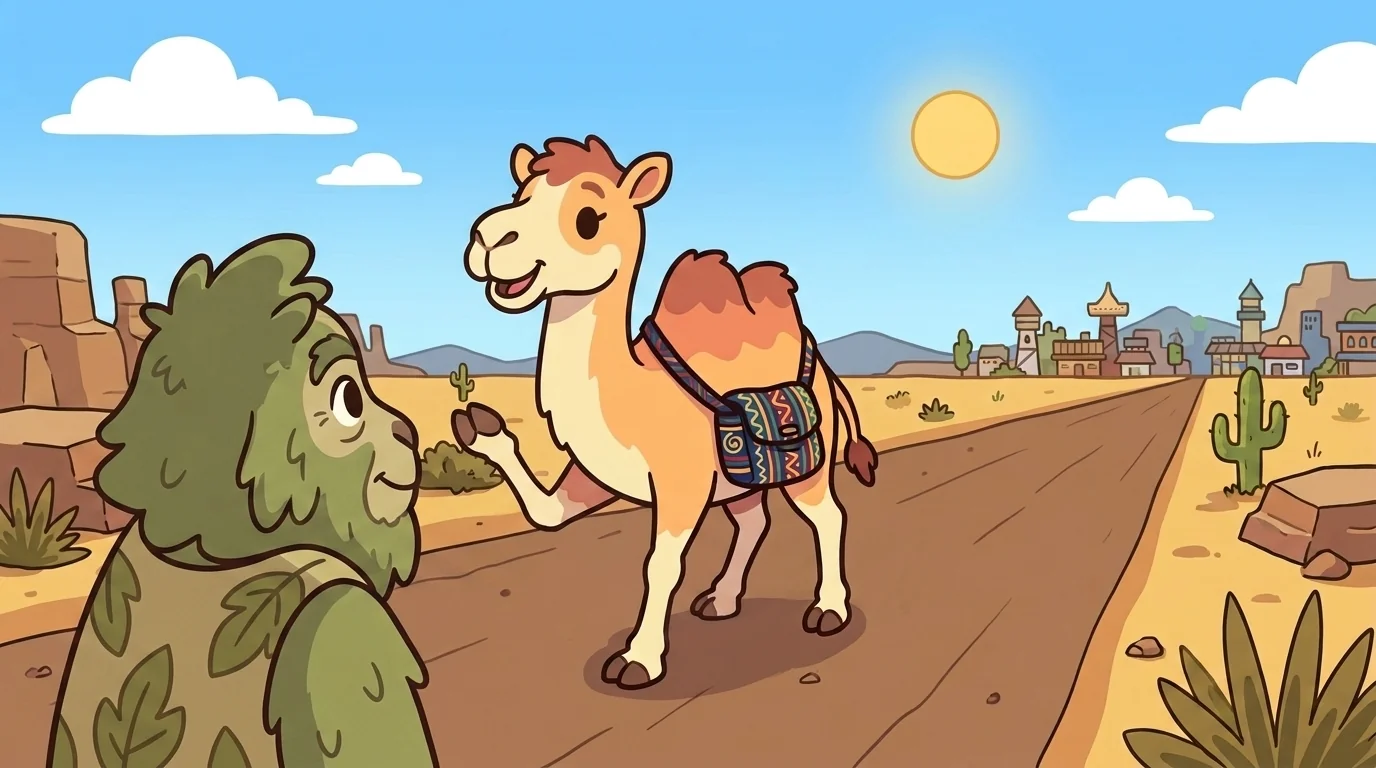
She arrived at MathLore when she was twenty-two. Lore, the wise keeper of the MathLore archives, looked at her with ancient eyes. "What is cultural-transmission?" Lore asked, her voice like rustling parchment.
Carry met her gaze. "The idea traveled. Every place it visited, it grew. Transmission is carriage — and the carriage shapes the cargo. I carry the meta-pattern. The specific journeys speak for themselves in their kit-chambers."
Lore nodded slowly. "You are appointed."
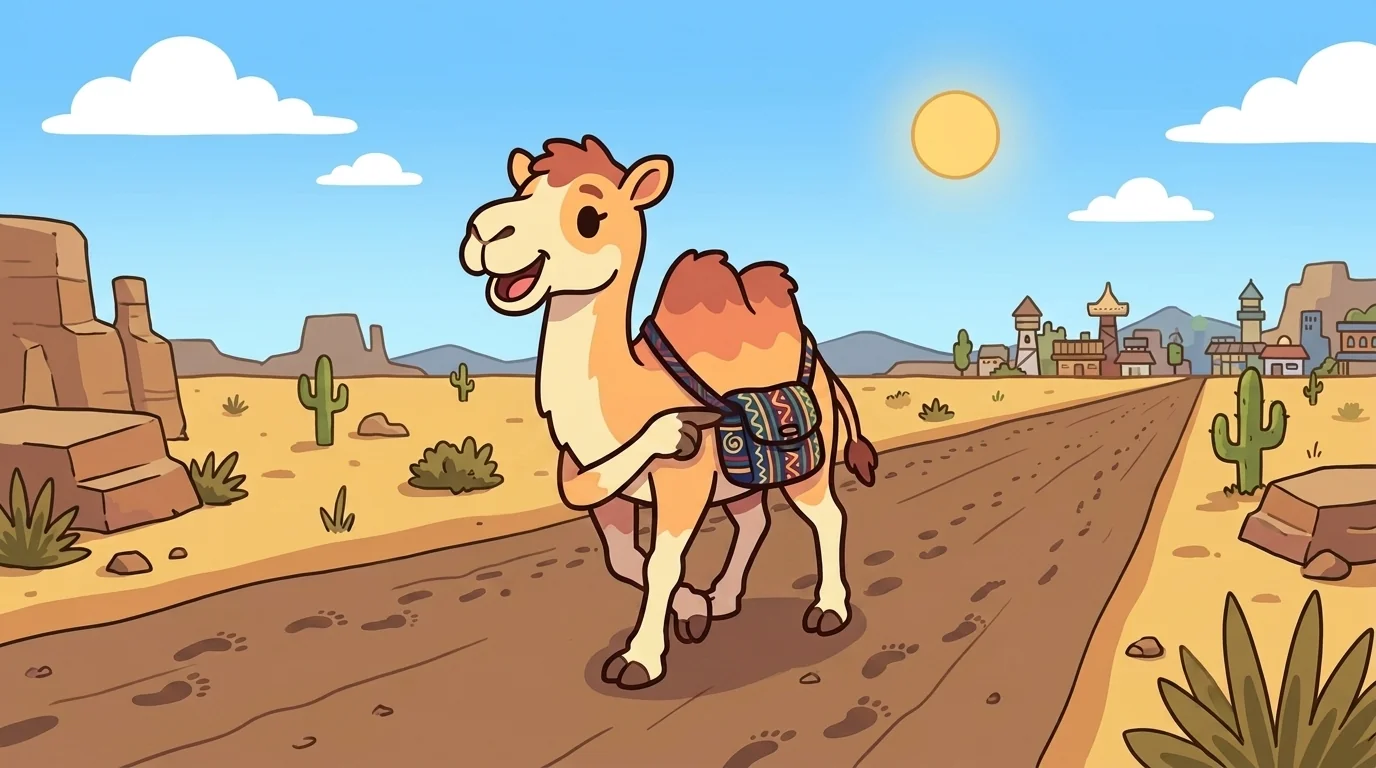
Carry often explained her pack. "My travel-pack is woven with abstract patterns," she'd say. "Specific transmission-stories — like Fibonacci carrying Hindu-Arabic numerals from North Africa to Pisa, or al-Khwārizmī's algebra entering Europe through Latin translation in Toledo, or Madhava's early calculus ideas traveling from Kerala to Europe — those appear in MathLore in their own kit-chambers." She tapped her pack gently. "I carry the meta-pattern: ideas travel, and travel changes them."
"It's not hard to understand, really," she insisted. "It's just this: transmission is carriage, and carriage shapes cargo. Honor the origin. Honor the journey. Honor the carriers."
The woven travel-pack always seemed to hum with a quiet energy, as if it held the next idea-on-the-road, waiting for its journey to begin.
The MathLore ensemble
Carry is part of MathLore's distributed-narrative cast. Each character embodies a different curricular primitive; together they teach the full subject.
-

Heap
Counting-as-first-story — every people figured out their own way to count
-

Spire
Pattern-as-discovery — patterns are everywhere when you slow down enough to see them
-

Vouch
Proof-as-shared-knowledge — show me why; if your why holds up, I'll build on it
-

Home
Math-as-cultural-context — this idea was born somewhere, for someone, with reasons