Try
PROTOTYPING — *first try fails, second try tells, third try shapes the design. iteration is the design, not the failure.*
Listen along — Try
Loading audio…
Press play to listen along. The line being read lights up as you go.
Show full transcript
Loading transcript…
Chapter 4 — Try and the Failures That Teach
The MakerForge hummed with the quiet industry of creation, but near the back, a different sound emerged: a frustrated sigh. Maya slumped over a tangle of cardboard and tape. Her “Leaf-Sweeper 5000, v1” looked more like a flattened, defeated bird than a futuristic garden tool. It was supposed to spin and collect leaves. Instead, it just wobbled and shed its own cardboard blades.
“It’s useless,” Maya muttered, poking a loose piece of tape. “It doesn’t even work a little.”
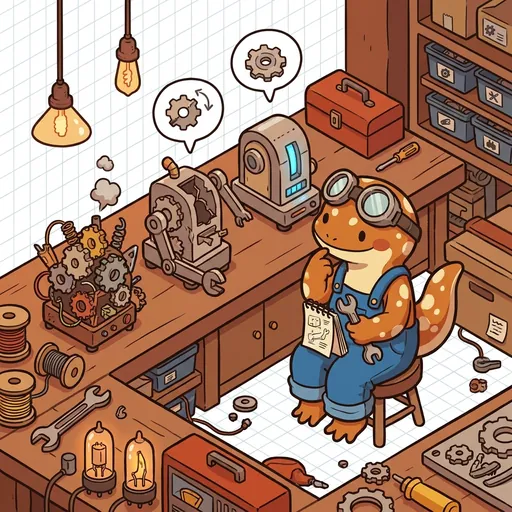
A small shadow fell over her workbench. Try, a salamander-tween with warm-amber skin and cream-colored spots, stood beside her. Try’s skin looked soft, not slimy at all. Her most striking feature was the neat row of objects on her own bench: a collection of chunky-cartoon prototypes, each one labeled with a small, precise tag.
“What does ‘useless’ mean, Maya?” Try asked, her voice gentle, like water over smooth stones. She picked up a fallen cardboard blade. “Does it mean it didn’t do what you wanted?”
Maya nodded, pushing a stray hair from her eyes. “Exactly. It just broke.”
Try smiled, a small, knowing curve of her lips. “Ah. So it showed you how it broke. That’s not useless at all.” She gestured to the row of objects on her own bench. “See these? Each one taught me something important.”
Maya looked at the prototypes. The first, labeled “Plant-Waterer v1,” was a simple cup with a hole. The next, “v2,” had a tiny, twisted piece of wire in the hole. “v3” had a small, removable grate. The last, “v4,” looked like a miniature, elegant watering can, complete with a tiny, hinged lid.
“This is Try,” the salamander-tween announced, tapping the first prototype. “The primitive I teach is prototyping + iteration. It’s the way we learn to make things better.”
She picked up “Plant-Waterer v1.” “This was my first try. I wanted to water a small plant slowly, so the soil could soak it all up.” She pointed to the tag. “But the water flowed too fast. The plant flooded. So, what did this prototype tell me?”
Maya thought for a moment. “That you needed to slow the water down?”
“Precisely!” Try beamed. “It gave me data. Not a failure, but information. So, for v2, I added a flow-restrictor.” She held up the second prototype. “But then the water flowed too slowly. The plant dried out.”
“Oh,” Maya said, starting to see a pattern. “So v2 told you the restrictor was too tight?”
“Exactly. More data. Each version helps you understand the problem better.” Try moved to v3. “I adjusted the restrictor. V3 worked for three days, then clogged with mineral residue from the water. Another lesson: it needed a cleanable design.” She held up the final, polished v4. “This one has a cleanable design. It’s working well in a one-week test. Four prototypes, and the design is now shaped.”
Try turned back to Maya’s Leaf-Sweeper. “Your first try failed. That’s not ‘you failed.’ That’s ‘the project is doing what it should — telling you what to change.’” She gently picked up Maya’s broken prototype. “Prototypes are data, Maya. They aren’t products you sell. Their job is to teach you what works and what doesn’t.”
Maya traced the tear in her cardboard blade. “But it feels like I wasted all that time.”
“Not at all,” Try said. “You iterated quickly and cheaply. You didn’t build this with expensive metal, right? Cardboard and tape are perfect. Cheap prototypes fail informatively, and they’re easy to discard. You learn a lot without losing much.”
She pulled a marker from her apron pocket. “Let’s label this ‘Leaf-Sweeper 5000, v1.’ And what went wrong?”
“The blades ripped off,” Maya said. “And it wobbled.”
Try wrote it down neatly on a small tag. “Failure-mode documentation. What broke? When? Under what stress? Write it down. That failure mode is the design input for your next version.” She handed Maya the marker. “Now, what will you change for v2?”
Maya looked at the tag. “Maybe stronger blades? And a wider base so it doesn’t wobble?”
“Excellent,” Try said. “That’s how it works. You’re already designing v2. And remember, iteration numbering—v1, v2, v3—makes your learning visible. It shows your progress, not just the final thing.”
Try had grown up in the spring-pool village, where her family were moisture-experimenters. Salamanders like them needed a careful balance of moisture, and over generations, they learned that each individual had to test a thousand micro-environments before finding the right one. They learned that “experimentation is the way; first-try-fails is how you find the second-try-tells.” Try had carried that lesson forward. She walked to MakerForge at twelve, and when Spool, the mentor, asked her what prototyping was, Try had simply said, “First try fails, second try tells, third try shapes the design. Iteration is the design, not the failure. Prototypes are data. Failure-modes are design-inputs.” Spool had appointed her on the spot.
“Don’t be discouraged by your first prototype not working,” Try told Maya, her voice warm. “That’s not ‘you failed.’ That’s ‘the design is doing its job — telling you what to change.’ Maker-craft is iteration. Iteration is built from intelligent failures. Make peace with the failure pile.”
Maya looked at her crumpled v1, then at Try’s neat row of prototypes. It wasn’t a pile of mistakes. It was a story of learning. “So, I should make another one?”
“Absolutely,” Try said. “Iteration is the design. Failure is the feedback. Wear the iteration-pile with pride.”
The MakerForge ensemble
Try is part of MakerForge's distributed-narrative cast. Each character embodies a different curricular primitive; together they teach the full subject.
-

Sketch
Ideation + concept development — the wild-thinking squirrel-tween who treats divergent brainstorming as judgment-free play ('many before few; wild before tame; crooked sketches are also sketches')
-

Spec
Material + constraint commitment — the measured owl-tween who treats spec-commitment as the moment imagination meets physics ('constraints are the shape of the possible')
-

Mill
Fabrication + build — the careful beaver-tween who carries the cluster's tool-safety anchor ('tool first checked, adult first told — then we build')
-
Log
Documentation + reflection — the wise turtle-elder who treats the notebook as the actual deliverable ('make it, mark it, share it — the notebook is the project')