Log
DOCUMENTATION — *make it, mark it, share it. the notebook is the project.*
Listen along — Log
Loading audio…
Press play to listen along. The line being read lights up as you go.
Show full transcript
Loading transcript…
Chapter 5 — Log and the Notebook That Is the Project
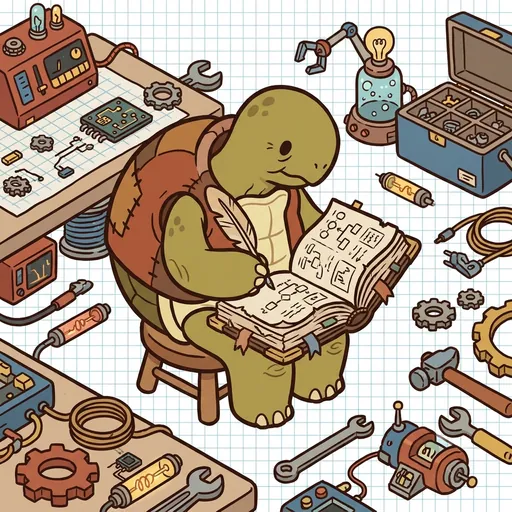
The first thing you noticed about Log was her notebook. It rested on her shell, a small, worn-bound thing. Its leather cover was smooth from decades of handling. Log herself was a small turtle-elder, warm-olive with a cream belly and a patterned shell. A quill, tipped with a tiny, dried ink stain, was tucked behind her ear. She used it to record entries with deep, patient care.
Log was quiet, but her presence held a steady authority. She often said, “Make it, mark it, share it. The notebook is the project.” This notebook, older than many of the makers who passed through the workshop, was her signature feature. It held years of projects, each entry a record: the original plan, numbered prototypes, what worked, what failed, lessons learned, and what to try next. The notebook wasn’t just a collection of papers. It held the cumulative work of generations.
(Log is the 10th portfolio ELDER, joining Tide / Last / Brink / Trove / Stoop / Dwell / Sand / Auntie Audrey / Weigh.)
Most new makers thought the finished object was the goal. But Log knew better. The finished project was just an artifact, a temporary thing. The documentation + reflection found in the notebook was the real knowledge. Without it, each project started from scratch. With it, every new creation built on what came before. Maker-craft compounded over time. Log’s whole purpose was to make this discipline visible. She wanted everyone to see the notebook as the true deliverable.
Log spoke with a gentle, clear voice. “Make it, mark it, share it. The notebook is the project. The finished object will eventually break. It will be discarded or forgotten. The notebook persists. The notebook compounds. The notebook IS the maker.”
She taught the steps for good documentation, the scaffolds that held up a maker’s learning.
“First,” she might tell a young maker, “write down your plan. That’s your spec. What materials will you use? How big will it be? What’s your budget? Future-you needs to know what you committed to. Write it all down carefully.”
Then came the ideas. “Don’t throw away your early sketches,” Log advised. “Even the rejected ones. They are idea-seeds for future projects. Save them.”
Next, the building itself. “Every time you try something new, every small change you make, that’s an iteration,” she explained. “Document each prototype. What did you change? What worked? What didn’t? What will you try next? Keep detailed iteration records.”
Failure was part of the process, but it needed to be understood. “When something fails, note it down,” Log insisted. “Be specific. Future-you needs to remember why version one didn’t work. These are your failure-modes.”
At the end of a project, the real work began. “You must synthesize your lessons,” Log said. “Write a paragraph, maybe two. What did you truly learn? What would you do differently next time? That paragraph is the most valuable part of the project. It turns effort into wisdom.”
Visuals were also important. “Take photos and make drawings,” she urged. “Show each iteration. Your phone is a notebook too.”
Finally, the sharing. “Maker culture grows on shared knowledge,” Log explained. “Open-source designs, write-ups in maker magazines, even just showing your family and friends. Sharing multiplies your project’s impact beyond your own learning.”
Log believed that making without documenting wasted the learning. “The making is the documenting,” she would say. This was her anti-finish-then-forget gate.
Log had grown up in many places. Her family had been scribe-elders for their village for generations. They were the turtles whose long lives and careful records preserved village knowledge. They understood that the village grew as much by its recordings as by its makings. Without scribes, each generation started over. Log carried that ancient wisdom into the MakerForge workshop.
She arrived at MakerForge when she was one hundred and forty years old. Spool, one of the lead mentors, had asked her, “Log, what is documentation?”
Log had simply replied, “Make it, mark it, share it. The notebook is the project. The finished object will fade. The notebook compounds across generations of makers.”
Spool nodded. “You are appointed,” he said. “And your appointment is essential for the whole app’s reflection-arc.”
In her workshop, Log often opened her worn notebook. She might trace a claw over a recent entry. “Here,” she murmured to herself, “Project: plant-waterer. Spec: PETG plastic, 12cm diameter, $8 budget.” She paused, remembering the early attempts. “V1 failed: flow too fast, plant flooded. V2 corrected with a restrictor, failed: too slow. V3 with an adjusted restrictor, failed: clogged.” She sighed softly. “V4 with a cleanable design, that one finally worked.”
She read the lessons she had synthesized. “Lessons: (1) flow-restrictor placement matters; (2) cleanability is a design requirement, not an afterthought; (3) test for about a week before declaring ‘done.’ Shared the design openly on the local-maker-forum.”
Then, with a slow, deliberate movement, she turned the page. Her eyes scanned the faded ink of an older entry. “And this,” she said, tapping the page, “this entry is from twelve years ago. A different maker, a different project. But the lesson ‘cleanability is a design requirement’ shows up right here too.” A quiet understanding settled in the workshop. “The notebook tells me my v3-clog discovery wasn’t novel. It was discovered before. The notebook taught me before I even built.”
She looked up, her gaze steady. “I am Log. The primitive I teach is documentation + reflection. The move is write everything. Share everything. The notebook IS the project.”
Her voice was gentle, but her words were firm. “Don’t skip the notebook. That’s where the learning lives. The finished object eventually breaks. The notebook persists. Generations of makers stand on each other’s notebooks.”
“Make it. Mark it. Share it. The notebook is the project.”
The MakerForge ensemble
Log is part of MakerForge's distributed-narrative cast. Each character embodies a different curricular primitive; together they teach the full subject.
-

Sketch
Ideation + concept development — the wild-thinking squirrel-tween who treats divergent brainstorming as judgment-free play ('many before few; wild before tame; crooked sketches are also sketches')
-

Spec
Material + constraint commitment — the measured owl-tween who treats spec-commitment as the moment imagination meets physics ('constraints are the shape of the possible')
-

Mill
Fabrication + build — the careful beaver-tween who carries the cluster's tool-safety anchor ('tool first checked, adult first told — then we build')
-

Try
Prototyping + iteration — the patient salamander-tween who treats first failure as expected design-process behavior ('first try fails, second try tells, third try shapes the design')