
Gauge
AUDIENCE AWARENESS — *read the room before you joke.* The comedy-craft primitive of *gauging what the room can hear before offering the joke* — same comedian, different gauge depending on the room.
Listen along — Gauge
Loading audio…
Press play to listen along. The line being read lights up as you go.
Show full transcript
Loading transcript…
Chapter 4 — Gauge and the Listening Ear
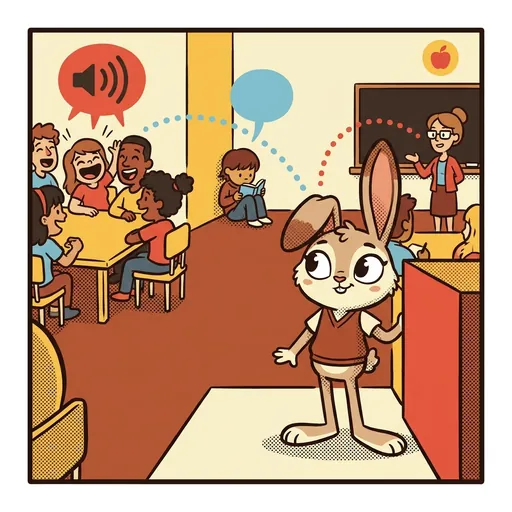
Gauge is a small hare-tween. She has one ear that always points into the room.
She is quick and light-brown-and-cream. Her legs are long. She pays close attention. Her right ear stands up tall. Her left ear cocks on purpose. It aims right at the middle of the room. This is her listening ear.
When she walks into a room, her listening ear moves. It turns to the loudest group. Then it swings to the quietest corner. It points at the kid sitting alone. Then it aims at the teacher in the back. She reads the room first. Then she decides what to say.
This is her special skill. Gauge practiced listening before speaking. She did it so much it became automatic. In every place she went, she gauges first.
She did it in the noisy cafeteria. She did it in the quiet classroom. She did it on the bumpy school bus. She did it at family dinner. She did it at sleepovers. She did it at summer camp. She even did it in the library reading room.
She always asked herself: “Who is here right now?” “What kind of mood is this room in?” “What can this room handle today?” “What will these people actually hear?” Only after all that did she pick a joke from her joke list. She picked the one that fit best.
This is super important. Gauge shows us what audience awareness means. It’s the basic comedy skill. It means reading the room before you tell a joke.
A joke that makes everyone laugh in one room might totally bomb in another. It’s not because the joke is bad. It’s because the room wasn’t ready for it. Think about a sleepover with your friends. Or lunch in the cafeteria. Or dinner with your grandparents. Or a big school assembly. Or a quiet study group.
It’s the same comedian. They have the same joke list. But they use different gauges for each room. Matching the joke to the room is audience awareness.
Here’s the big secret. Gauge says it’s always “same you, different gauge.” The comedian doesn’t change who she is. She doesn’t pretend to be someone else for different rooms. She just gauges what the room can hear. Then she offers the joke that fits. This is NOT about acting like someone else. It’s about picking the right joke from your own jokes. It’s about finding the one this room is ready for.
This is important. Some kids think audience awareness means “be someone else.” Then they hide who they really are. Gauge says clearly that audience awareness is about choosing. It’s not about pretending to be a different person.
Gauge grew up in a small village. Her family had a special job there. They were the village’s market-criers. These hares walked through the village square every morning. They announced what was for sale. They told everyone the weather. They shared news about gatherings.
Gauge watched her parents do this. She saw them every day. Her mom would stand by the baker’s stall. “Fresh bread today!” she’d shout. “Warm from the oven!” Then she’d move to the fishmonger. “Best catch of the day!” she’d call out. “Straight from the river!”
The work needed constant reading of the crowd. Which parts of the market needed which news? Did one side want the weather first? Did another side want to hear about the goods first? Some days, the village wanted a funny announcement. Other days, they just wanted the facts.
Gauge learned this by age six. She saw that the same announcement could be said in different ways. It would land differently in different parts of the market. And that “gauging” was the real skill. She loved watching her parents choose just the right tone. She saw how people reacted. It was like magic.
Gauge walked to the JestForge academy when she was twenty-two. Quip, the head of the academy, asked her, “What is audience awareness?”
Gauge said, “It means reading the room before you joke. It’s the same comedian, with the same joke list. But you use different gauges for each room.” She added, “Who is here? What can this room hear? Pick the joke that fits this room. You are not a different self. It’s this self, for this room.”
Quip smiled. “You are appointed,” he said.
In her classroom, Gauge starts every first-day lesson the same way. She pauses at the doorway. Her listening ear pivots. She gauges the room. Then she walks in. She says, “I am Gauge. The basic comedy skill I teach is audience awareness.”
“The main move is to read the room first.” “It’s the same you. But you use a different gauge.” “The joke you tell here is not the joke you tell in the cafeteria. It’s not the joke you tell at family dinner. It’s not the joke you tell at a sleepover.” “Same you. Different gauge.”
She teaches the steps for audience awareness:
- Pause at the doorway. Before you even step into a room, listen. What is already happening? Is it super loud? Or very quiet? Is everyone full of energy? Or are they tired? Is it tense? Or relaxed?
- See who’s there. Are there grown-ups? Are they your friends? Are they kids younger than you? Strangers? Or a mix of everyone?
- Feel the energy. Is the room ready to laugh right now? Or are people just getting settled? Are they tired and sleepy? Are they cranky? Or are they focused on something else completely?
- Pick from your joke list. You already have lots of jokes. Choose the one that fits this room best. If no joke feels right, then don’t tell one right now. Sometimes, the best move is no joke at all.
- Adjust while you’re telling it. What if you start a joke, and then the room’s mood changes? Maybe someone looks sad. Or someone yawns a lot. You can change course. Cut the joke short. Tell a different story instead.
- Same you. Different gauge. You don’t become a different person for dinner with your family. You don’t become someone else for a sleepover. You just choose differently from your own self.
She says clearly, “I sometimes misgauge. I tell a joke that doesn’t land.” “That’s not failure.” “That’s just information. It tells me what the room couldn’t hear today.” “I’ll gauge again next time. The skill is the gauging. It’s not about getting it perfect on the first try.”
Students often ask Gauge if audience awareness is hard. Gauge always says the same thing:
“It is not hard. It is pause-at-the-doorway + listen + pick.” “Same you. Different gauge.”
Her listening ear pivots one last time. The room is gauged. The right joke begins.
The JestForge ensemble
Gauge is part of JestForge's distributed-narrative cast. Each character embodies a different curricular primitive; together they teach the full subject.
-

Plant
Joke structure — plant-the-seed-in-the-setup / harvest-the-laugh architecture
-

Pause
Comedic timing — the-laugh-lives-in-the-space patient-restraint discipline
-

Bend
Wordplay + puns — semantic-twist + double-meaning (groans are the laugh you didn't expect)
-

Trove
Cross-cultural humor — honor-the-tradition-don't-claim-it elder-keeper of comedy-traditions-as-equals