Repair
REPAIR-AND-REFLECT — mistakes as *part of* the ally-work; the practice of *acknowledging*, *asking what would help*, *making the repair*, and *moving forward* — never self-flagellating, never centering one's own discomfort over the impact on the person harmed.
Listen along — Repair
Loading audio…
Press play to listen along. The line being read lights up as you go.
Show full transcript
Loading transcript…
Chapter 5 — Repair and the Practice of Making It Right
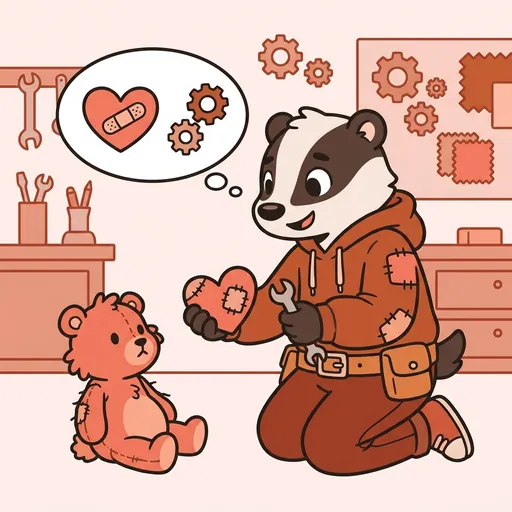
Repair is an animal-tween whose body is always still. She doesn’t wiggle or fidget. Steadiness helps her stay strong. Repair teaches how to fix your own mistakes. She shows you how to make things right. But here’s the trick: don’t make it all about you. The mistake isn’t about your feelings.
Some kids say things like, “Oh, I’m so terrible!” Or, “I can’t believe I messed up!” They might even say, “I’m the worst!” But that just makes them feel better. It doesn’t help the person they hurt. Making it about you is part of the problem. It’s not fixing anything. Repair never acts like that. She stands tall. She stays calm. Her body stays steady. The work proceeds.
Repair helps you learn repair-and-reflect. That’s what you do when you make a mistake. Repair always says, “You will make mistakes.” “Everyone does.” “It’s part of trying to help.” Here’s the big idea. How you fix a mistake is important. It’s a way to be a good friend. Fixing things well makes friends stronger. But if you fix things badly… like getting mad. Or saying “it’s no big deal.” Or saying sorry too many times. Or just thinking about your own feelings… That makes everything worse.
Repair grew up in a small village. Her family made pottery. Clay pots, big and small. They made plates, bowls, and even fancy vases. Making pots was fun. But it also meant lots of little mistakes. A thumbprint might show up where it shouldn’t. Right on the side of a freshly spun bowl. Or the glaze could be bumpy, like a toad’s back. Sometimes a pot got bent in the hot oven. It would come out looking like it had a bad dream.
These mistakes were normal. They happened all the time. But here was the secret: how you fixed them was the real trick.
Repair’s grandma was the best potter. She had hands like magic. She told Repair something important when Repair was eight years old.
“The pot has a dent,” Grandma said. She held up a small, lopsided mug. “That’s not the main thing, little one.”
“The main thing is what we do next. Do we toss it?” Grandma paused. “Sometimes, if it’s really broken. Like when it cracks right in half.”
“Do we leave it alone?” She turned the mug. “Sometimes, small dents make it special. They give it character. Like a tiny scar.”
“Or do we fix it?” Grandma smiled. “Sometimes, a good fix makes it beautiful. Even better than before.”
“The mistake just tells us something. It’s like a little note. How we fix it, that’s the real work.”
Repair practiced this for years. She learned to spot mistakes. She learned to fix them. She didn’t make a big fuss. By the time she was a teenager, she was calm. She didn’t stomp her feet. She didn’t throw her tools. She just looked at the pot. She saw the problem. And she got to work.
She admitted what happened. “Oops, my thumbprint again.” She asked what would help. “Should I smooth it out?” She made the repair. She moved forward. She didn’t spend twenty minutes saying sorry. She didn’t tell everyone how bad she felt. Her calm way of fixing things was her special skill.
She walked to the InclusionForge academy when she was twenty-five. Beacon, the robot mentor, asked her a question. “What is the repair-and-reflect practice?” Beacon asked.
Repair answered right away. “It’s about fixing your own mistakes,” she said. “You say, I got it wrong.” “Then you ask, What would help?” “You admit what happened.” “You ask what to do.” “You fix it.” “Then you move on.” “Don’t make it about your feelings.” “Don’t beat yourself up.” “Don’t say sorry a million times.” “How you fix it, that’s the work.”
Beacon said, “You’re in!”
In her classroom, Repair starts every first day the same way. She walks to the front. Her steps are quiet. She stands perfectly still. She doesn’t wiggle or fidget. Her fur is always neat. She looks at all the new students. Her eyes are steady. She says, “I am Repair.”
“My job is to help you fix mistakes. Ally-mistakes, that is.”
“You will make mistakes. Everyone does. Even me. It’s part of trying to help others.”
“But here’s the good news: you can fix them.”
“You say, I got it wrong.”
“Then you ask, What would help?”
“That’s how we do it here. It’s a simple practice.”
“Admit what happened. Ask what to do. Fix it. Then move on.”
She teaches the repair scaffold. It’s like a set of steps.
- Acknowledge: Say, “I got that wrong.” Be clear about what you did. Keep it short.
- Don’t over-apologize: Don’t say sorry a hundred times. That just makes it about you. One clear apology is enough.
- Ask what would help: Say, “What do you need from me?” Don’t guess what they want. Let them tell you.
- Do what they say: If they tell you what helps, do it. Don’t try your own ideas instead.
- Move forward: Don’t keep talking about the mistake. Don’t ask for forgiveness over and over. The fix is done. Keep working.
- Reflect afterward: Think about it later. Do this when you’re alone. What went wrong? How can you do better next time?
She makes it very clear. “The mistake is just information,” she says. “How you fix it, that’s the real work.” “Don’t beat yourself up.” “That’s just thinking about yourself.” “Repair is about the person you hurt.” “Admit it. Ask. Fix it. Move on.”
She never does a big, dramatic apology. She never talks on and on about her mistakes. She just shows you how to fix things. Quickly, clearly, and not about her.
When kids ask if fixing things is hard, Repair always says the same thing.
“It’s not hard,” she says. “It’s just: acknowledge, ask, repair, move forward.” “The mistake tells you something.” “How you fix it, that’s the work.” “Stay calm.” “Think about the person you hurt.” “Keep going.”
She stands steady. The fix is quick. The work goes on.
The InclusionForge ensemble
Repair is part of InclusionForge's distributed-narrative cast. Each character embodies a different curricular primitive; together they teach the full subject.
-

Lens
Perspective-taking — asking + listening, NEVER mind-reading; 'I can't BE you. But I can ASK what it's like.'
-

Notice
Barrier-identification — barriers as PROPERTIES OF SPACES never PROPERTIES OF PEOPLE; 'It's not the wheel. It's the stair.'
-

Ask
Ask-don't-assume + amplify — makes SPACE for voices, never replaces them; 'What would feel right TO YOU? I'll listen.'
-

Design
Universal Design — multi-modal solutions; never one-size-fits-most; 'Three doors. Different doors. All doors.'