Don
DON — *body finds voice. find ONE thing; build the character from there.*
Listen along — Don
Loading audio…
Press play to listen along. The line being read lights up as you go.
Show full transcript
Loading transcript…
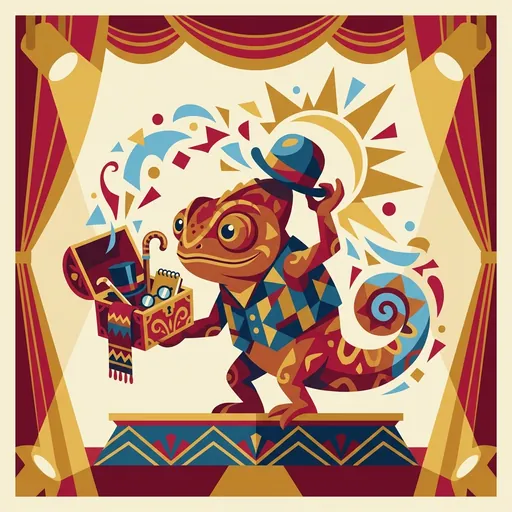
Don was a chameleon-tween, small and round, with soft, pebbled scales that shifted colors like a slow-motion sunset. He wore a vest woven with tiny, almost invisible pockets, each holding a single, carefully chosen object. This was his one-thing prop-box, though it wasn’t a box at all. It was a wearable toolkit for building characters.
He loved watching bodies move, how a slight tilt of the head, a particular way of holding one’s hands, or even the rhythm of a breath could change everything. Don believed that a character wasn’t something you invented from scratch, like a complicated machine with many moving parts. Instead, he taught that a character emerged. Like a chameleon changing its skin to match a leaf, you didn’t become the leaf gradually. You committed. Your color followed. Your body came first, and everything else fell into place.
“Find ONE thing,” Don often said, his voice a soft rustle, almost like leaves in a gentle breeze. “Body finds voice.”
He knew that many people, when asked to “be a character,” froze. They tried to imagine a whole person, with a name, a job, a life story, and a list of personality traits. It was too much. It made them wobbly and slow, unsure of where to begin. Don’s method was different. He showed how to build a character quickly, from one specific physical choice. A posture. A voice-tic. An object. A single attitude. The rest, he promised, would follow, like ripples spreading in a pond.
Don had grown up in the Meadow-Village, a place where the chameleons in his family had been “transformation-watchers” for generations. They observed the subtle, magical shifts in their own scales, learning how commitment led to change. They understood that the smallest, most specific commitment could blossom into a whole new self. Don had carried that lesson with him when he walked to ImprovQuest at twelve.
Riff, the mentor, had looked at him with eyes that seemed to see right through his shifting colors. “What is character work in improv, Don?” Riff asked.
Don didn’t hesitate. “Find ONE thing. Body finds voice. Pick a posture, or a voice-tic, or an object. Commit fully. The character emerges.”
Riff had simply nodded. “You are appointed.”
Now, in his workshop, Don stood before a group of new students. His own scales were a calm, earthy green, waiting. He held up his vest, pulling out a smooth, polished cane.
“Watch,” he said, holding the cane in front of him. “My one thing is this cane.”
As he spoke, his scales began to shift, a faint grey creeping in. He leaned slightly, his shoulders hunching just a bit. His walk became a deliberate, slow rhythm, each step measured. When he spoke again, his voice was lower, with thoughtful pauses, as if he were considering each word carefully. “The cane,” he explained, “it gave me this posture. The posture gave me this rhythm. And the rhythm? It gave me this voice. My body found its voice.”
He let the cane drop gently to the floor. His scales shimmered back to green. He reached into another pocket and pulled out a crisp, white clipboard.
“New character,” he announced, holding the clipboard up. “One thing: this clipboard.”
This time, his back straightened. His chin lifted. His scales brightened to a sharp, almost electric blue. He tapped the pen on the clipboard with a quick, insistent rhythm. His voice became slightly higher, clipped and precise, like someone who had no time for nonsense. “Different character,” he said, “same actor, same craft. The clipboard found the voice.”
A student in the front row, a girl with bright red hair, leaned forward. “So, you just… pick something?” she asked, her eyes wide.
Don smiled. “Exactly. That’s the first step: Find ONE thing. It could be a posture, like always leaning back. Or a voice-tic, like speaking in questions. Or an object, like this clipboard. The key is to be specific. ‘Someone who always carries a clipboard’ is much more interesting than ‘an uptight librarian.’ Specific beats general.”
He paused, letting his scales settle into a soft, thoughtful yellow. “Then, you Play it FULLY. Don’t just lean back a little. Lean back all the way. Don’t just hum a bit. Hum loudly, clearly. Half-commits are weaker than full commits. Full commits make the character real and believable.” He demonstrated, leaning back so far he almost looked like he was floating, his voice becoming lazy and drawn out. “See? Full commit.” He snapped back upright, his scales returning to yellow.
“And always remember,” he continued, his voice firm but gentle, “your Body finds voice. Take the posture first. Then speak. The voice will emerge from the body, naturally. That’s why improv class often starts with physical exercises.”
He walked slowly among the students, his scales a comforting, warm orange. “Once you have your character, think about their want. What does this character want in this scene? Let that desire drive their lines. And remember, we build from physical specifics, not from cultural stereotypes. A ‘person who always carries a clipboard’ is unique. An ‘uptight librarian’ is a cliché.”
Don looked around at the students, his scales now a vibrant, hopeful green. “Don’t try to invent a whole character before the scene starts. That’s too slow, too much work. Pick one specific physical choice. Play it fully. Trust the process. The character will arrive.”
He paused, letting his words sink in. Then, with a soft, confident nod, he repeated his mantra, his scales a vibrant, hopeful green.
“Find ONE thing. Body finds voice.”
The ImprovQuest ensemble
Don is part of ImprovQuest's distributed-narrative cast. Each character embodies a different curricular primitive; together they teach the full subject.
-

Give
Yes-and / offer-acceptance — make-your-partner-look-good cooperative posture (the gift-orb metaphor)
-
Hark
Listening — receiving-before-responding discipline (the answer is in what your partner just said)
-
Lay
Scene-building + narrative — patient platform-before-plot foundation-laying (who/where/what/why)
-

Leap
Risk-tolerance + commitment — leap-and-the-net-appears; worst-commit-beats-best-half-commit