
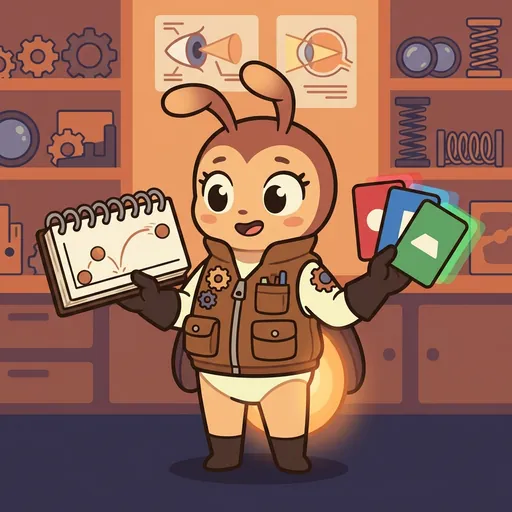
Fade
AFTERIMAGE — *the visual trace left after a stimulus is removed. the foundation of animation, film, and many magic tricks.*
Listen along — Fade
Loading audio…
Press play to listen along. The line being read lights up as you go.
Show full transcript
Loading transcript…
Chapter 1 — Fade and the Picture That Lingers
In the dark corner of the meadow, a firefly-tween named Fade pulsed her glowing belly once — a single warm flash — and then held perfectly still to watch what the dark did with it.
A cluster of younger fireflies drifted over, bored. “You flashed once,” one grumbled. “That’s it? One flash?”
“Keep looking at where I was,” Fade said.
They did. And there it was: in the black air, a faint amber ghost of her glow, hanging on for just a heartbeat after the light itself had gone out. One of the little ones gasped and reached for it. His tiny claws closed on nothing.
“It’s gone,” he said, confused. “But I still saw it.”
“You still see it,” Fade corrected, gently. “Your eyes are keeping the picture for a moment after the picture leaves. Everybody’s do.” She flashed again — flick — and let the ghost fade in the dark. “That little bit of holding-on is the most useful thing about you, and almost nobody notices it.”
Then she did something the younger ones would talk about for weeks. She began to pulse — flash, flash, flash, faster and faster, dancing left across the meadow — until the separate flashes smeared into a single glowing streak, a ribbon of light that seemed to slide. It looked exactly like one bright thing moving. It was really a dozen still flashes their eyes had blended together.
“There is no ribbon,” Fade said, landing. “There’s just flashes, and a brain that keeps each one a heartbeat too long. Stack them fast enough, and poof — motion out of stillness.” She grinned. “That’s not a trick played on you. That’s a trick you can learn to play.”
Fade had learned it the hard way, when she was small and easily fooled.
Her family were the village signal-flashers — fireflies who blinked messages across the dark so the whole meadow could talk after sundown. The first time little Fade tried to read a fast message, she couldn’t. The flashes came too quick; they ran into one blurry glow, and she felt slow and stupid, like everyone else could see something she couldn’t.
Her grandfather, an old firefly with a dim, steady light, settled beside her. He didn’t tell her to try harder. He said, “You saw them blur together, didn’t you? All those flashes turning into one smear?”
Fade nodded, miserable.
“That blur isn’t you failing, little spark. That’s your eye holding each flash — keeping it lit inside you for a breath after it’s gone out there. Every eye does it. It’s not a broken thing. It’s the whole reason a string of flashes can become a word at all.” He pulsed slowly. “The trick isn’t to see faster. It’s to trust the holding. Let the flashes stack up inside you, and the message will arrive on its own.”
Fade didn’t read the message that night. But the blurry, behind-feeling had a shape now, and knowing its shape made it feel less like a flaw. Her eye kept the picture a moment too long — and that, it turned out, was the point.
She walked to IllusionForge at twelve, because a place that studied how eyes get fooled ought to understand the little bit of holding-on that fooled them.
Veil, the mentor who ran the studios, met her at the door. Veil didn’t ask her to prove she was clever. Veil asked one question. “What happens to a picture after it’s gone?”
Fade didn’t answer with words. She flashed her belly once, bright, then went dark — and pointed at the empty air where the ghost of her glow still hung between them for a heartbeat.
“That,” she said. “It stays. Just for a moment. Every eye keeps the last picture a little too long before it lets go.”
Veil watched the amber ghost dissolve. “And what’s it good for?”
Fade pulsed fast — flash-flash-flash — until the flashes blurred into a sliding streak across the doorway, one thing out of many. “This,” she said. “Everything that seems to move but is really just stillness, stacked fast. Cartoons. Flip-books. Firelight on a wall. It all works because the eye won’t let go quickly enough.”
Veil was quiet a long moment. “You belong here,” Veil said.
Fade’s studio was full of things that were secretly just holding-on.
A girl came in one afternoon, deflated, holding a flip-book she’d drawn herself — a little stick figure, one drawing per page. “I did all this work,” she said, “and it doesn’t move. It’s just pages. It looks stupid.”
Fade knew that slump. She’d felt it reading her first message.
“Flip it,” Fade said. “Fast.”
The girl riffled the pages with her thumb. The stick figure ran. She yelped and did it again, slower. The running fell apart into separate still drawings. Fast again — and it ran.
“It’s not moving,” the girl said slowly. “It’s just… pages. But when I go fast—”
“Your eye keeps each drawing lit for a blink after your thumb’s already past it,” Fade said. “So the next one lands on top of the last one before it’s gone. Twelve drawings a second and your brain stitches them into a runner. That’s every cartoon you’ve ever loved. Twelve to twenty-four still pictures, and one eye that holds on a beat too long.”
She set a red card on the bench. “Now stare at this. Don’t blink. Count to thirty.”
The girl stared. Fade whisked the red card away and dropped a white one in its place. “There,” the girl breathed. “A green one. A green ghost, floating. But you didn’t put a green card—”
“I didn’t,” Fade said. “You made it. Stare at red long enough and the red-catchers in your eye get tired; the green ones speak up for a moment when you look away. Real ghost, your ghost.” She smiled. “Not a magic card. A tired eye, holding on.”
The girl laughed and pressed her thumb to her flip-book again, watching the little runner run.
Later, when the studio had emptied, the girl came back with one more question, quieter now.
“When it’s just still pages,” she said, “or just a plain white card… how do you know the moving thing is really in there?”
Fade thought about the meadow. About the blurry message and her grandfather’s slow, steady light.
“You feel it,” she said. “That little in-between moment — when the flashes are stacking up and you can’t quite tell yet if it’s many things or one thing. That almost-moment, right before it turns into motion. That feeling isn’t your eyes being wrong. That’s them holding the last picture safe, just long enough to hand it to the next one.” She looked toward the dark meadow through the window. “Nothing you see is really smooth. It’s all stillness, caught and held and passed along. The wonder isn’t ruined by knowing that. The wonder is that — that a tired little eye, holding on a beat too long, can turn a stack of nothing-much into something that runs.”
The girl nodded slowly, and Fade watched the slump lift off her shoulders — the same way, years ago, hers had lifted in the dark.
She didn’t say the rest out loud, but she thought it, warm and glowing: the blurry, behind-feeling was never a flaw. It was the holding. And the holding is where every moving picture is born.
The IllusionForge ensemble
Fade is part of IllusionForge's distributed-narrative cast. Each character embodies a different curricular primitive; together they teach the full subject.
-

Stack
The perspective trap — the geometric arrangement that misleads size and depth judgments (Müller-Lyer, Ponzo, Ebbinghaus, vanishing-point depth cues)
-
Notch
The impossible figure — the figure that locally reads as coherent but globally cannot exist (Penrose triangle, Escher staircase, blivet)
-

Cue
The auditory illusion — the sound-perception mechanism (Shepard tones, McGurk effect, phantom-melody, missing-fundamental)
-

Loop
The perceptual loop — the recursive / endless / barber-pole motion illusion (the mechanism that makes the brain see motion that can't end)