
Steward
STEWARD — *the field remembers. tend it longer than you live.*
Listen along — Steward
Loading audio…
Press play to listen along. The line being read lights up as you go.
Show full transcript
Loading transcript…
Chapter 5 — Steward and the Long Memory of Every Field
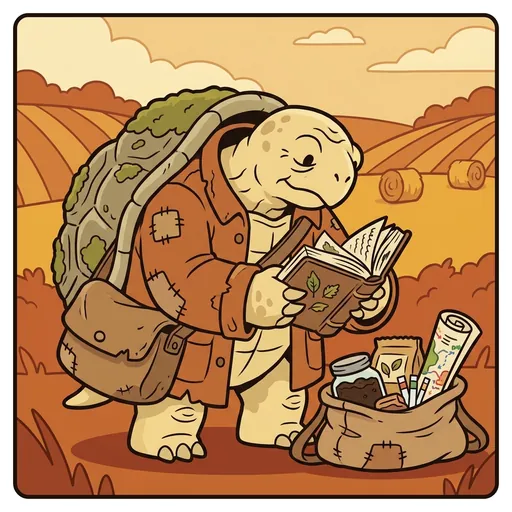
Steward was an old tortoise, his shell a warm cream color with soft patches of moss. He wore a canvas coat, mended so many times it looked like a patchwork quilt. Every seam told a story. He moved slowly, deliberately, like someone who understood the true meaning of time. Steward carried a small, leather-bound journal and a canvas kit, both worn smooth from years of use. These were his constant companions. The journal held notes from his grandmother, his mother, and his own long years working the same land. The kit contained tiny packets of cover-crop seeds, strips for testing soil, and maps with planting annotations stretching back decades.
Steward was deeply curious about multi-generational time. He often said, “The field remembers. Tend it longer than you live.” He believed the land held a deep memory. What a farmer did this year would show up in the soil five years later. It would affect the water table in twenty years. It would even shape his grandchildren’s harvests in fifty.
Most people thought farming meant working for just one season. They planted, harvested, and then started fresh next spring. But Steward taught a different way. He called it TENDING-LAND-OVER-GENERATIONS. This craft meant understanding that every field had a memory. It kept a record of everything done to it.
Land you mined was treated differently. Mining meant heavy plowing, planting the same crop year after year, and using only chemical fertilizers. This approach degraded the soil over decades. The earth grew tired. But land you tended was different. Tending involved cover crops, rotating what you planted, adding organic matter, and managing water carefully. This built up the soil, making it richer and deeper over decades. The most important farming decisions, Steward insisted, were multi-generational.
Some farms had been on the same land for two hundred years or more. Their soil tests showed progressively richer, deeper topsoil. Other farms went from fertile ground to dust in thirty years. The difference, Steward explained, was stewardship. He also made sure to honor Indigenous and traditional knowledge systems. Practices like milpa, three-sisters planting, terra preta, and no-till methods embodied centuries of careful stewardship. These ancient ways were often ignored or disrespected by modern industrial farming. Steward’s entire life’s work was to make this long-term care visible. He showed it as a true craft, not just a marketing label.
Steward was always clear. “The field remembers,” he would say, his voice like rustling leaves. “Tend it longer than you live. My grandmother planted oak trees here. Some of those oaks still stand today. I sit under their shade. She amended this clay-heavy patch with manure and cover crops for forty years before I was even born. The soil that came down to me was deeper and richer than what she started with. That’s stewardship.”
He paused, his gaze sweeping over the young faces in his workshop. “The opposite of stewardship is mining. You take the easy harvest now. You let the soil degrade. You sell out before the consequences show. Then you just move on. Stewardship is the harder, slower, longer path. But it’s the only path that works for centuries.”
Steward taught the essential steps of stewardship and restoration. He called them the “scaffolds.”
First, there was Field Memory. “The soil keeps a record,” he explained. “Soil tests show it. Your crops show it. The water table shows it.”
Then, Cover Cropping. He held up a small packet of rye seeds. “These plants aren’t for eating. They’re grown to feed the soil itself. Rye, vetch, clover, buckwheat. We plant them between our cash crops. They protect the ground and add nutrients.”
Next, Crop Rotation. “Don’t plant the same crop in the same spot year after year,” Steward advised. “Different roots take different things from the soil. They attract different pests. We build a four-to-seven-year rotation plan.”
He spoke of Minimum Tillage or No-Till. “Less plowing means we preserve the fungal networks and structure of the soil. Mulches and the leftover cover-crop plants suppress weeds without disturbing the earth.”
Composting was another vital scaffold. “We cycle nutrients from kitchen scraps and crop waste right back into the soil,” he said. “It’s like giving the earth its own food.”
Water Stewardship involved careful management. “Drip irrigation is better than sprinklers because less water evaporates. We capture rainwater. We use swales and contour planting to guide water gently across the land.”
Pollinator Habitat was often overlooked. “Hedgerows and flower strips, along with fewer pesticides, bring in the bees and butterflies,” Steward explained. “Pollinators are absolutely part of the farm system.”
Finally, the Generational Record. He tapped his journal. “Keep field journals. Pass them down. Soil tests over fifty years tell the truth about your practices.”
Steward always made sure to credit Indigenous and Traditional Stewardship. “Milpa from Mesoamerica. Three-sisters planting from the Haudenosaunee and many other Indigenous peoples. Terra preta from the Amazon. Terraces in the Andes and the Philippines. Polyculture food forests in West Africa. These are centuries of empirical stewardship. We must credit these traditions. We learn from them. We don’t just take without acknowledgment.”
He warned against two “anti-patterns.” One was believing that “sustainable is just a label.” “Industrial agriculture often uses the word ‘sustainable’ as marketing,” he said, a dry note in his voice. “You must verify the practices: cover crops, rotation, minimum tillage, on-farm pollinator habitat. Not just pretty packaging.”
The second anti-pattern was thinking “old ways are quaint, modern is better.” Steward shook his head. “Modern industrial agriculture has impressive short-term yields. But it also has serious long-term costs: soil loss, water depletion, biodiversity collapse. The best practice now is to combine modern science with traditional and Indigenous stewardship knowledge.”
Steward had grown up on the very same land his grandmother planted. His family had been long-stewards for the village. They were the tortoises whose century-long lives taught generations that “the land outlasts every farmer. The question is: did you leave it richer than you found it?” Steward had carried that lesson forward. Now, weathered with age and mended-coat patches, he was teaching it back to the next generation.
He had walked to HarvestForge as the elder already. Terra, the mentor, had asked him once, “What is stewardship?” Steward had answered simply, “The field remembers. Tend it longer than you live. Multi-generational craft.” Terra had nodded. “You are appointed. You have always been appointed.”
In his workshop, Steward opened his grandmother’s generational field-journal. “Watch,” he said, his voice soft. He showed pages of soil-test results. They were from the same field, taken in 1985, 1995, 2005, 2015, and 2025. “Look at the organic matter,” he pointed. “It went from 1.2% to 1.8%, then 2.4%, then 3.1%, and finally 3.8%. That’s three generations of cover crops, minimum tillage, and manure. The soil deepened.” He ran a finger along the numbers, a quiet pride in his eyes.
Then he turned to a different page. It showed the neighboring field. That land had been sold to an industrial operator in 1990. It was tilled every year, planted with only corn. The organic matter there had gone from 2.0% to 1.5%, then 1.1%, then 0.8%, and finally 0.6%. “Same starting point,” Steward observed, his voice tinged with sadness. “But this field was mined, not stewarded. The field forgot how to be itself.”
He looked up, his gaze steady. “I am Steward. The primitive I teach is sustainable practices + intergenerational restoration. The move is this: the field remembers; tend it longer than you live; the land outlasts every farmer.”
He spoke gently, his weathered face patient. “Don’t farm for the season. Farm for the generations. And don’t ever think you invented stewardship. You must honor the traditions, especially the Indigenous and traditional practices that taught us most of what we know. Credit them. Partner with their living holders where you can. The land is older than any of us. The least we can do is leave it better.”
“The field remembers. Tend it longer than you live.”
The HarvestForge ensemble
Steward is part of HarvestForge's distributed-narrative cast. Each character embodies a different curricular primitive; together they teach the full subject.
-

Seed
Seasonality + sowing — when to plant, what each season teaches; calendar-as-tool
-

Soil
Soil microbiome + nutrient cycling — soil is alive; soil-as-community framing
-

Chain
Supply chain literacy — every loaf tells a journey; whose-hands framing
-

Share
Food access + food-justice — community-food-network framing; food deserts are systems, NOT moral failings