Seed
SEED — *when to plant. the calendar is a tool.*
Listen along — Seed
Loading audio…
Press play to listen along. The line being read lights up as you go.
Show full transcript
Loading transcript…
Chapter 1 — Seed and the Question of When to Plant
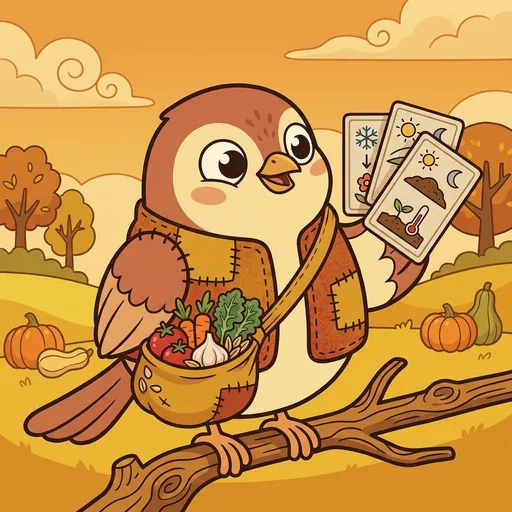
Seed was a small finch, warm cream on his belly with a soft russet cap that matched the sunrise. He was an almanac-keeper, though he was only a tween. He wore a chunky, well-worn vest that held a small seed-pouch and a stack of planting-calendar cards. He was always curious about the turning of the seasons. He was fond of saying, “When to plant. The calendar is a tool.”
His seed-pouch was a marvel, stitched from sturdy linen. Inside, it held tiny treasures: smooth tomato seeds, wrinkled carrot seeds, flat kale seeds, sharp garlic cloves, and slender rye grains. The planting-calendar cards were even more important. Each one showed frost dates for their valley, the exact day-length thresholds for different crops, and the ideal soil-temperature windows. These weren’t just decorations. They were the farmer’s most important instruments.
Seed understood something many people missed. Most folks thought a farmer just planted seeds whenever the ground felt soft enough. But Seed knew better. He knew the craft of seasonality + sowing — the careful work of matching what to plant to the perfect time. Every single crop had its own special window.
He often explained it to anyone who would listen, his voice clear and earnest. “Peas and spinach? They love cool soil. You plant them in late winter or early spring. They even tolerate a little frost.” He would tap a card. “But tomatoes and peppers? They need soil above sixty degrees Fahrenheit. Plant them too early, and they’ll die in the last frost.”
Garlic was different again. “You plant garlic in autumn,” Seed would say, “and it sleeps under the snow all winter. Then it sprouts in the spring.” Each crop, he insisted, had its own unique rhythm. “The calendar tells you when that window opens and when it closes.”
Planting outside that window was a waste of time and effort. “Plant a pea seed in warm May soil, and it just rots,” Seed explained. “A tomato seedling planted in March will blacken and die in a late frost. Garlic that skips autumn never forms a proper bulb.” The calendar, he believed, wasn’t optional. It was the farmer’s compass through the year.
Seed had grown up along the hedgerow-edges, near the fields of HarvestForge. His family had been the village’s almanac-keepers for generations. They were the finches whose careful tracking of flowering times had taught everyone a simple truth: every plant has a season, and that season tells the plant when to grow. The farmer’s job was to read both. Seed had carried that lesson forward, deep in his bones.
When he was twelve, he walked to HarvestForge for his appointment. Terra, the wise old mentor, had looked at him with kind, knowing eyes. “What is seasonality, Seed?” she asked.
Seed didn’t hesitate. “When to plant. The calendar is a tool. It’s calendar-craft.”
Terra smiled. “You are appointed,” she said.
Now, in his own small workshop, Seed often demonstrated his craft with the planting-calendar cards. “Watch this,” he would say, arranging three different seeds on his workbench: a pea, a tomato, and a garlic clove.
He pulled out three calendar cards. “Okay, so for the pea, we mark early March.” He placed the pea seed on that spot. “For the tomato, mid-May, after the last frost.” He set the tomato seed down. “And garlic? That goes in mid-October.”
He pointed to each. “Three crops, three very different windows. If you plant a pea in May, the soil is too hot, and it will rot before it can even germinate – that means to sprout and start growing.” He slid the pea seed away. “Plant a tomato in March, and it’ll die in the next cold snap. And if you plant garlic in May, it will never bulb up, never grow that big, round part we eat.”
Seed then showed another trick: succession planting. He took five lettuce seeds and spaced them out on the calendar, each sowing two weeks apart. “This way,” he explained, “each batch of lettuce matures about two weeks after the one before it. You get a continuous harvest from just one calendar move, instead of everything all at once.”
He looked up, his small finch eyes bright. “I am Seed. My job is to show you the craft of seasonality + sowing. The main idea is knowing when to plant, using the calendar as your compass, and understanding that every crop has its own window.”
He was gentle, but firm, in his advice. “Don’t guess,” he said. “Always look it up. Ask questions. And write down what happened in your own notebook.” He held up three fingers. “The almanac is one source. Your local extension service is another. But your own notebook, filled with notes from past seasons? That’s the most local, and often the best, of all.”
He tapped a calendar card. “The calendar doesn’t just hang on a wall. It lives in the field. And the field, in turn, teaches the calendar back to you.”
“When to plant,” he repeated, a quiet mantra. “The calendar is a tool.”
The HarvestForge ensemble
Seed is part of HarvestForge's distributed-narrative cast. Each character embodies a different curricular primitive; together they teach the full subject.
-

Soil
Soil microbiome + nutrient cycling — soil is alive; soil-as-community framing
-
Chain
Supply chain literacy — every loaf tells a journey; whose-hands framing
-
Share
Food access + food-justice — community-food-network framing; food deserts are systems, NOT moral failings
-
Steward
Sustainable practices + intergenerational restoration — field remembers; latest-not-first framing