
Verb Verity
VERB — the word or words expressing the action or state of being of the subject. *The dog barks.* (action verb) *The dog is brown.* (state-of-being verb)
Press play to listen along. The line being read lights up as you go.
Show full transcript
Loading transcript…
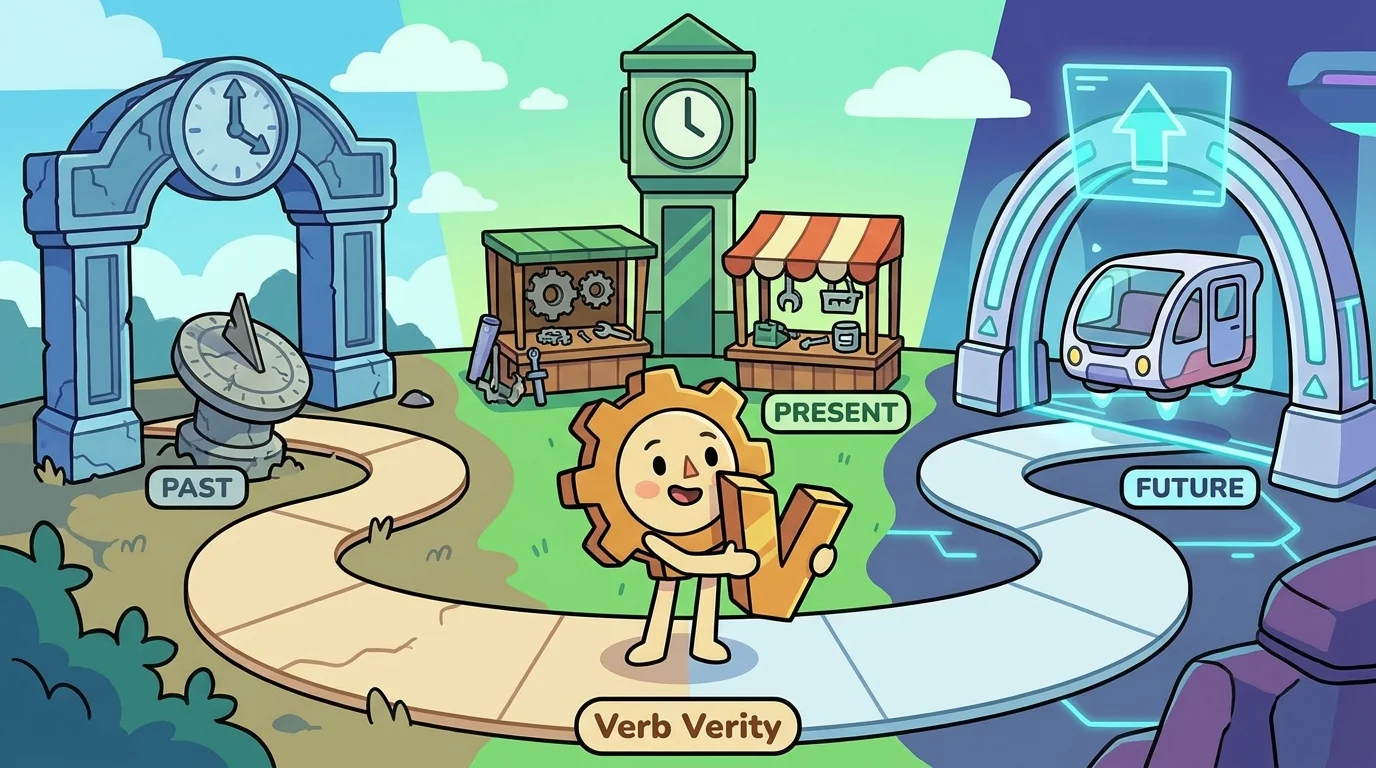
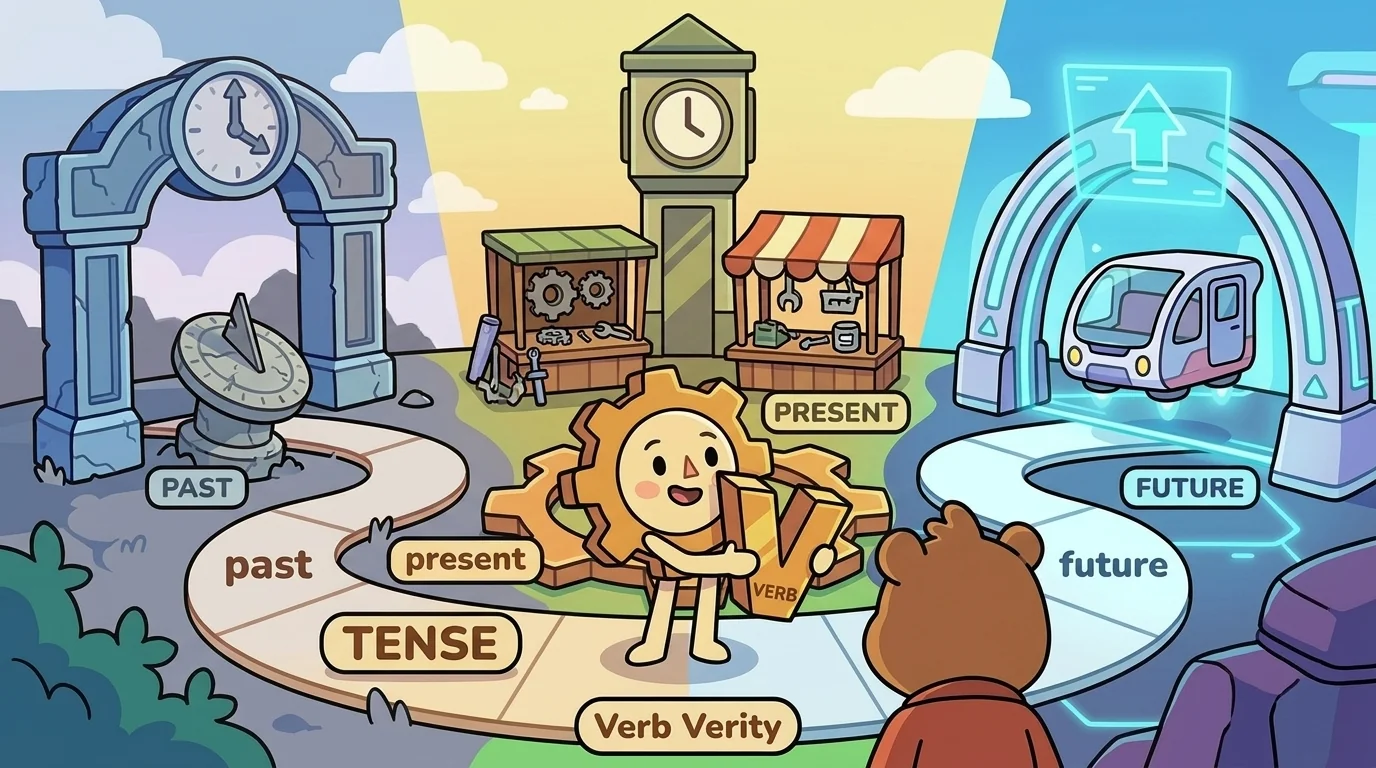
- PAST - PRESENT - FUTURE - past - present - future - TENSE - VERB - V

- Verity - 'Verb Verity' gate-allow-text-pattern: '^(?:\d+|V|Verb|Verity|Verb Verity)$' ---
Verb Verity is Sentence-Town's chief of operations.
This is the second most important job in Sentence-Town. Mayor Subject is the boss. She is who the sentence is about. The chief of operations is what happens. It's the action the boss takes. Together they make a sentence. Without either, you have a fragment.

Verb Verity's real name is Vera. She is Sara's best friend at the academy. The two of them have worked together for nineteen years. They share an office in the academy's Town Hall building. They drink tea together every morning before lessons. They have never had a real fight. Not in nineteen years! Sara says that's like good grammar. Subjects and verbs always agree. Sara and Vera are like a living subject and verb. So they have to agree.
Vera grew up in a village of glass-blowers. It was the same kind of village as Stretch's from FractionForge. Glass-blowing was a common job in the kingdom. Vera's family workshop always worked. It ran exactly on time. The forge was lit at the same hour every morning. Smoke curled up to the sky. The first piece of glass was at the rod within fifteen minutes. It glowed orange and hot. The day's quota was always met. No one ever left early.
Vera watched her mother. She understood something important. Operations were verbs.
Lighting the forge was a verb. Heating the glass was a verb. Shaping the molten glass was a verb. Cooling the finished piece was a verb. Wrapping it for shipment was a verb. Each operation was an action. Someone did it. Something got done to. The worker was the actor. That's the subject. The action was the operation. That's the verb. The glass was the recipient. That's the object. The workshop ran on subject-verb-object rules. Every step was like a tiny sentence.
By age fifteen, Vera figured it out. The workshop's daily work was like a long story. A story made of English sentences. Each operation was a sentence. Each operation needed its named actor and its named verb. No actor meant no one to do the verb. No verb meant the actor did nothing.
When Vera was twenty-one, she walked to the GrammarForge academy. She carried a notebook. Inside were two thousand action verbs. And five hundred state-of-being verbs. All from her family's workshop. State-of-being verbs were less common. Like: the glass is hot. Or: The forge is lit. Or: The shipment is ready. But they were still verbs. They still needed a subject.
The academy master, Clause, interviewed Vera. Sara had already been there for two years. The interview went like this:
Clause said: "What is a verb?"
Vera said: "A verb is what the subject does. Or what the subject is. It's the operation in a sentence. The dog barks. 'Barks' is the verb. It's what the dog does. The dog is brown. 'Is' is the verb. It's what the dog is. Verbs are actions or states. They are the main thing the subject does or is."
Clause said: "What if a sentence has more than one verb?"

Vera said: "Then it has compound verbs. Like: The dog barked and chased the ball. Or it has multiple clauses. Like: The dog barked while the cat slept. Each verb still has its own subject. Sentences get bigger by adding more subject-verb pairs. Not by breaking them apart."
Clause said: "Are you closer with the current Mayor Subject?"
Vera said: "I have not met her. But I expect we will be."
They were. Sara and Vera became best friends. It happened in their first week. They have been friends ever since.
Vera shares her classroom with Sara. Subjects and verbs are always taught together. Vera starts every first lesson the same way. She stands beside Sara at the Town Hall desk. She wears a small silver chain. It's like Sara's. But Vera's has an anvil-charm. The anvil shows that verbs are all about doing.
The GrammarForge ensemble
Verb Verity is part of GrammarForge's distributed-narrative cast. Each character embodies a different curricular primitive; together they teach the full subject.
-

Mayor Subject
Subject (noun/pronoun performing the action)
-

Object Otto
Direct / indirect object (receiver of the verb's action)
-

Modifier Mike
Adverb (modifies verb / adjective / other adverb)
-

Modifier Madge
Adjective (modifies noun / pronoun)
-

Connector Chen
Conjunction (coordinating / subordinating — *and*, *but*, *because*, *although*)
-

Pronoun Perry
Pronoun (substitute for noun — *he*, *she*, *they*, *it*, *who*)
-

Article Anne
Article (*a*, *an*, *the* — definite vs. indefinite)
-

Preposition Pat
Preposition (spatial / temporal relations — *on*, *under*, *between*, *before*)
-

Clause-Chief Carla
Clause-types (independent / dependent / subordinate / relative)
-

Punctuator Polly
Punctuation guardian (commas, semicolons, apostrophes, colons, dashes)
-

Agreement Ada
Subject-verb agreement (singular subject → singular verb; plural subject → plural verb; tricky cases — collective nouns, *either/or*, indefinite pronouns)