
Pronoun Perry
PRONOUN — a word that substitutes for a noun previously mentioned. *He, she, it, they, who, that.* Reduces repetition.
Press play to listen along. The line being read lights up as you go.
Show full transcript
Loading transcript…
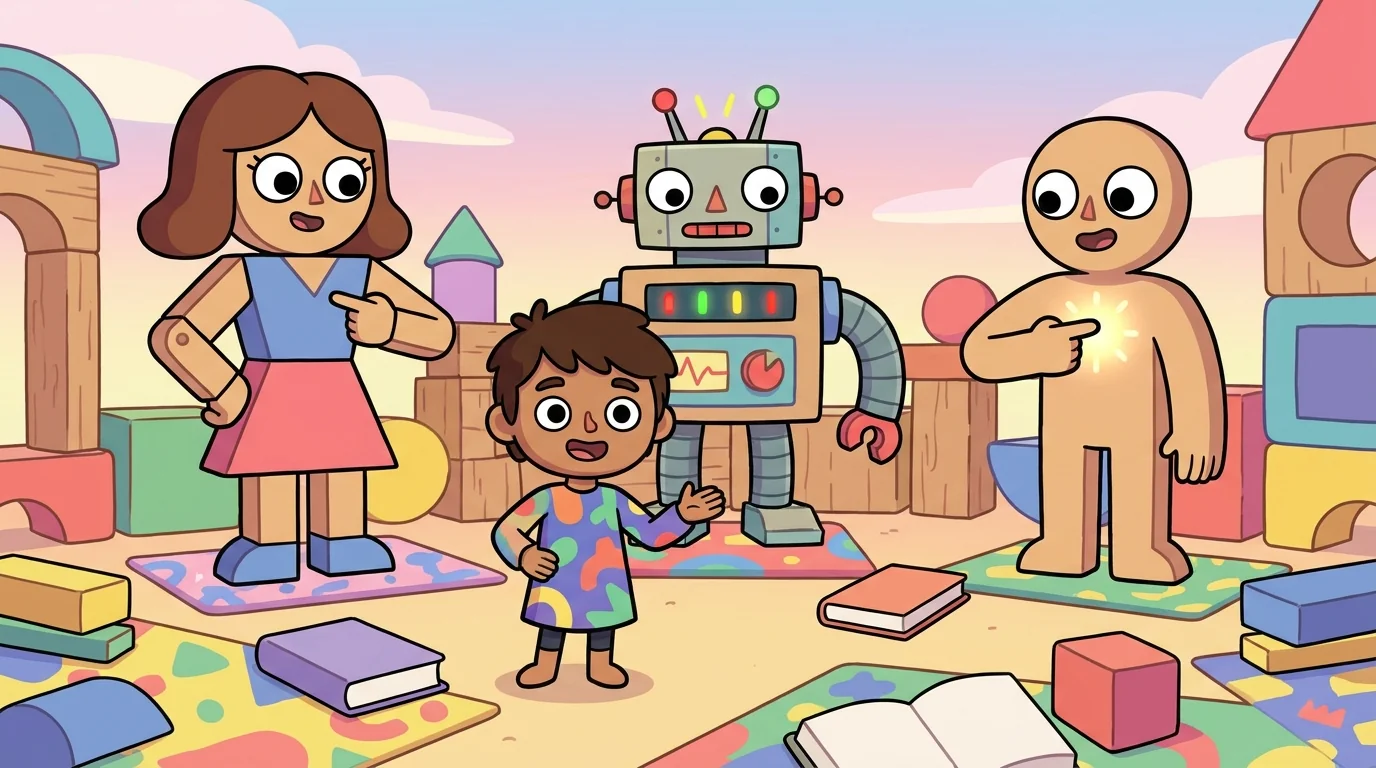
Peregrine, though everyone called him Perry, was Sentence-Town's substitute clerk. His job was *efficient referring. When a noun had already been mentioned in a sentence – like the dog – and that same noun needed to appear again, Perry would step in. He substituted a pronoun for the noun. This way, the sentence didn't have to repeat the full noun. Think of it: "The dog barked, and the dog ran" became "The dog barked, and he ran." That little he* was Perry's work. The substitution kept the meaning clear but cut down on needless repetition.
Perry himself was efficient and slightly invisible. His invisibility, in fact, was the whole point. Good pronoun use worked like that; the reader never noticed the substitution. They just followed the meaning without a second thought. Bad pronoun use, on the other hand, was very visible. A reader would pause, confused: Who is he referring to? Perry’s main goal was to make sure his work vanished into the flow of words.
Perry grew up in a family of meticulous record-keepers. His parents both worked at the kingdom's central records office. They had spent their lives filing millions of small administrative cards. From a young age, they taught Perry a vital lesson. A well-organized records system never repeated information unnecessarily. Each piece of data could be filed once. After that, it was simply referenced by a short code, a card-number, or a name-tag. "Reference replaces repetition," his father would often say, tapping a stack of freshly filed papers. This was the central principle of records management.
By the time Perry was twelve, he saw the connection. English pronouns were doing the exact same job as those record-references. A noun was introduced, like a new file opened. The noun didn't need to be brought out again. A pronoun simply referred back to that noun, continuing the conversation smoothly. The pronoun was like a tiny card-number for the noun, pointing straight to the original file.

When Perry turned twenty, he walked to the GrammarForge academy. He carried a thick folder, stuffed with years of careful observation. Inside, he had compiled a long list of what he called "pronoun-antecedent pairings." He had pulled them from all sorts of books. Some showed how good writers managed their pronouns. They always made it perfectly clear which noun a pronoun referred to. Others showed how bad writers worked, leaving the reader utterly confused. The academy master, a stern but fair woman named Ms. Syntax, listened patiently. She studied his examples, her gaze sharp. When Perry finished, she simply nodded. "You understand the invisible work," she said. She appointed him to the substitute-clerk role on the spot.
Perry has been the academy's pronoun teacher for twelve years now.
In his classroom, he starts every first-day lesson the same way. On his desk sits a small wooden card-rack. It’s filled with small index cards. Each card has a noun written on it. He picks up a card, holding it high for everyone to see. "Here we have the dog," he announces, his voice calm and clear. He places the card carefully into a slot in the rack. "This is our original noun. Our first mention."
Then, he picks up a smaller, lighter card. This one just says "he." He slides it right in front of the "the dog" card. "This," Perry explains, "is what a pronoun does. He is a substitute for the dog. The original card is still in the rack, you see. The noun has been filed. But the reference is now a smaller, lighter card. Both cards still point to the same dog." He pauses, letting the idea settle. "It's quicker. It's cleaner."
A student, a boy named Leo with perpetually messy hair, raises his hand. "So, like, if I say 'Leo likes pizza, and Leo ate a whole pizza,' that's bad?"
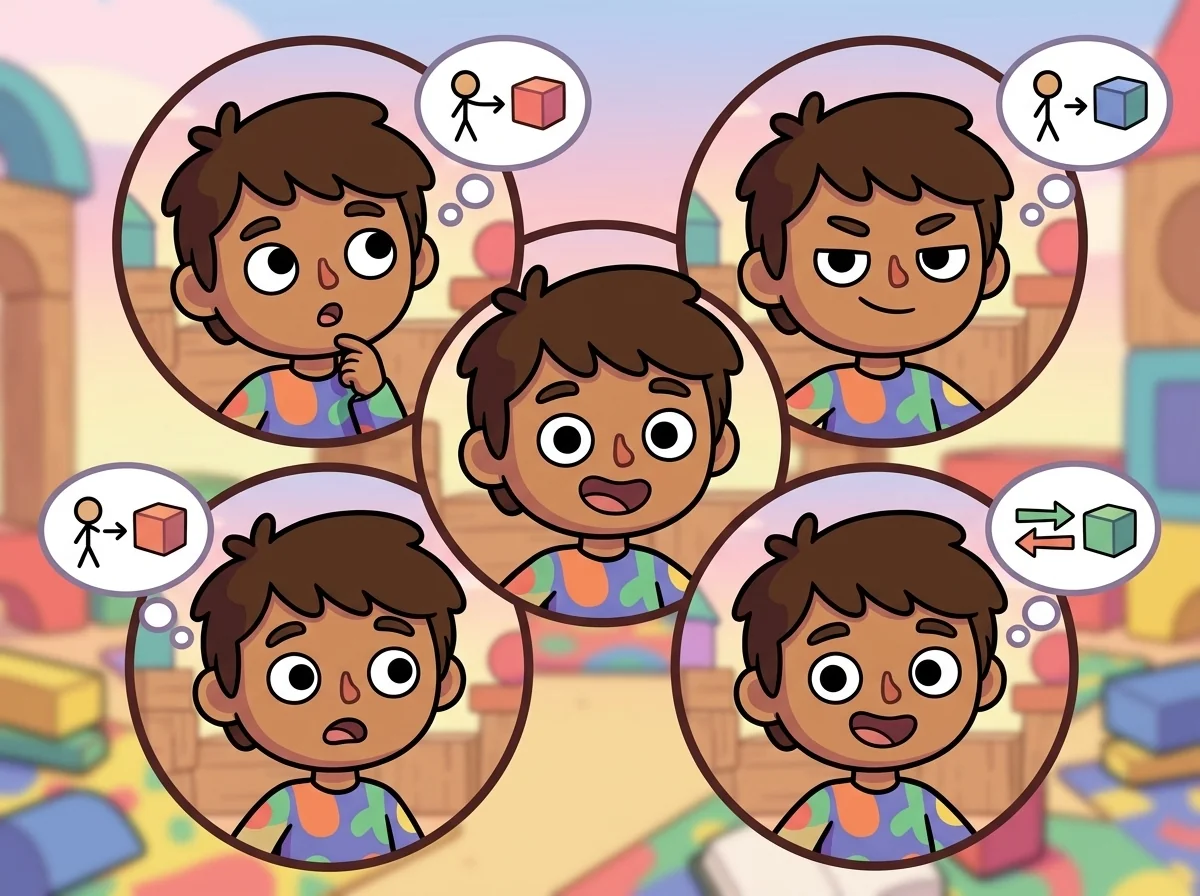
Perry smiles. "Precisely, Leo. How would you fix it?"
Leo thinks for a moment. "Leo likes pizza, and he ate a whole pizza?"
"Excellent," Perry says. "You've made an *efficient reference*."
He then demonstrates the kinds of pronouns. "We have he, she, it, they," he says, gesturing to the class. "These are third-person pronouns. They refer to someone or something else." He points to himself. "I and we are first-person. They refer to the speaker." Then he points to a girl in the front row. "You is second-person. It refers to the person being spoken to." He pulls out more cards. "Who, which, that are relative pronouns. They connect parts of sentences." He holds up a card that says "This." "This, that, these, those are demonstrative pronouns. They point things out." Finally, he shows cards like "myself, yourself, himself." "These are reflexive pronouns. They refer back to the subject of the sentence." Each pronoun type, he explains, has its own specific way of referring.
Next, Perry teaches the *pronoun-antecedent agreement rule. This is where things can get tricky, and it’s a rule he emphasizes. "A pronoun must agree with its antecedent in number and gender," he states. "The antecedent is the noun the pronoun refers back to. Number means singular or plural. Gender* means masculine, feminine, or neuter."
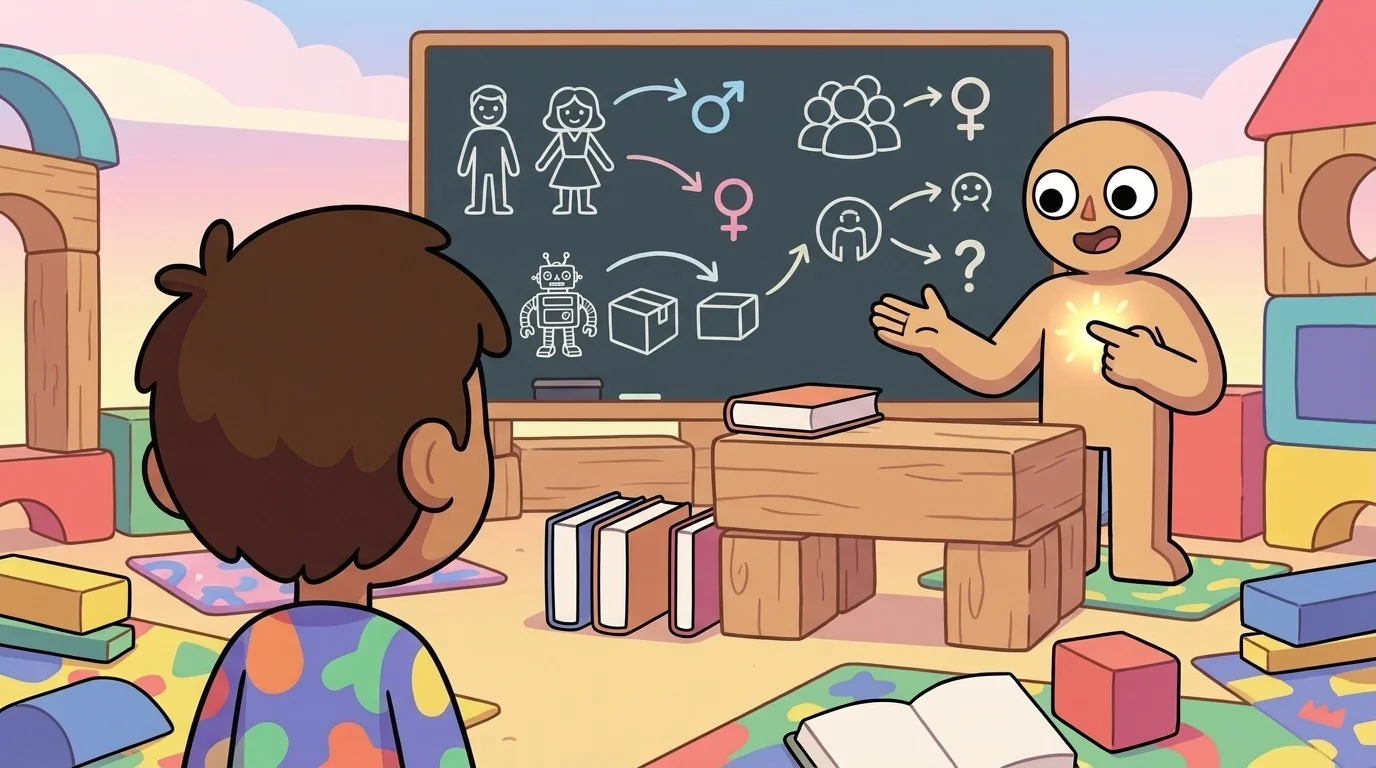
He holds up the the dog card. "If our antecedent is the dog," he says, "which is singular and neuter, what pronoun do we use?"
"It!" several students call out.
"Correct. It." He then holds up a card saying the dogs. "What about the dogs?"
"They!"
"Good. Now, what if we have the dog and the cat?" Perry asks, holding up two cards side-by-side. "Two singulars, but together they form a compound subject."
A girl named Maya, who always had her hand up, answers, "Still they! Because it's plural now."

"Exactly, Maya. The compound makes it plural." Perry then moves to the trickiest part, the one that causes the most errors. "Now, listen carefully. What about the word everyone?" He writes it on the board. "It seems plural, doesn't it? Like it means many people."
"Yeah, 'everyone' is lots of people," Leo agrees.
"Grammatically," Perry explains, "it is singular. Traditionally, you would say 'Everyone brought his or her lunch.' But modern usage has changed. Now, it's perfectly acceptable, and often preferred, to say 'Everyone brought their lunch.'" He writes the example on the board: "Everyone brought their lunch." "This avoids awkward phrasing and is widely understood." The agreement rule, he tells them, is the single most common source of pronoun errors.
When children ask whether pronouns are hard, Perry always gives the same answer. His voice softens slightly, but his message is firm.
"They are not hard," he says. "They are references. Each pronoun points back to a noun that was introduced earlier. Your job, as a writer, is to make sure the reader can always follow that reference. If the reference is unclear, if there's any confusion at all, then use the original noun. Clarity matters more than brevity. Always."
He still keeps the wooden card-rack on his desk. Sometimes, the children ask if they can add their own noun-and-pronoun cards. Perry always lets them. After twelve years, the card-rack is quite full now. It holds a colorful collection of student-contributed cards, each one a testament to an invisible, efficient reference.
The GrammarForge ensemble
Pronoun Perry is part of GrammarForge's distributed-narrative cast. Each character embodies a different curricular primitive; together they teach the full subject.
-

Mayor Subject
Subject (noun/pronoun performing the action)
-

Verb Verity
Verb (action / state of being)
-

Object Otto
Direct / indirect object (receiver of the verb's action)
-

Modifier Mike
Adverb (modifies verb / adjective / other adverb)
-

Modifier Madge
Adjective (modifies noun / pronoun)
-

Connector Chen
Conjunction (coordinating / subordinating — *and*, *but*, *because*, *although*)
-

Article Anne
Article (*a*, *an*, *the* — definite vs. indefinite)
-

Preposition Pat
Preposition (spatial / temporal relations — *on*, *under*, *between*, *before*)
-

Clause-Chief Carla
Clause-types (independent / dependent / subordinate / relative)
-

Punctuator Polly
Punctuation guardian (commas, semicolons, apostrophes, colons, dashes)
-

Agreement Ada
Subject-verb agreement (singular subject → singular verb; plural subject → plural verb; tricky cases — collective nouns, *either/or*, indefinite pronouns)