
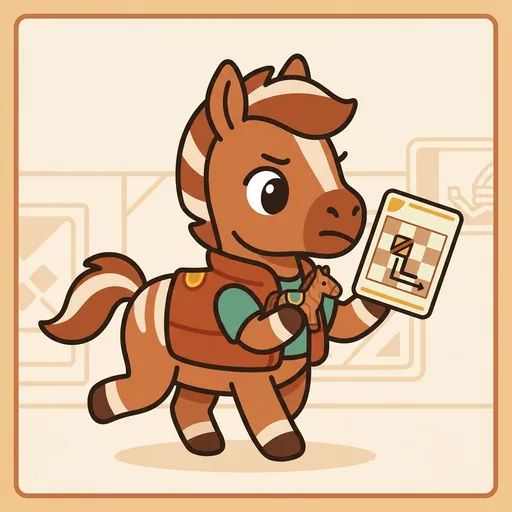
Knight Lu
LU — the knight moves one-then-diagonal, but the first step can be blocked.
Listen along — Knight Lu
Loading audio…
Press play to listen along. The line being read lights up as you go.
Show full transcript
Loading transcript…
Chapter 3 — Knight Lu and the Blockable Jump
The board was quiet, and Knight Lu was about to make a beautiful move.
There, two steps away, sat an enemy soldier — undefended, waiting to be taken. Lu could see the whole path in her head: forward one square, then diagonal one square out, landing right on top of it. A clean capture. The kind of move that made a crowd lean in.
She lifted a hoof. And then, out of pure habit, she looked at the square in between.
There was a friendly cannon sitting right on it.
Lu set her hoof back down. “Hm,” she said, to no one.
A little pig-tween across the table blinked. “You’re not going to take it? It’s right there.”
“It is right there,” Lu agreed. “But my first step is blocked.” She tapped the cannon gently with the edge of her horse-charm. “I move one square straight, then one diagonal. That straight step has to pass through this square first. And someone’s standing in it.”
“So jump over him.”
Lu shook her head, warm and unhurried. “That’s a different game. In this one, my horse can’t leap. If the path is blocked, the move is simply gone.” She studied the board again, found another line, and slid to the left instead — a slower plan, but a real one. The soldier stayed safe for another turn, and Lu didn’t mind at all.
“You saw it, though,” the pig-tween said. “You saw the good move.”
“I did,” said Lu. “Seeing it is easy. The hard part is checking whether it’s actually allowed.”
Lu learned to check the in-between square the day she got badly, embarrassingly stuck.
She was small then, and quick, and very proud of being quick. She’d found what she was sure was the winning move and thrown her hoof down on it fast, before anyone could stop her — and her hoof had landed on a piece that was already blocking her path. The move wasn’t legal. She had to take it back in front of everyone.
Her face went hot. Her chest tightened up the way it does when you’ve been sure and turned out wrong. She wanted to slide right off the edge of the board and disappear.
An old horse who kept the games at the market lowered himself down beside her. He didn’t tell her to be more careful. He just said, softly, “You went straight for the landing, didn’t you? You forgot to look at the road.”
Lu nodded, miserable.
“Everybody wants to look at where they’re going,” the old horse said. “Almost nobody looks at what they have to pass through to get there. That in-between square — that little step you don’t even think about — that’s the whole thing. Miss it, and the cleverest plan in the world just… stops.”
That night Lu lay awake and turned it over. The hot, stuck, wrong feeling didn’t go away, exactly. But it changed shape. It became a small quiet voice that said, before every move: look at the road, not just the landing. And once she started listening to that voice, the stuck feeling almost never came back.
She walked to the General’s academy at twelve, because a place that studied strategy ought to respect the moves that could be stopped.
General Mei met her at the gate and asked no hard questions. Just one. “Show me how your horse moves.”
Lu didn’t answer with words. She set two pieces on the practice board: her own horse, and a single stone directly in front of it. Then she looked up.
“Go on,” Mei said. “Move the horse.”
“I can’t,” Lu said. “Not that way. The stone is on the square my first step passes through.” She reached out and moved the stone aside, and then she made the L-shaped jump, smooth and certain. “See? The move was never wrong. The road was just closed. Move the block, and the road opens.”
General Mei looked at the two pieces for a long moment. “Most beginners,” she said slowly, “learn every move a piece can make, and forget the one thing that stops it. You learned the stopping first.”
“The stopping is the interesting part,” Lu said.
Mei smiled. “You belong here.”
Lu’s corner of the academy was always full of students who moved too fast.
A young rabbit came storming up one afternoon, ears flat with frustration. He’d been trying the same knight capture over and over, and the tutor kept telling him it wasn’t allowed. “But it’s a knight move,” he said. “One and then diagonal. I did it exactly right and it’s still wrong!”
Lu knew that flat-eared feeling. She’d worn it herself.
“Set it up for me,” she said. He did — his horse, and the piece he wanted to take.
“Now,” said Lu. “Before you touch anything — put one hoof on the square your horse would step through first. The straight step, before the diagonal.”
The rabbit reached out. His paw hovered over the in-between square. And there, sitting on it, was one of his own pieces.
He went very still.
“Oh,” he said.
“There it is,” said Lu, gently. “The road was closed the whole time. Your move was perfect. It just wasn’t available.” She nudged the blocking piece to a new spot. “Try it now.”
The rabbit made the jump. It landed cleanly. He let out a breath he’d been holding for what looked like an hour.
“So it’s not a rule about the knight,” he said, working it out. “It’s a rule about the square in front of it.”
“That’s the whole craft,” said Lu. “Check the in-between square before you believe the jump is legal. Block the road, and the horse is stuck — no matter how good the landing looks.” She tilted her head. “Every game has its own rules. This one asks you to look at the road. So we look at the road.”
Later, when the corner had emptied out, the rabbit came back with a smaller, quieter question.
“When you check the in-between square,” he said, “and you have to give up a move you really wanted… doesn’t it feel bad? Like you lost something?”
Lu thought about the hot-faced day at the market, and the old horse, and the little voice she’d carried ever since.
“It used to,” she said. “The first time, it felt awful — like being caught, like being clever and wrong at the same time.” She reached out and rested her hoof, for just a second, on the square between two pieces. “But now, when I stop and check the road, it feels like the opposite. It feels like slowing my breath. Like I’m not going to get caught this time, because I already looked.” She smiled at him. “The pause isn’t losing something. The pause is the safe part.”
The rabbit nodded slowly, and Lu watched his ears lift back up — the same way, years ago, her own stuck feeling had finally let go.
She didn’t say the rest out loud. But she felt it, calm and sure, all the way down to her hooves: the careful, in-between moment — the one everybody rushes past — is the one that keeps you steady.
The GeneralsTale ensemble
Knight Lu is part of GeneralsTale's distributed-narrative cast. Each character embodies a different curricular primitive; together they teach the full subject.
-

General Zhang
Decisive command — clear orders, clear outcomes
-

Elephant Wei
Powerful straight-line attack pattern
-

Soldier Jin
Forward-advancing infantry — pawn structure
-
Chariot Che
The chariot — straight-line power that sweeps the whole open file
-
Advisor Shi
The advisor — palace-bound diagonal guard who never leaves the General
-

Marshal Shuai
The General piece — the calm center the whole game protects
-

River Chu
The central river — the boundary that divides the board and transforms soldiers who cross it
-
Palace Gong
The palace — the fortress home that shelters the General and advisors
-
Sightline
The flying-General rule — the watcher of the invisible line between the two Generals