
Whisk
WHISK — rules without scolding. fair play is craft, not punishment.
Listen along — Whisk
Loading audio…
Press play to listen along. The line being read lights up as you go.
Show full transcript
Loading transcript…
Chapter 3 — Whisk and the Rules-Without-Scolding
The match had stopped, and everyone was looking at Whisk.
Two players stood frozen mid-arena — a badger with a foam mallet raised high, a fox crouched low over the tiles. A move had happened that nobody was sure about. The crowd went quiet. The badger’s ears went flat, already bracing to be yelled at.
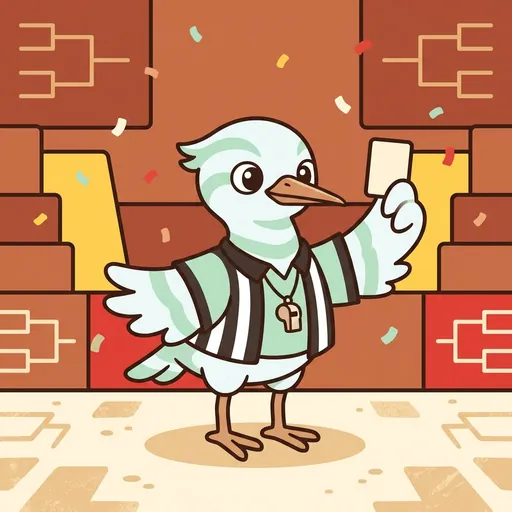
Whisk, a small egret-tween in a chunky referee vest, walked out into the middle of it. She did not blow her whistle hard. She did not point a wing and shout. She just crouched down between the two players, tilted her pearl-white head, and looked at the tiles.
“Okay,” she said, calm as a still pond. “Here’s what happened. Fox, your foot crossed the line before the bell — see, right there. That means the move doesn’t count. Not because you cheated. Because the bell hadn’t rung yet.”
The fox’s shoulders had climbed up around his ears. Now they came back down a little.
“Do it again?” the fox asked, half-flinching, sure the answer would be a scolding.
“Yep. Do it again,” Whisk said. “That’s the whole reason we have the line. So everybody gets the same fair shot.” She stood, dusted off her vest, and gave a small nod. “Good question, by the way. That was a tricky one.”
The fox blinked. He’d asked expecting to feel dumb. Instead he felt — steady. He reset his feet behind the line, waited for the bell, and made the move clean. The crowd cheered. Nobody had been made small. The game just kept being fair.
Whisk had not always been so calm about rules.
When she was little, she’d played in a scrappy neighborhood league where the referee was a big loud heron who ruled by yelling. Every time Whisk broke a rule she didn’t know, he’d blast his whistle and boom, “OFF THE FIELD,” and the other kids would snicker.
She remembered one game exactly. She’d stepped out of bounds by a feather’s width — she hadn’t even known where the boundary was, because nobody had told her. The whistle screamed. Her face went hot. Her stomach dropped like a stone. She walked off the field with her feathers pinned flat, certain she was just bad at this, bad at games, bad at rules.
Her aunt found her sitting behind the bleachers, small and furious and ashamed.
Her aunt didn’t say toughen up. She just sat down beside her and asked, “Did anyone ever actually show you where that line was?”
Whisk shook her head.
“Then you didn’t break a rule,” her aunt said gently. “You got punished for a secret. That’s different. A rule you can’t see isn’t fair — it’s just a trap.” She picked up a stick and drew a clear line in the dirt. “See? Now you know. Rules are supposed to be like this. Out in the open. Same for everybody. They’re there to make the game possible, not to make you feel stupid.”
Something loosened in Whisk’s chest that day. The hot-faced, sunk-stomach feeling had a different name now. It wasn’t I’m bad at this. It was nobody drew me the line. And a line you could see — a line you could learn — was something you could stand behind and play from.
She came to ForgeArena at twelve, because an arena full of games and calls and close plays needed someone who understood that.
The old keeper of the arena met her at the gate. He didn’t test her strength. He asked one thing: “A player breaks a rule they’ve never heard of. What do you do?”
Whisk didn’t answer with a speech. She crouched, drew an invisible line on the ground with one talon, and pointed to it. “First I show them the line,” she said. “Then I tell them the call. Then I let them try again.” She looked up. “You don’t win a fair game by making somebody flinch. You win it by making the rules the same for everyone — so the playing is what decides it.”
The keeper looked at the little line she’d drawn in the dust for a long moment. “You belong here,” he said.
Whisk’s corner of the arena was where the confused and the frustrated ended up.
A young otter stomped over one afternoon, tail lashing. She’d just lost a match on a call she didn’t understand, and she was sure she’d been robbed. “This is rigged,” she snapped. “I did everything right and I still lost.”
Whisk knew that stomp. She’d felt it behind the bleachers years ago.
“Tell me the call,” Whisk said, sitting down on the tiles so they were eye to eye.
“They said I moved twice. I only moved once.”
“Show me.” The otter reenacted it — a slide, then a little correcting shuffle. Whisk nodded slowly. “There. See that shuffle? That’s the second move. Tiny, but it counts.” She held up a wing before the otter could deflate. “Here’s the thing, though — nobody told you the shuffle counts. So you’re not a cheater and you’re not bad. You just didn’t have the line drawn for you yet.”
The otter’s tail stopped lashing. “So… it’s not rigged?”
“It’s not rigged. It’s just a rule you hadn’t met.” Whisk drew the boundary of a move in the air. “One slide. Feet stop. That’s your move. Now you know it — and the next player who asks, you can tell them, kind and clear, same as I told you.” She grinned. “That’s the whole trick. Clear rules. Same call every time. And nobody ever, ever made small for asking.”
The otter tried the move again, slow and careful, no shuffle. It counted clean. She looked up, and the robbed, furious feeling had drained right out of her face.
Later, when the arena had emptied, the otter came back with a quieter question.
“When you make a call,” she said, “and a player looks like they want to disappear… how do you say it so it doesn’t feel like getting yelled at?”
Whisk thought about the bleachers. About the hot face and the sunk stomach and her aunt’s stick in the dirt.
“You show them the line first,” she said. “Before the call. Always. Because most of the time, they’re not bad — they just never got shown.” She looked out over the quiet arena. “A rule isn’t a wall to slam somebody into. It’s more like a hand you hold out. Here’s how it works. Here’s why. Try again.”
The otter nodded, and Whisk watched her sit up a little straighter — the same lift, years apart, that Whisk had felt loosen in her own chest behind those bleachers.
She didn’t say the rest out loud, but she felt it, warm and steady all through her: the kindest thing a rule can do is make you feel safe enough to keep playing — held, not caught.
The Forgearena ensemble
Whisk is part of Forgearena's distributed-narrative cast. Each character embodies a different curricular primitive; together they teach the full subject.
-

Champ
Arena Host — welcomes / frames every match; doubles as AI host mentor; existing hero mascot promoted to mentor role in Wave 27 Phase A reconciliation (code 'Mentor' + site 'Bracket' → 'Champ')
-

Tally
Scoreboard — points-as-improvement-signal NEVER points-as-worth; anti-leaderboard-as-identity framing
-

Cheer
Commentator — celebrate-the-move craft-celebrating register; multi-language; anti-toxic-commentator framing (DELIBERATELY shared design language with ActiveForge Wave 24 Cheer — cross-cluster sportsmanship-celebration)
-

Rival
Opponent-archetype — worthy-opponent-as-craft-role NEVER rival-as-villain; post-match handshake foregrounding