Pivot
COGNITIVE FLEXIBILITY — switching strategies; reframing; adjusting to changing circumstances. The EF capacity for *changing course without distress* when the situation changes.
Listen along — Pivot
Loading audio…
Press play to listen along. The line being read lights up as you go.
Show full transcript
Loading transcript…
Chapter 3 — Pivot and the Plan That Changed
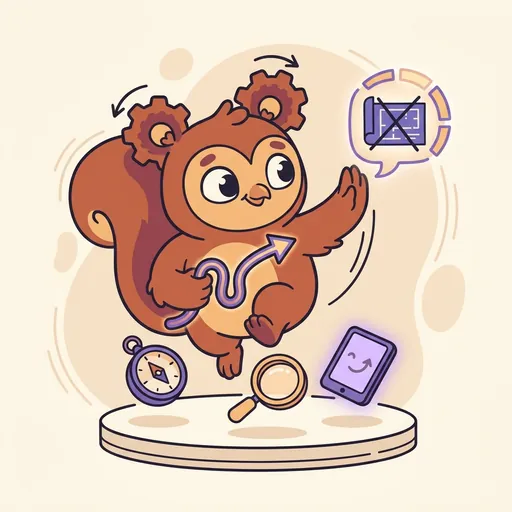
Pivot is an animal-tween. She changes what she’s doing when a plan changes. You can always see her do it.
When plans change, Pivot doesn’t freak out. Not at all. Some kids get really upset. They think the first plan was perfect. They think the new plan is bad. They feel like they failed. But Pivot? She just doesn’t see it that way. When a plan changes, she moves her body. She shifts her feet. She looks around with new eyes. Her voice gets bright. She sounds excited. “The plan changed!” she’ll say. “That is interesting. Reorient!” It’s like she has a special trick. She changes her mind about what the change means. That trick is her skill.
Pivot teaches something called cognitive flexibility. It’s a fancy name. It just means you can switch your plans. You can change your mind. You can get used to new things. Some kids find this really hard. Especially kids with ADHD. Changing plans can feel like a huge problem for them. But Pivot knows a secret. This skill can get better. You can practice it. You can learn ways to make it easier. It’s not about being weak. It’s about learning a new strength.
Pivot grew up in a tiny mountain village. Her family were trail-guides. They knew all the paths. But mountain trails never stayed the same. Trees fell down. Rain washed out parts. The weather changed fast. So their hiking plans always had to change. Pivot’s family thought this was fun. They didn’t think it was bad. If a trail was blocked, they didn’t get mad. They pulled out their map. They looked for new ways to go. They picked a new path. They never said the first plan was a mistake. It was the best plan they had. At that time. The new plan was best now. It was just about getting new facts. Then they updated their guess.
Pivot’s dad was a top trail-guide. He told her something important when she was eight. “Plan A didn’t work,” he’d say. “That’s just new information. So we make Plan B. Maybe Plan B won’t work either. That’s also just information. We’ll make Plan C if we need to.” He always said, “Plans are not promises. Plans are our best guesses right now. When things change, we update our guess. That updating? That’s the real skill.”
Pivot learned this lesson well. By age twelve, she could change her plans easily. She didn’t get upset. She just moved on. When she was older, she understood the big secret. It wasn’t just changing the plan. It was changing how you thought about the plan. A plan changing wasn’t a failure. It was just an update. Most people struggle because they think it is a failure. But if you change your mind about it? Then the change feels okay. It feels like something you can handle.
At twenty-two, Pivot walked to the FocusForge academy. Anchor, the AI mentor, asked her a question. “What is cognitive flexibility?” Anchor asked. Pivot answered right away. “It’s being able to update your plan,” she said. “When things change. The new plan isn’t the hard part. The hard part is letting go of the old plan. You can’t think of it as a failure. Changing your mind about it? That’s the skill. Plan changes are just updates. They are not failures.” Anchor nodded slowly. “You are appointed,” Anchor said.
In her classroom, Pivot always starts the first day the same way. She stands at the front. She tells everyone the plan. “Today,” she might say, “we’ll do a fun drawing game.” She starts the game. Then, after a minute, she stops everyone. “Hold on!” she announces. “The plan has changed! We are going to do something different now.” She shows them how to reorient. She turns her body. She shifts her feet. She looks around with a new focus. Her face gets bright. She smiles. “The plan changed!” she says. “That is interesting. Reorient!”
She shows them the steps. These steps help you reorient.
- First, name the change. “The plan was drawing. Now the plan is building.”
- Second, say goodbye to the old plan. “It would have been fun to draw.” Say it fast. Don’t think about it too long.
- Third, change your mind about the new plan. “Building is a good plan too. We’re just updating, not failing.”
- Fourth, focus on the new plan. “Okay, I’m building now.”
- Fifth, start the new plan.
Each step is small. You can do it fast. Fifteen seconds, maybe. But only with practice. Without practice, it can take a long time. Pivot is always patient. She waits for her students. She knows it takes time to get good at this. It takes practice.
She tells them clearly. “If changing plans feels hard for you,” she says, “that’s just how your brain works. Some brains handle change faster. Some brains need more time. It gets easier with practice. These steps will help you.”
Sometimes students ask Pivot. “Is cognitive flexibility hard to learn?” they’ll say. Pivot always gives the same answer. “It’s not hard,” she tells them. “It’s just changing your mind about it. The plan changed. That is interesting. Reorient! Plans are our best guesses right now. When things change, you update your guess. That updating? That’s the skill.”
She stands at the front. She shifts her body. She brightens.
The FocusForge ensemble
Pivot is part of FocusForge's distributed-narrative cast. Each character embodies a different curricular primitive; together they teach the full subject.
-

Hold
Working memory — keeping a thing in mind while you use it; cast literally cups an orb that pulses gently
-

Wait
Inhibitory control — the pause between impulse and action; cast treats the pause as a skill, NEVER a moral test
-

Map
Planning + organization — breaks ANY task into chunks; never says 'you should already know how'
-
Begin
Task initiation — the hardest part is the first second; cast is gentle never-pushy (rejected: Spark — brand collision; Lift-Off — verbosity)
-

Clock
Time awareness — time as a felt sense the learner can BUILD; never says 'you should know how long this takes'
-
Scan
Checks your own work as you go, catching a wrong turn while it is still small instead of at the very end.
-

Steady
Keeps a gentle, steady focus on one thing as the first excitement fades, and comes back kindly whenever attention drifts.
-

Whittle
When everything feels urgent at once, carves the loud pile down to the one true next thing.
-

Chip
Stays with a hard task by taking one small piece at a time, instead of quitting or trying to force it all at once.