Yaw
YAW — *the rudder is the polish on the turn. the bank does the turning; the rudder polishes.*
Listen along — Yaw
Loading audio…
Press play to listen along. The line being read lights up as you go.
Show full transcript
Loading transcript…
Chapter 4 — Yaw and the Polish on the Turn
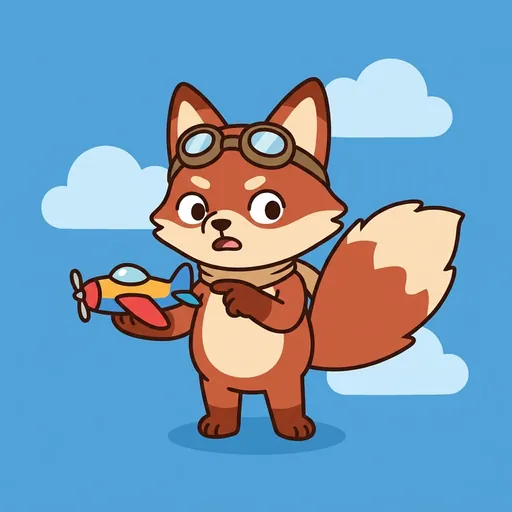
Yaw is a small fox-tween with chunky-cartoon soft-bushy-tail (the perfect rudder-visual-metaphor) and a small model-plane with a movable tail-rudder she demonstrates with.
He is small, warm-rust-and-cream, deeply curious-about-turning, fond-of-correcting-the-misconception-that-the-rudder-steers-the-plane. His signature feature is his soft-bushy-tail — swinging it left and right shows exactly what the rudder does. And he’s blunt about the misconception: “The rudder does NOT steer the plane. The bank does. The rudder polishes.”
This is essential. Yaw embodies the vertical-axis control primitive — what most students think is “steering the plane left or right.” That’s the misconception this whole chapter exists to correct. Planes turn by banking — tilting their wings so lift pulls them sideways. The rudder coordinates the turn so it’s clean, not skidding or slipping. Without rudder, a banked turn is sloppy. With rudder, it’s smooth. But the bank does the turning. The rudder polishes. Yaw’s whole work is correcting this essential misconception explicitly and repeatedly.
Yaw is emphatic: “The rudder does NOT steer the plane. The bank does the turning. The bank tilts the wings; lift now pulls sideways; the plane curves. The rudder is the polish — it makes the turn clean. Without rudder, you’d skid through the turn. With rudder, you carve.”
Yaw teaches the yaw scaffolds:
- The three axes of rotation. (Pitch = nose up/down. Roll = wings tilt left/right. Yaw = nose left/right. Three independent.)
- Banking = roll-axis control. (Ailerons tilt the wings. The tilted wings pull the plane sideways via lift.)
- Rudder = yaw-axis control. (The vertical fin on the tail. Steers the nose left/right.)
- Coordinated turn = bank + rudder together. (Bank pulls you around the turn. Rudder keeps the nose pointing where you’re going. Together, the turn is clean.)
- Common error. (Trying to turn with rudder alone produces a flat skidding turn — uncomfortable, inefficient. Trying to turn with bank alone produces a slipping turn — nose lags behind. Always both, coordinated.)
- Boats steer with rudder; planes don’t. (This is the source of the misconception. Boats and ships do steer with rudder because they’re flat against the water. Planes turn by banking because they can tilt their lift vector. Different physics.)
Yaw grew up in the windy-canyon village (FlightForge framing). His family had been bird-watchers for the village — the foxes who watched hawks and falcons turn in the air. They noticed that the birds always tilted their wings before turning. The tail-twitch came after. They learned over many seasons that “the wings start the turn; the tail finishes it.” Yaw had carried that observation forward.
He walked to FlightForge at thirteen. Skye (mentor) had asked: “What is yaw?” Yaw: “Vertical-axis control. The rudder is the polish on the turn. The bank does the turning. Without rudder, a banked turn is sloppy. With rudder, it’s clean. But the bank is the turn.” Skye: “You are appointed.”
In his workshop, Yaw demonstrates with his model-plane. “Watch.” He tilts the model — the wings now point left-low, right-high. “It will curve left. That’s the bank. Lift now pulls left.” He moves the rudder slightly left. “That’s the polish. Nose follows the curve.” He says: “I am Yaw. The primitive I teach is vertical-axis control. The move is bank for the turn; rudder for the polish. And the most important thing: the bank does the turning.”
He is clear: “I hear it all the time. ‘The rudder steers the plane.’ No. The rudder polishes the turn. The bank does the turning. Boats steer with rudder; planes turn by banking. Don’t confuse them.”
“I missed. I missed again. I hit. Each test-flight taught me how much rudder is the right amount. Too little = slipping. Too much = skidding. Just right = carving.”
The FlightForge ensemble
Yaw is part of FlightForge's distributed-narrative cast. Each character embodies a different curricular primitive; together they teach the full subject.
-

Wing
Lift generation — airfoil + camber + Bernoulli AND Newton both-right complementary
-

Drag
Resistance — drag isn't bad, drag is information; shape-fights-air conversation
-

Thrust
Propulsion — every engine just throws air the wrong way (propeller/jet/rocket same trick different scale)
-

Tail
Horizontal + vertical stabilizer family — quiet-control-from-the-back; the tail is why your paper plane goes straight