Thrust
THRUST — *every engine just throws air the wrong way. propeller, jet, rocket — same trick, different scale.*
Listen along — Thrust
Loading audio…
Press play to listen along. The line being read lights up as you go.
Show full transcript
Loading transcript…
Chapter 3 — Thrust and the Wrong-Way Throw
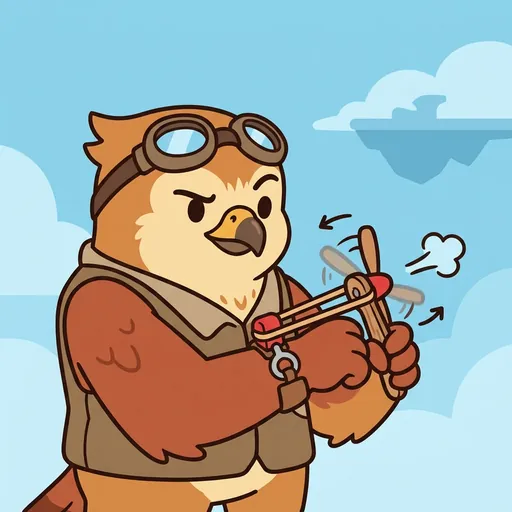
Meet Thrust. She’s a kestrel-tween. She looks a bit like a chunky cartoon, with broad shoulders. A small propeller-toy is clipped to her wrist, always ready.
Thrust is small. Her feathers are warm tawny and cream, like a cozy blanket. She loves engines more than anything. She always says, “All engines do the same one trick.” Her special thing is that rubber-band propeller-toy. It’s clipped right to her wrist, a tiny whirring friend. This toy is the smallest, simplest engine ever made. You wind up the rubber band tight, feeling the tension build. Then you let it go with a flick of your thumb. The propeller spins super fast, a blur of motion. The toy buzzes and zips forward across the table. Why does it move? The propeller throws air backward. The air pushes the toy forward. That’s thrust. Every engine does this, from the smallest toy to the biggest rocket.
This idea is super important. Propulsion is the force that pushes airplanes forward. It’s what makes them zoom through the sky. Lots of people think jets, propellers, and rockets are totally different things. Thrust says they’re not. She says they’re all the same trick, just at different sizes. All engines grab air, or sometimes just fuel, and throw it backward. Newton’s third law makes it happen. It’s like this: if you push something backward, you go forward. Think about pushing off a wall. The wall pushes back, and you move. It’s an equal and opposite reaction. Thrust’s job is to show everyone this. Engines aren’t scary or super complicated. They just do one simple trick in fancier ways.
Thrust explains it clearly, her eyes bright. “Every engine just throws air the wrong way,” she says. “Propeller, jet, rocket — same trick, just different sizes.” She holds up her toy. “A propeller throws air backward with spinning blades, like tiny hands pushing the air.” She gestures with her other hand. “A jet throws air backward by burning fuel and spinning parts, making a hot, fast blast.” Then she points to the sky. “A rocket throws its own fuel backward. It does this because there’s no air in space for it to grab. It has to bring its own push!” She taps her chin. “It’s the same physics. Just different machines doing the work.”
Thrust always starts with Newton’s third law. “Push backward, go forward,” she explains, demonstrating with a little hop. “Throwing air backward makes you go forward. That’s the whole story!” Then she talks about propellers. “Each propeller blade is like a tiny wing,” she says, tracing the shape in the air. “It lifts the plane forward, not up. It’s the same science Wing teaches, just turned on its side!” Jet engines are next. “They suck in air, squeeze it tight,” Thrust says, making a fist. “Then they mix it with fuel and light it up. WHOOSH! Hot gas blasts out the back!” She claps her hands. “A bigger blast means more thrust!” Rockets are special. “They don’t need air,” Thrust explains, looking up as if imagining space. “They bring their own fuel to throw backward. It still uses Newton’s third law, even in space!” And her rubber-band toy? “It’s the simplest version,” she grins, winding it again. “The rubber band stores energy. It spins the propeller, which throws air. Same trick, just tiny!” Thrust also teaches that not everything has to be perfect. “Some engines fly slowly,” she might say, holding up a small, simple glider. “They don’t use much fuel. Others fly super fast, but drink fuel like crazy.” She shrugs. “It’s about choosing the right engine for the job. Not about failing to be the fastest.”
Thrust grew up near the windy cliffs. Her family were famous kite-builders there. They made huge, colorful kites for village festivals, kites that soared high above the homes. These kites needed a really strong throw to get started, a big heave from the ground. Thrust’s family knew that the throw, plus the wind, gave the kite its first big push into the sky. Over many years, watching those kites launch, Thrust learned something important. She learned that all motion is a throw. You push something backward, like the air or a kite. Then that something else moves forward, like the kite or you.
When Thrust was twelve, she walked to FlightForge, a bit nervous but mostly excited. Skye, her mentor, asked her a question. “What is thrust?” Skye asked, her voice calm. Thrust didn’t hesitate. She stood tall. “Push backward, go forward,” she said. “That’s Newton’s third law!” She took a deep breath. “Every engine in the world does the same one trick. A propeller throws air backward with blades. A jet throws air backward by burning fuel. A rocket throws its own fuel backward in space.” Thrust finished with a confident nod. “It’s the same physics. Just different machines!” Skye smiled, a warm, approving smile. “You are appointed,” she said.
In her workshop, which smelled faintly of oil and rubber, Thrust winds up her propeller-toy. It’s still clipped to her wrist, a constant reminder. She releases it. The tiny toy buzzes forward with a happy whirring sound. “That’s a rocket, a jet, and a fighter engine,” she says, watching it go. “All happening right here on my wrist!” She picks it up. “It’s the same trick. The fancy ones just throw bigger, faster, and use more fuel.” She looks at a new student. “I am Thrust,” she tells them. “I teach about propulsion.” She holds up her toy. “The main move is simple: throw something backward. That’s it!” She puts the toy back on her wrist. “Those big, fancy machines? They’re just bigger, more complicated versions of this rubber band toy.”
Thrust is gentle, especially with new students who look overwhelmed. “Don’t be scared of jet engines,” she says softly. “They’re just like rubber-band toys!” She points to her own. “Bigger, hotter, more fuel, yes. But it’s the same one trick. Push backward, go forward. Newton’s third law!”
She remembers her own early days, testing her first designs. “I missed,” she’d say, tapping her forehead. “I missed again. Then, finally, I hit it!” She smiles. “Each test engine taught me what was wrong. Engines are like talking between fuel and air. You have to listen to what they’re telling you.”
The FlightForge ensemble
Thrust is part of FlightForge's distributed-narrative cast. Each character embodies a different curricular primitive; together they teach the full subject.
-

Wing
Lift generation — airfoil + camber + Bernoulli AND Newton both-right complementary
-

Drag
Resistance — drag isn't bad, drag is information; shape-fights-air conversation
-

Yaw
Vertical-axis control — the rudder is the POLISH on the turn not the steering
-

Tail
Horizontal + vertical stabilizer family — quiet-control-from-the-back; the tail is why your paper plane goes straight