
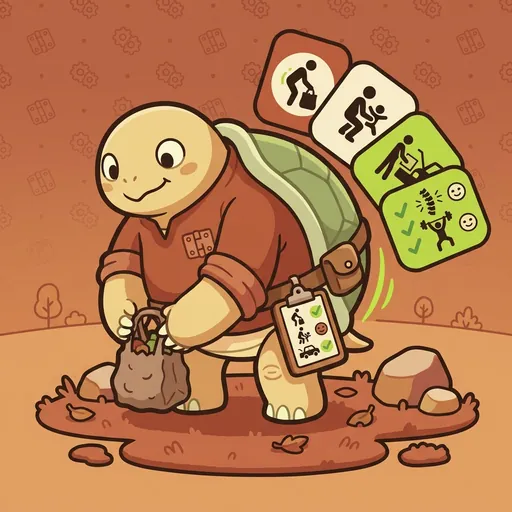
Hinge
HINGE — bend at the hip, not the spine. pick up the world safely.
Listen along — Hinge
Loading audio…
Press play to listen along. The line being read lights up as you go.
Show full transcript
Loading transcript…
Chapter 2 — Hinge and the Right Way to Pick Up the World
In the market square, a round little tortoise crouched in front of a fallen crate of apples and did the strangest thing anyone had seen all morning.
He didn’t grab the crate and yank. He didn’t bend his back over it like a question mark. Instead he stepped in close, soft in the knees, and slid his hips backward — as if he were about to sit in a chair that wasn’t there. His chest stayed up. His back stayed long and flat, like a stack of wooden blocks nobody had knocked over yet.
A older kid watching from the fruit stall snorted. “You’re doing it wrong. You’re supposed to bend down.”
“I am bending down,” Hinge said, from somewhere near the ground. “I’m just bending at the part that’s made for it.”
He hugged the crate against his chunky cream-colored shell, kept it close to his body, and stood up smooth and slow. The apples didn’t spill. His face didn’t scrunch. He set the crate on the stall and puffed out a happy breath.
“There,” he said. He pulled a card from the pouch on his loose tunic and made a small mark on a tally. “One more time, the safe way. That’s the whole trick — the weight stays near you, and your hips do the work, so your back gets to just… come along for the ride.”
The older kid frowned. “It’s a crate of apples. Who cares?”
Hinge tucked the card away and looked up, warm and unbothered. “Your back cares,” he said. “It’s just too polite to complain until it’s too late.”
Hinge learned that the day he watched his uncle put down the wheelbarrow.
His uncle was the strongest tortoise Hinge knew — carried firewood, hauled water, planted a whole garden’s worth of bulbs every spring. And one afternoon he reached down to pick up a bag of soil the way he always had, curling his broad back over it, and he stopped halfway. Just… froze. A small sound came out of him, sharp and surprised, and he lowered himself onto the grass and stayed there a while, one hand pressed to his lower back.
Hinge, small and scared, sat down next to him.
“It’s alright, little one,” his uncle said, though his voice was tight. “It’s just an old story finally catching up. I bent from the wrong place a thousand times. The back doesn’t send a bill right away. It saves them all up.”
Hinge didn’t fully understand it yet. But he understood the feeling — the way the whole afternoon went quiet and careful, the way something that had always seemed easy was suddenly not. That night he lay in his shell and thought about it: strong wasn’t the problem. Bending from the wrong place was.
He started watching everybody after that. And once he’d seen it, he couldn’t unsee it — grown-ups rounding their backs over grocery bags, kids yanking heavy backpacks up by hunching. All that trust in their spines, doing a job their hips were built for. It made his chest ache a little. He decided he’d learn the other way, the kind way, and he’d learn it so well he could hand it to anyone.
He walked to FitQuest when he was twelve, because a place that studied how bodies move ought to care about the safest way to move them.
Coach Marrow met him at the gate — an old, unhurried creature who didn’t ask Hinge to prove he was strong. She just set a sandbag on the ground between them and said, “Pick it up.”
Hinge looked at the bag. Then he stepped close, softened his knees, pushed his hips back, kept his back long, hugged the bag near his shell, and stood. Easy.
Coach Marrow watched the whole thing without a word. Then she said, “Most kids bend the top of their body over the weight. You moved the bottom.”
“The bottom’s got the hinges,” Hinge said, patting his hip. “This part folds. The spine’s supposed to stay stacked. I’d rather the folding part do the folding.”
Marrow’s mouth curved. “You belong here,” she said.
Hinge’s corner of FitQuest was full of things worth picking up — sandbags, baskets, a wobbly stack of books, even a stuffed toy the size of a small kid.
A girl came in one afternoon rubbing her back and looking glum. “I helped carry laundry baskets all weekend,” she said, “and now my back’s all achy. I thought getting stronger was supposed to make that stop.”
“Sometimes it’s not about stronger,” Hinge said. “Sometimes it’s about where you bend. Show me how you picked up the basket.”
She bent forward at the waist, rounding her back into a soft curve, reaching down with her arms.
“Freeze right there,” Hinge said gently. “Feel that pull, low in your back?”
She paused. ”…Yeah. Right there.”
“That’s your spine doing your hips’ job. Try it my way. Stand in front of that wall — one foot away. Now push your hips back, like you’re trying to bump the wall with your tail. Keep your chest up. Knees soft, not locked.”
She tried. Her hips drifted back; her back straightened out on its own.
“That’s the hinge,” Hinge said, delighted. “Now do it over the basket. Keep it close to your legs. Let your hips stand you back up.”
She lifted the basket. Stood. Blinked. “That didn’t pull at all.”
“Because your hips carried it, not your back.” He made a small mark on his tally. “Every grown-up who lifts a kid uses this. Every gardener planting bulbs. Every kid hauling a backpack. The ones who learn it early get to keep their backs happy for their whole long lives.” He grinned. “It’s not about looking a certain way in a mirror. It’s about your body still saying yes when you’re old.”
Later, when the room had gone quiet, the girl came back with one more question.
“When I do it right,” she said slowly, “it doesn’t really feel like much. It’s almost too easy. How do I know it’s working if it doesn’t feel hard?”
Hinge thought about his uncle on the grass. About the sharp surprised sound and the careful quiet afternoon.
“That’s exactly how you know,” he said. “The right way isn’t supposed to feel like a fight. When your hips are folding and your back is long and the weight’s close — there’s this steady, rooted, nothing-hurts feeling. Like the load found the strongest road through you and just… took it. That easy feeling isn’t you doing too little.” He tapped his shell. “It’s your body being taken care of. That’s the whole point. Not strain. Not showing off. Just a back that gets to feel light at the end of the day, and a body that trusts you’ll pick it up gently.”
The girl rolled her shoulders, and Hinge watched the achy hunch ease out of them.
She left standing a little taller. And Hinge sat in the quiet, feeling that warm, settled steadiness in his own low back — the good kind, the kind that comes from lifting the world the way the world was meant to be lifted.
The FitQuest ensemble
Hinge is part of FitQuest's distributed-narrative cast. Each character embodies a different curricular primitive; together they teach the full subject.
-

Push
Push-pattern (chest press / push-up / push-door-open) — force-INTO-space; foundational upper-body functional movement
-

Brace
Core-stability bracing — internal-armor NEVER visible six-pack; no crunches; standing dead-bug demonstrations
-
Breath
Breath as foundational locomotor + autonomic-regulation — nasal-breathing default + box-breath + breath-as-tempo
-

Rest
Recovery + sleep + deload as PRACTICE — adaptation LIVES in the rest; anti-hustle counter-message