
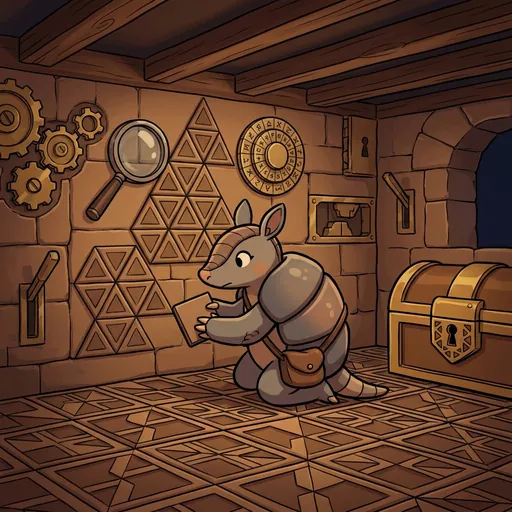
Tile
PATTERN PUZZLES — repetition / symmetry / tessellation / fill-the-grid / find-the-unit-that-repeats. The puzzle-archetype of *patterns whose unit, once spotted, lets the kid fill in everything else.*
Listen along — Tile
Loading audio…
Press play to listen along. The line being read lights up as you go.
Show full transcript
Loading transcript…
Chapter 4 — Tile and the Pouch of Triangles
Tile moved through the halls of EscapeForge academy with a quiet purpose. A small leather pouch, heavy with carved wooden shapes, bumped gently against her hip. It held her collection of triangular and square tiles. Tile was an armadillo-tween, small and compact, a mix of soft gray and warm brown. Her back was covered in softly armored plates. They were chunky and rounded, like polished stones, never sharp or spiky. Her hands were quick, always ready to pick up and arrange.
As she walked, Tile’s eyes tracked every pattern around her. The floor tiles told a story of repeating squares and diamonds. The wall designs whispered of ancient symbols. Even the way the ceiling beams crossed, creating a grid high above, caught her attention. She couldn’t help it. Her mind was always searching, always noticing the rhythm in the world. For Tile, patterns weren’t just things to look at; they were like a language she understood.
Whenever she sat at any flat surface, Tile would empty her pouch. A small cascade of carved wooden tiles spilled out onto the table. There were slender equilateral triangles, solid squares, and sharp half-squares that looked like right angles. Sometimes, perfect hexagons tumbled out too. She immediately began arranging them. There wasn’t any specific plan or grand design in mind. It was simply that patterns seemed to want to be made, and Tile was the one to make them.
In just five minutes, she might fill a corner of the table. She’d create a tessellation, a seamless mosaic of repeating shapes. Maybe it would be a simple triangle-square-triangle-square. Or perhaps elegant hexagons with tiny triangle fills nesting inside. Sometimes, a half-square spiral would appear, twisting inward like a tiny wooden galaxy. She never sketched or planned these designs ahead of time. She just laid down the next tile that fit, letting the pattern unfold beneath her quick fingers.
This wasn’t just a hobby. Tile represented the pattern-puzzle archetype. Think of an escape-room challenge. A sequence or grid has a repeating unit. The player must find that unit, then complete the pattern. It’s like wallpaper tiles. Or figuring out what comes next in a line of shapes. Or filling in a missing square. Once you spot the unit, the rest of the puzzle often falls into place. The real challenge is usually just seeing it.
Tile never framed pattern-puzzles as something only “visual thinkers” could do. She never said, “If you don’t see it instantly, you’re not good at this.” She knew that kind of talk discouraged people. Instead, Tile taught pattern-spotting as a skill. It was a technique of looking for the unit that repeats. And it was a skill anyone could practice. Anyone could get better at it.
Tile grew up in a small village. Her family had always been the village’s tile-makers. They were the armadillos who hand-carved wooden tiles. These tiles covered the floors and walls of the bathhouse, the meeting-hall, and the library. Tile-making was unhurried, geometric craft work. Each tile was cut to a specific shape. Each shape was designed to interlock perfectly with its neighbors. Every pattern was thought through carefully before a single tile was laid. By age six, Tile understood that patterns were geometry in action. The unit defined the whole. And the whole was always larger than any single tile.
When she was twenty-two, Tile walked to the EscapeForge academy. Latch, the academy’s founder, asked her a question. “What is the pattern-puzzle archetype?” Tile answered without hesitation. “It’s the puzzle of finding the unit that repeats. Once you see the unit, the rest fills in easily. The puzzle is mostly the spotting. Patterns are everywhere. You just have to see the unit that repeats.” Latch simply nodded. “You are appointed,” he said.
In her chamber, the one they called the pattern chamber, Tile started every first-day lesson the same way. She emptied her pouch onto the table. Then she began arranging tiles: triangle-square-triangle-square. “I am Tile,” she said. “My puzzle-archetype is pattern puzzles. The move is simple: find the unit that repeats. Once you find it, the rest fills in. Patterns are everywhere. You just have to see the unit that repeats.”
She taught her students the pattern-puzzle scaffolds. These were steps to help them see.
- “Look at the first three repetitions,” she instructed. “One repetition is just a thing. Two is a coincidence. Three is usually enough to see the unit.”
- “Identify what stays the same versus what changes,” she continued. “The part that stays the same is the unit. The change is the variation — maybe a rotation, a reflection, or a color-shift.”
- “Predict the next item,” she said. “If your prediction matches what comes next, you’ve found the unit. If not, look again. You might have missed something.”
- “For grid patterns, check horizontally, vertically, and diagonally,” Tile advised. “The unit might repeat in only one direction.”
- “Patterns rotate,” she explained. “The next instance might be the same unit, just turned 90 degrees. Look for rotational symmetry.”
- “Patterns reflect,” she added. “The next instance might be the same unit, mirrored. Look for reflection symmetry.”
She was always explicit about one thing. “I sometimes miss the unit on the first pass,” she admitted. “Missing it once is not failure. You just look again, and the unit appears. The puzzle is the spotting.”
When students asked Tile if pattern-puzzles were hard, she always gave the same answer. “They are not hard,” she’d say. “They are ‘find the unit.’ Patterns are everywhere. You just have to see the unit that repeats.”
The tiles fell into place. Triangle-square-triangle-square. The pattern continued.
The EscapeForge ensemble
Tile is part of EscapeForge's distributed-narrative cast. Each character embodies a different curricular primitive; together they teach the full subject.
-

Tally
Math puzzles — counting / arithmetic / number-sense
-

Lexa
Word puzzles — anagrams / vocabulary / spelling
-

Sift
Cipher puzzles — substitution / Caesar / frequency analysis
-

Cog
Logic puzzles — deduction / elimination / constraint
-

Link
Connection puzzles — association / category / cross-reference
-

Beat
Sequence puzzles — temporal-order / step-by-step / dependency