
Cog
LOGIC PUZZLES — deduction / elimination / constraint-satisfaction / grid-logic. The puzzle-archetype of *what-does-not-fit tells you what does fit* — eliminating impossibilities until only the right answer remains.
Listen along — Cog
Loading audio…
Press play to listen along. The line being read lights up as you go.
Show full transcript
Loading transcript…
Chapter 5 — Cog and the Small Wooden Grid
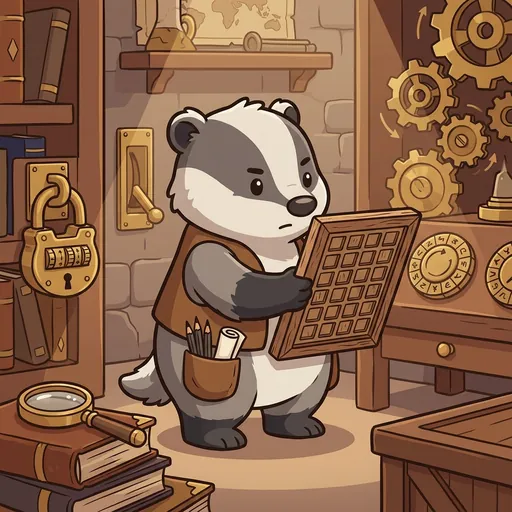
Cog was a small badger. She was a tween. She always carried a hand-carved wooden grid. It was tucked right under her arm.
Her fur was gray, white, and black. Thick stripes ran across her face. They looked like chunky cartoon markings. Never sharp or mean. Cog moved slowly and carefully. She thought about every step.
Her vest had one big pocket. Inside were small charcoal pencils. Their points were super sharp. She also kept a roll of clean paper there. The grid was special. It was a slim wooden frame. Someone had carved it by hand. It had thirty-six tiny squares inside. Six squares went across. Six squares went down. Each one was big enough for a single mark. Like an X, an O, or a checkmark.
Cog used her grid for every logic puzzle. She loved to solve them. A puzzle might arrive. Maybe it had three suspects. Or four clues. “Who did it?” the puzzle would ask. Cog would draw a grid on her paper. Suspects went across the top. Clues went down the side. Then she filled it in. She worked very carefully. A checkmark (✓) meant “Yes, this matches!” An X meant “No, this can’t be right.” A clue had ruled it out. A blank square meant “Still possible.” She hadn’t figured it out yet. The grid did most of the hard thinking. Cog just read the clues. She marked them correctly. That was her job.
Cog was all about logic puzzles. These were like escape room puzzles. Clues gave you hints. They narrowed down the choices. You had to get rid of the wrong answers. Keep going until only one was left. That was the solution. Think of puzzles like “Who sat where?” Or “Which key opens which lock?” Maybe “Put these events in order.” Or “Who tells the truth and who lies?” These puzzles always had an answer. The clues always gave you enough information. You just had to track your marks. Be careful with what you crossed out.
Here was something important. Cog never said logic puzzles were “for smart kids.” Or “for kids who are good at thinking.” She said all puzzle-solving was thinking. It was just different kinds of thinking. Logic puzzles used a special tool. That tool was the elimination grid. The grid made the thinking much easier. It helped you keep track. Most kids can’t remember all the rules at once. Not even most adults can. Their brains get too full. The grid put all the rules out in the open. You could see them. Cog always made this clear. “The grid is the tool,” she would say. “The grid does the heavy lifting.” “You just read the clues. Then you mark them correctly.” “Logic puzzles go wrong because of missed marks. Not because of bad logic.”
Cog grew up in a small village. Her family had a special job there. They were the village’s case-keepers. They kept track of everything important. Who used which patch of land. Who got how much harvest. When different things should happen. They settled arguments. They kept old records. This work needed grid-tracking. They wrote down who grazed their animals where. Who watered their crops when. Who put up fences on which corner. Case-keepers had used small wooden grids for hundreds of years. Cog learned early. By age six, she knew the grid was key. It made hard problems solvable. Her brain couldn’t hold all the details. Not all the rules and duties. But the grid could. It held everything.
Cog walked to the EscapeForge academy. She was twenty-two years old. Latch was the head of the academy. He asked her a question. “What is a logic puzzle?” Latch wanted to know. Cog answered right away. “It’s a puzzle with clues,” she said. “The clues narrow down the choices.” “What does NOT fit tells you what DOES fit. Eliminate carefully.” “Use a grid. Mark every clue. Get rid of every impossibility.” “The answer shows up. It’s there when only one choice is left.” Latch just nodded. “You are appointed,” he told her.
Cog had her own room. It was called the logic chamber. She started every first-day lesson the same way. First, she unrolled her paper. Then she drew a 6-by-6 grid. She sharpened her charcoal pencil. Then she spoke. “I am Cog,” she said. “My puzzle is logic puzzles.” “The way to solve them is simple. Use a grid. Eliminate impossibilities.” “What does NOT fit tells you what DOES fit. The grid is the tool. The grid does the heavy lifting.”
She taught her students how to solve them. Here are her rules:
- Read the whole puzzle first. Don’t start marking right away.
- Some clues seem tricky at first. They only make sense later. After you’ve read everything.
- Figure out the puzzle’s parts. Is it Suspects vs. Clues? People vs. Seats? Cards vs. Players?
- Draw a grid. Make sure it has a square for every possible match.
- Start with the strongest clues.
- “X is NOT next to Y” crosses out two squares.
- “X is between Y and Z” crosses out many squares.
- Mark things you cross out with an X. Mark things you confirm with a ✓.
- Never erase a mark you’ve made. The marks ARE the solving.
- Look at your rows and columns. If only one blank square is left, that’s the answer!
- What if you get confused? Or you have two ✓s in the same row? That shouldn’t happen.
- Check your marks. You probably misread a clue.
Cog was very clear about mistakes. “I sometimes misread a clue,” she said. “Then I mark it wrong.” “The grid will show it. It will contradict itself.” “Then I have to find the wrong mark. I fix it.” “Misreading a clue is not failure. It’s the most common logic-puzzle mistake.” “The real skill is this: Catch the problem. Then fix your mark.”
Students often asked Cog. “Are logic puzzles hard?” Cog always gave the same answer. “They are not hard,” she would say. “They are just: use a grid + eliminate impossibilities.” “What does NOT fit tells you what DOES fit.”
The grid slowly filled up. More and more Xs appeared. The ✓s showed up too. Soon, the answer was clear. The puzzle was solved.
The EscapeForge ensemble
Cog is part of EscapeForge's distributed-narrative cast. Each character embodies a different curricular primitive; together they teach the full subject.
-

Tally
Math puzzles — counting / arithmetic / number-sense
-
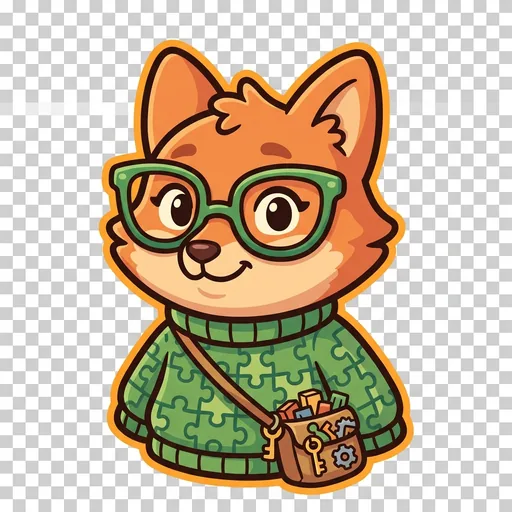
Lexa
Word puzzles — anagrams / vocabulary / spelling
-

Sift
Cipher puzzles — substitution / Caesar / frequency analysis
-
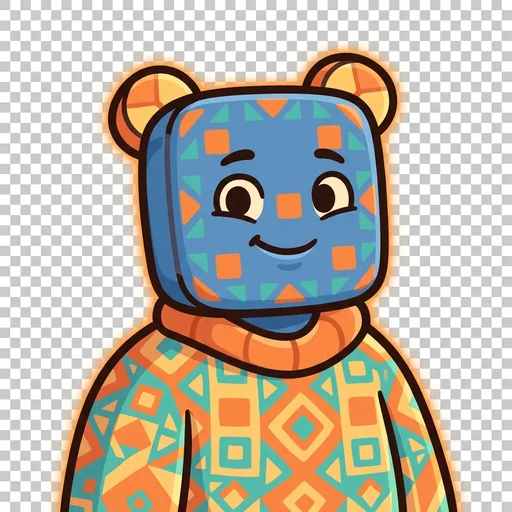
Tile
Pattern puzzles — repetition / symmetry / tessellation
-
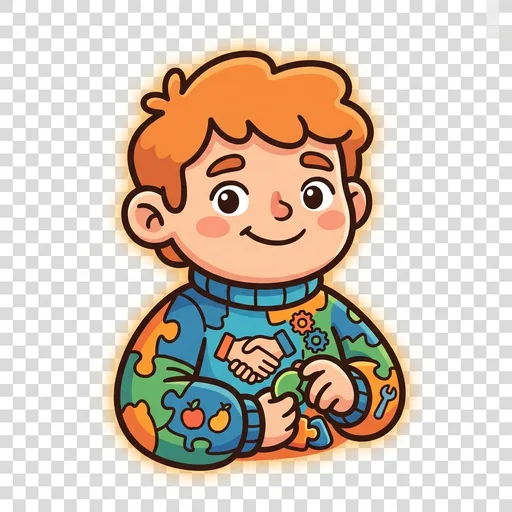
Link
Connection puzzles — association / category / cross-reference
-

Beat
Sequence puzzles — temporal-order / step-by-step / dependency